
Remember me
Most of us grumbled through the latest federal government shutdown, vexed by airport delays, minimally staffed national parks, and shuttered local offices. But the forty-three-day disruption in federal service hit hard for hundreds of thousands of furloughed federal employees going without pay and for the roughly 42 million Americans served by the Supplemental Nutrition Assistance Program (SNAP), formerly known as food stamps, which at around $100 billion in annual spending is both the nation’s largest food assistance program and one of its largest anti-poverty programs for the non-elderly. A month into the shutdown, despite having access to nearly $6 billion in contingency funds, the Trump administration chose to stop issuing SNAP benefits—the first time in the program’s sixty-one-year history that it failed to deliver support to which enrollees were entitled.1 States sued, and federal courts ruled that the administration acted illegally, but the White House continued to withhold full SNAP funding as it appealed to the Supreme Court. The legal tussle was mooted with the end of the shutdown on November 12, and the US Department of Agriculture, which administers the program, moved to transfer SNAP funds to the states for eventual transmission to enrollees.
In the meantime, a few states had tapped their own budgets to keep SNAP benefits flowing in the expectation—or the hope—that the federal government would reimburse them after the shutdown ended. But most states could or would not plug the gap, causing millions of Americans to go weeks without allotted funds. The effects were direst for households that normally have access to program benefits at the start of each month.2 Many quickly ran out of money and found themselves forced to fall back on the nation’s charitable food sector, which started issuing urgent appeals for public donations.
Your local food pantry is the face of that sector. With an estimated 60,000 food pantries across the nation, chances are good that you have one nearby. Maybe it’s run out your church basement, a local hospital or health center, or your town’s emergency services department. It likely operates one or two days a week, possibly by appointment only, is staffed almost entirely by volunteers, and distributes food largely obtained through donation. It is the safety net of last resort for those unable to buy food at a retail market. During the shutdown calls to the nationwide 211 helpline seeking information on food pantries spiked, surpassing previous peaks brought on by natural disasters. Food pantries across the nation reported dramatic upticks in demand.
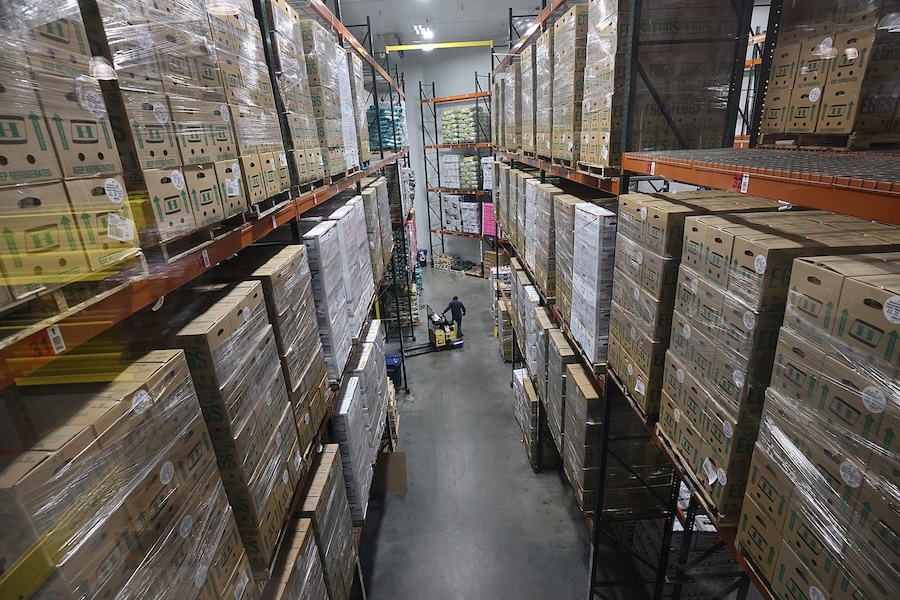
The food pantry is just the most visible part of a vast and mostly submerged charitable food sector. What keeps it all running are food banks—industrial-scale, warehouse-like distribution facilities that look and function much like their commercial counterparts, with the same cold storage areas, palletizers, and truck bays. Such distribution centers range in size from the new 300,000-square-foot facility being built by the Houston Food Bank—everything is bigger in Texas—to the comparatively modest 20,000-square-foot facility operated by the Hoosier Hills Food Bank in south-central Indiana. For comparison’s sake, your typical Costco runs about 146,000 square feet. You likely pass your regional food bank on the highway without knowing it.
The shutdown made visible what normally goes unnoticed. But it should also bring us to ask: How did the charitable system anchored by the food bank become such a fixture of our social welfare landscape? And how much of the weight of providing for those in need can this system bear?
Donations to food banks tend to be in kind—food, not cash. Most come from food manufacturers and retailers offloading excess or unwanted product for one reason or another, at a volume far surpassing the cans and boxes collected in all those church and school food drives. Each day staff unload semitrucks laden with product in the bank’s truck bay (or bays), while other, smaller trucks and vans arrive at assigned times to pick up shipments designated for participating food pantries, meal programs, and social service agencies. Inside, volunteers sort through donations and assemble bespoke allotments for the food bank’s diverse clientele. Anyone who has worked in a commercial food distribution facility would recognize the daily rhythms: big shipments of food in, smaller shipments of food out.
Even as the Trump administration forced more people to rely on the food bank system by withholding SNAP funds, it was also putting these distribution centers under more direct pressure. A non-trivial amount donated to food banks historically comes from the federal government in the form of “surplus” agricultural commodities, much of it via The Emergency Food Assistance Program (TEFAP), which since 1983 has also provided cash to food banks to help them process and distribute bulk federal foods. But in early 2025 the Trump administration abruptly slashed some $500 million previously allotted to TEFAP for such commodities—cancelling deliveries of some 94 million pounds of fresh produce, fruit, meat, poultry, milk, and eggs—and made similar drastic cuts to other programs that aided the charitable food sector.
The cuts underscored the extent to which the food bank has come to represent a peculiar feature of American political economy: what Walter Lippman, writing in 1932, called the “paradox of want in the midst of abundance.”3 For at least a century the United States, with its favorable natural resources and policies of largely unrestricted agricultural production, has struggled with the problem that it produces too much food. Trump’s TEFAP cuts were not caused by shortage. There was (and is) plenty to go around, and his trade wars didn’t do much to help export markets or commodity prices or anything else that would shrink crop surpluses. The problem, quite simply, was that the administration didn’t want to spend supplemental money allocated by the Biden administration to purchase commodities for food banks. As if to emphasize the political nature of that decision, in November the USDA abruptly announced, to the relief of citrus growers in Texas and Florida (if not low-income Americans short on eggs), that it would purchase $30 million in oranges, grapefruit, and mandarins to prop up commodity prices sapped by crop surpluses, with plans to donate the fruit to the nation’s food banks.
At the same time, too many Americans struggle with the problem of too little food due to insufficient incomes and a paltry government safety net. In 2023, the latest year for which official data have been released, the USDA estimated that some 13.5 percent of American households, roughly 18 million, were “food insecure,” a condition, per the USDA’s definition, where a household at some time in the year faced challenges in putting food on the table, mostly due to limited financial means. Many of those households took advantage of SNAP, but others—for reasons of immigration status or other factors—could not. People in this situation typically end up at food pantries.
So do many whose SNAP benefits prove insufficient to last the month. Despite the $100 billion spent on SNAP in fiscal 2024, by some counts 50 million people in America still found themselves at a local food pantry at some time that year. Many of those households depended on the charitable food sector to plug the “SNAP gap” in normal times, but the shutdown drove them to food pantries earlier and at volumes not seen since the Covid-19 pandemic disrupted the economy. There was no guarantee that the charitable food sector would hold on until federal funds resumed.
“Soup kitchens” and meal programs for the destitute have dotted the nation’s cities and towns since the nineteenth century, and local charities collected canned goods for emergency or holiday food pantries as early as the 1950s, but the idea of a warehouse to store donated or “rescued” food is a product of the 1960s. Generations of activists in the sector have passed down the story of the food bank’s origins in the middle of that decade: an ex-sporting-goods distributor named John van Hengel was volunteering at the St. Vincent De Paul soup kitchen in Phoenix, Arizona, where he took to gleaning unwanted citrus from area homes and delivering the fruit to missions serving the homeless. Van Hengel soon tired of driving all over the rapidly growing city. It was then that he had an epiphany: “I envisioned a warehouse where I could store salvaged and agricultural surplus food, with an orderly and fair distribution to the poor,” he later told a local newspaper.4 He broached the idea with the pastor of his church, St. Mary’s Basilica, who soon offered a former bakery building donated to the church, along with a loan from the parish council to support operations. Van Hengel and three other volunteers moved in, cleaned up the building, and opened doors in December 1967.
Around this time, the story goes, van Hengel chatted with a woman whose husband was on death row for murder. She mentioned that she was able to feed her ten children with food scavenged out of grocery store dumpsters, a surprising amount of which was perfectly good. What was needed, the woman told van Hengel, was a place to deposit the “surplus” food for later withdrawal—like a bank. Van Hengel checked for himself and discovered that, for one reason or another, area markets, farms, and businesses were discarding a lot of edible food. He set out to convince their operators to donate their “surplus” to his center, now named the St. Mary’s Food Bank, after the church that supported him. The new “food bank” was an immediate success: it gave area businesses somewhere to offload their surplus and area charities somewhere to obtain free or heavily discounted food for their clients.
The concept of the food bank as warehouse and distribution center spread gradually in the following decade as religious clergy and secular social justice activists realized that it met two needs at once: addressing the problem of too much—a nation awash in surplus or otherwise unwanted food—and too little, getting food to those who could not afford it. By the late 1970s a dozen regional food banks dotted the national landscape, most brought together by van Hengel under the newly formed America’s Second Harvest (now Feeding America) network, whose aim was to develop national standards for food banks and act as a single point of contact for donations from the nation’s major food companies.5

Denver Post/Getty Images
A volunteer inspecting the canned good shelf at a food bank run by the Central Denver Community Services, an organization founded the previous year by a group of five local churches, Denver, Colorado, December 15, 1975
The food bank sector exploded in the 1980s as Ronald Reagan made deep cuts in the federal social welfare safety net, including food stamps, even while the worst recession since the 1930s ripped through the Midwest farm belt and the industrial towns of the Rust Belt. Dozens of new food banks and hundreds of local food pantries popped up in short order, aided in no small part by the federal government—if by accident. Faced with public opprobrium for his seeming cold-heartedness in the face of widespread deprivation among laid-off industrial workers and newly bankrupt farmers, in late 1981 Reagan authorized the release of millions of pounds of government surplus cheese and butter, all previously purchased to prop up dairy prices and stored in caves awaiting some use. The sudden flood of “government cheese” swamped states and localities unprepared to handle volumes of bulk food, prompting bipartisan criticism of the effort. With Reagan’s acquiescence Congress enacted TEFAP—originally the Temporary Emergency Food Assistance Program—to support effective distribution, including funds to nonprofits able to handle surplus commodities. These federal dollars gave food banks critical organizational capacity, and by the end of the decade their number had grown to nearly two hundred. In 1990, apparently admitting the regrettable permanence of the emergency, Congress took the “temporary” out of TEFAP.
By then the food bank had gone international. In the 1980s the idea spread to Canada, and then to France, promoted by clergy who saw it as a more organized and efficient means to feed the hungry. Later the model expanded across Europe and ultimately globally, as environmentalists leveraged it to divert unwanted or “wasted” food from landfills, thereby reducing greenhouse gas emissions. Still others, such as a series of Tory governments in the United Kingdom over the past two decades, have a less lofty goal: finding a means to address food insecurity without spending much public money.
Today the American charitable food sector is bigger than ever—and much bigger than most Americans comprehend. Nearly four hundred food banks, food rescue organizations, and related programs collect donated and other “surplus” foods for distribution to those who need it. Over two hundred of these operations are part of the Feeding America network, which coordinates donations by major manufacturers such as General Mills and retailers like Walmart. Feeding America by itself is the nation’s largest charity by total revenues according to the Forbes rankings for 2024, taking in $287 million in cash contributions and $4.7 billion in donated food and services in the 2024 fiscal year, enough to provide 5.9 billion meals. The nation’s two largest food banks, the Midwest Food Bank ($558 million in revenues in fiscal year 2024) and Feed the Children ($415 million), are the nation’s thirty-sixth and thirty-eighth largest charities, each with their own corporate partners and distribution systems.
The food bank sector as a whole took in nearly $18 billion in total revenue in fiscal year 2024, up almost $2 billion from the previous year. Roughly $480 million was cash—a testament to Americans’ charitable impulses—some of which food banks used to purchase fresh produce and proteins. But the bulk was in the form of “surplus” food donated by corporations or the federal government, or “rescued” food that otherwise might have been discarded by retailers, the value of which is calculated based on estimated wholesale prices. Nearly half of that $2 billion in increased support came in the form of federal commodities provided by the Biden administration.
These numbers reflect a seemingly limitless growth in both supply and demand. While precise historical data are difficult to come by, the Feeding America (then America’s Second Harvest) network took in roughly 2.5 million pounds of food in 1979. By the early 2000s it was accepting over one billion pounds a year. Since then it has routinely accepted between two and three billion pounds a year, with highest totals during the Great Recession and the pandemic, when more people couldn’t afford to buy food, and food banks at once received more unsold products and fielded more need. Roughly 23 million people obtained food from the Feeding America network in the 1990s, a total that more than doubled to 50 million by 2024—a consequence, scholars argue, of decades of stagnant wages, ever-higher costs of living, and (save for a momentary wave of federal stimulus benefits during the pandemic) paltry government support for the non-elderly.
The Greater Boston Food Bank, located not far from my place of employment, reflects these trends. What started in the early 1970s with the homeless advocate Kip Tiernan distributing surplus food from the back of her station wagon today operates out of a 117,000-square-foot warehouse and distribution facility. In fiscal year 2024 it took in around $175 million in food and cash donations, employed around 160 staff, and distributed around 107 million pounds of food—enough for 90 million meals—to 600,000 area residents via its six hundred affiliated food pantries and other partners in eastern Massachusetts. Three other regional food banks cover the rest of the Commonwealth, in which one in three households are said to struggle with food security.
Even as the food bank became part of the American landscape, it remained largely overlooked, except during moments of crisis like the early days of the pandemic. But those crises were momentary, ebbing once federal funds flowed to affected households. What happens if “crisis” becomes the normal state?
We may soon find out, if changes in SNAP promulgated by Republicans in the recently enacted “One Big Beautiful Bill” budget play out as critics fear. The prospect that hundreds of thousands—perhaps millions—of people will get kicked off SNAP in the next couple years as Republicans seek to cut program spending by 20 percent gives charitable food sector executives nightmares. They know that SNAP supports far more meals than food banks could ever provide—up to nine times more, to cite one widely distributed statistic. Whatever the ratio, you cannot take away billions of dollars in annual federal support without doing damage, and food bank leaders doubt that private philanthropy can compensate for a hollowed-out state.
At the same time, the for-profit food system is changing in ways that could undermine the foundation on which the charitable food system is based. To put it plainly, what happens when “surplus” gets rarer and dearer? Food manufacturers and retailers, aided by federal and state tax credits on donations, for a long time have been happy to ship unwanted product to food banks as good business and good citizenship. Better to donate and get a tax credit than throw it away. But the economics of food production and retail are always a challenge, and as profit margins narrow many food companies now find it more appealing to sell off excess product to salvage stores or discount chains like the Dollar Store.
With companies streamlining supply chains and using better tracking technology, there simply may be less “waste” in the food system. This in turn would force food banks to use more of their own cash to bolster their inventories, with the help of episodic and unpredictable USDA purchases designed first and foremost to prop up commodity markets (and farmers). While food banks are trying to move away from overreliance on the highly processed foods that make up much of corporate donations, fresh produce and quality proteins are expensive, more so with recent inflation, and few food banks have the financial wherewithal to offset significant drops in corporate food donations.
There are plenty of criticisms of the charitable food system. Many come from disillusioned former insiders who argue, among other things, that it too often treats clients paternalistically, making them settle for restricted hours, limited selections, and food nobody else wanted—all of which ultimately dehumanizes those food banks are intended to serve.6 SNAP, for all its administrative hurdles, at least permits its users to buy the food they want at their local supermarket, like any other consumer. But absent any expansion in the nation’s social welfare programs, the charitable system anchored by the food bank remains America’s safety net of last resort. It was never meant to be more than that, let alone the solution to the paradox of want amidst plenty.








Comments (0)