





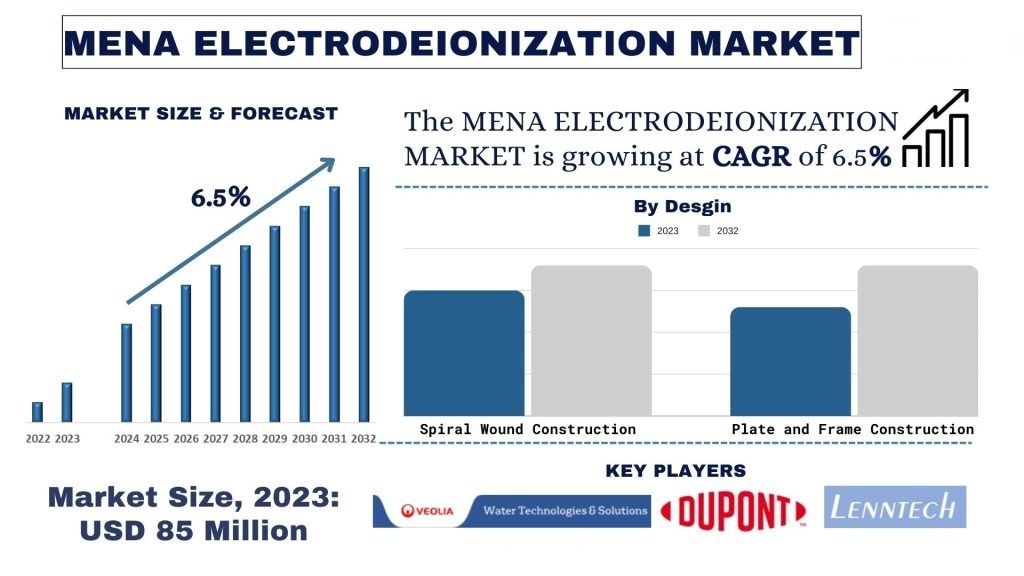
According to a new report by UnivDatos, MENA Electrodeionization Market is expected to reach USD Million in 2032 by growing at a CAGR of 22.67%. The rising demand for Electrodeionization is due to the key factor that has contributed to the growth, which is the government focus on EDI technology adoption, increasing demand from the industrial sector, and rising demand for sustainable water purification techniques. Considering the long-term sustainability goals as well as reducing carbon emissions, EDI has emerged as one of the promising technologies for water purification applications.
Growing Demand:
With the growing urbanization as well as enhanced migrant population, the countries in the Middle East and North Africa region have extensively focused on enhancing domestic production of goods, thereby reducing the dependence on imported goods. In line with this, many of the government policies and plans have been devised in order to achieve this long-term target. Considering the requirement for a high degree of purified water in crucial industries such as pharmaceuticals, consumer goods, food & beverages, power generation sector, etc. According to the International Energy Agency, the Middle East region is 50% dependent on conventional fuel for the generation of power, which requires a sizeable quantity of purified water. EDI, being a sustainable and continuous water flow technology, is further anticipated to rise during 2024-2032.
Access sample report (including graphs, charts, and figures): https://univdatos.com/reports/mena-electrodeionization-market?popup=report-enquiry
For instance, in 2022, South Korean petrochemical producer Daelim Industrial has planned to build an 80,000 t/yr polybutene manufacturing plant at the complex in Jubail. Construction of the new plant is scheduled to begin in 2022 and to be completed in 2024.
The Middle East & North Africa region has been extensively dependent on conventional fuel for water purification techniques due to economical prices as well as ease of availability. However, the respective technologies have been economical for the countries, creating a high degree of air pollution in the atmosphere and increasing the carbon footprint of the region. Considering the long-term sustainability goals as well as reducing carbon emissions, EDI has emerged as one of the promising technologies for water purification applications. One of the key advantages of EDI technology is energy efficiency. Continuous operation, no requirement of chemicals, high purity output, space efficiency, etc. All the aforementioned benefits of the new systems, adjoined with EDI technology, reduce both water and air pollution to a significant degree. Both plate and frame construction and spiral and wound construction-based designs used in the electrodeionization process do not require the usage of chemicals to segregate ionized particles, thereby reducing the wastage of water. Additionally, the respective technology also does not require a large space and is modular (can be increased or decreased the capacity by reducing the plate size).
Some of the prominent providers of the technology in the region are Qua Group, DuPont, Ion Exchange, etc. The respective companies have also established some of the EDI plants in the region which exhibits the slow but a notable shift in the adoption of sustainable water purification techniques.
Click here to view the Report Description & TOC: https://univdatos.com/reports/mena-electrodeionization-market
Technological Advancements in Electrodeionization:
Technological advancements in the electrodeionization market have significantly improved the applicability and efficiency of water purification technologies. These technological advancements include improved electrode design, enhanced membrane materials, increased automation and control, energy efficiency enhancement, etc. Of these, improved electrode designs, such as the usage of novel material, optimized geometrics, and enhanced surface coatings, have enhanced the performance and reduced energy consumption. Apart from this, the usage of enhanced membrane materials has also provided improved selectivity, durability, and resistance to fouling and enhanced the lifecycle of the EDI systems in long. Considering the advantages, the technological enhancement would support the growth of electrodeionization in the MENA region.
Conclusion:
In conclusion, the MENA Electrodeionization market is poised for continued growth and innovation driven by economic expansion, sustainable water purification technologies, technological advancements, and sustainable practices. The increasing demand for sustainable water purification techniques, as well as the need for improved production techniques in the water purification industry, underscores the pivotal role of Electrodeionization across the MENA region. As stakeholders navigate challenges such as cost management, regulatory compliance, and market competitiveness, collaborations, investments in Electrodeionization infrastructure, and rising demand for water purification from the industrial sector would also play a vital role in shaping the future of the MENA Electrodeionization market, ensuring its resilience and contribution to the MENA water purification industry.
Contact Us:
UnivDatos
Contact Number - +1 978 733 0253
Email - contact@univdatos.com
Website - www.univdatos.com
Linkedin- https://www.linkedin.com/company/univ-datos-market-insight/mycompany/
Comments (0)