Featured Snippet
Generative engine optimization (GEO) services improve content visibility in AI-powered search results. Unlike traditional SEO, GEO leverages generative AI and answer engines to provide precise, contextual results. Businesses can utilize strategies from an Answer Engine Optimization (AEO) agency to optimize both standard search listings and AI-driven platforms for higher engagement and conversions.
Introduction
The search landscape has evolved far beyond simple keywords. Today, businesses must adapt to AI-powered search engines that prioritize context, relevance, and user intent. Generative engine optimization (GEO) services are at the forefront of this evolution, helping brands rank for AI-driven queries while enhancing discoverability across multiple platforms.
Incorporating Answer Engine Optimization (AEO) agency strategies enables organizations to optimize content for answer engines and generative AI, ensuring that responses are accurate, contextually relevant, and actionable. By understanding SEO, AEO, and GEO, businesses can align their digital strategies with the future of search, improve engagement, and maintain a competitive edge.
What is SEO, AEO, and GEO?
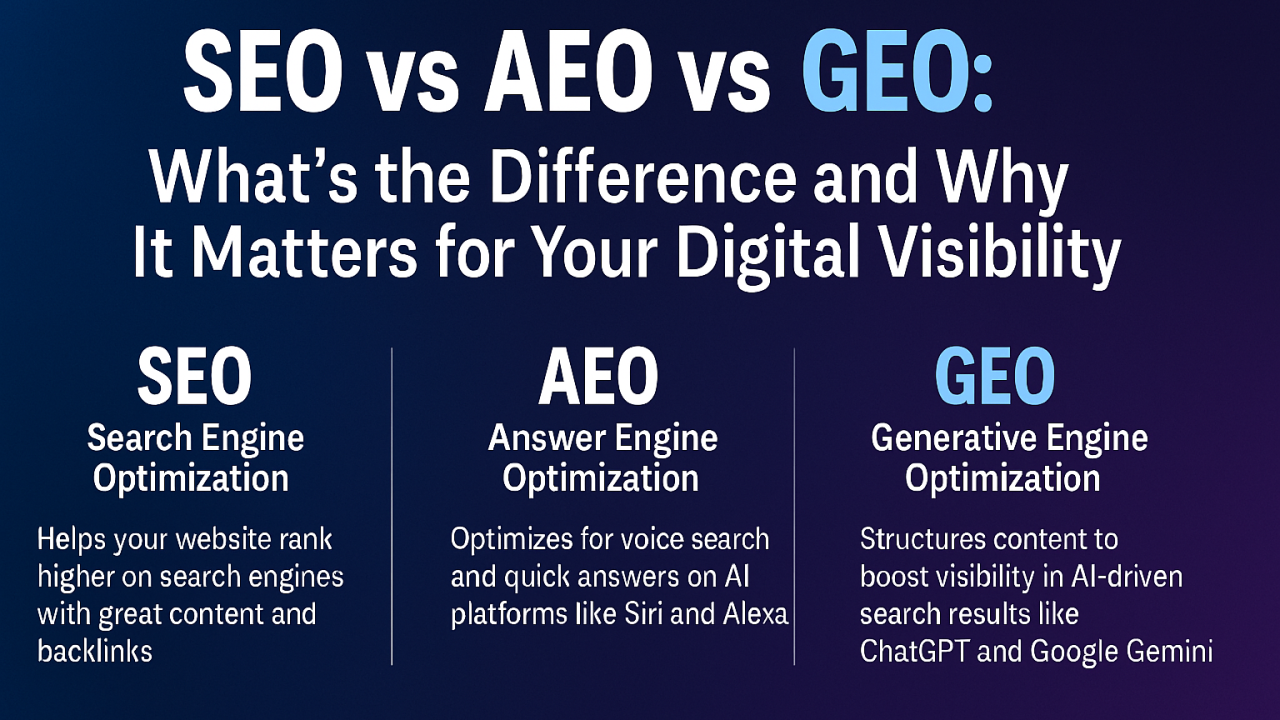
Understanding the distinctions between these three approaches is key to effective digital strategy:
-
SEO (Search Engine Optimization): Focuses on improving visibility on traditional search engines using keywords, backlinks, and technical SEO.
-
AEO (Answer Engine Optimization): Optimizes content to appear in AI-powered answer boxes, virtual assistants, and conversational search platforms.
-
GEO (Generative Engine Optimization Services): Leverages generative AI to create, optimize, and deliver content that aligns with AI-driven search intent.
SEO: The Traditional Backbone
SEO remains essential for driving organic traffic:
-
Keyword targeting: Research and integrate relevant terms
-
Backlinks: Establish authority through quality links
-
Technical SEO: Ensure fast, mobile-friendly, and crawlable websites
Example: A blog post optimized with long-tail keywords and structured headings may still rank in top search results while also being prepped for AEO and GEO adaptation.
AEO: Optimizing for Answer Engines
AEO focuses on positioning your content for direct answers in AI search:
Example: Optimizing a product page so virtual assistants provide concise answers directly to user queries increases click-through rates and engagement.
GEO: Generative Engine Optimization Services
GEO takes AEO further by integrating generative AI:
-
AI evaluates content contextually and semantically
-
Content is optimized to answer complex queries naturally
-
Supports dynamic, AI-generated snippets and summaries
Example: A GEO strategy might enable AI chatbots to generate contextually accurate product recommendations based on user intent, enhancing user experience and driving conversions.
Why Businesses Need GEO Services
-
Enhanced relevance: Deliver precise answers to complex queries
-
Future-proof strategy: Prepare for AI-first search engines
-
Competitive edge: Stand out in emerging search platforms
-
Higher engagement: Improved content visibility and click-through rates
Integrating GEO with Existing SEO Strategies
Businesses don’t replace SEO with GEO—they integrate:
-
Use existing SEO keywords as the foundation
-
Add AI-optimized semantic clusters
-
Enhance technical SEO for AI comprehension
Example: A travel brand can combine SEO-optimized city guides with GEO-optimized AI responses for virtual assistants, boosting both organic and conversational search visibility.
Core Strategies for Effective GEO
-
Content structured for generative AI
-
Semantic keyword mapping
-
Technical implementation
-
Regular performance review
Tools and Platforms
AI-powered tools for GEO:
-
MarketMuse: Content strategy using AI semantic analysis
-
Clearscope: Optimizes content relevance for AI queries
-
SurferSEO: Supports AI-driven keyword mapping and content auditing
These tools work in tandem with Answer Engine Optimization (AEO) agency services for maximum efficiency.
Measuring GEO Success
Key metrics:
-
AI search visibility and rankings
-
Engagement: dwell time, CTR
-
Semantic keyword performance
-
Conversions and ROI
Reporting:
-
Use AI dashboards to identify content gaps
-
Track hybrid SEO/GEO performance
-
Refine strategy based on predictive insights
Case Studies and Real-World Applications
A SaaS company implemented GEO strategies across 200 pages:
-
Integrated structured data and generative content
-
Partnered with an AEO agency
-
Results: 50% increase in AI-driven search visibility and 30% higher engagement
Challenges and Best Practices
Challenges:
-
Rapid algorithm changes in AI search
-
Maintaining content relevance
-
Balancing automation with human oversight
Best practices:
-
Regularly update and audit content
-
Use AI insights for decision-making
-
Combine SEO foundations with GEO techniques
Conclusion
While SEO laid the foundation for search visibility, AEO and GEO provide modern pathways to maximize AI-driven traffic. Leveraging Generative engine optimization (GEO) services along with Answer Engine Optimization (AEO) agency expertise ensures content remains discoverable, relevant, and authoritative. Businesses adopting these strategies today are better positioned to lead in the evolving AI search landscape.
CTA: Explore GEO services and AI-driven search solutions to optimize your brand for future-ready search visibility.
FAQ
-
How does GEO differ from traditional SEO?
GEO uses AI and generative content to answer complex queries, whereas SEO focuses on traditional ranking factors like keywords and backlinks.
-
Can AEO and GEO work together?
Yes, AEO targets answer engines while GEO ensures generative AI comprehends and optimizes content for broader AI-driven search.
-
What tools are best for GEO implementation?
MarketMuse, Clearscope, and SurferSEO are widely used for AI and GEO strategies.
-
How do businesses measure GEO success?
By tracking AI visibility, semantic keyword performance, engagement metrics, and conversions.
-
Is an AEO agency necessary for GEO optimization?
While not mandatory, an AEO agency provides expertise in structuring content for AI and answer engines, boosting GEO efficiency.