
Remember me


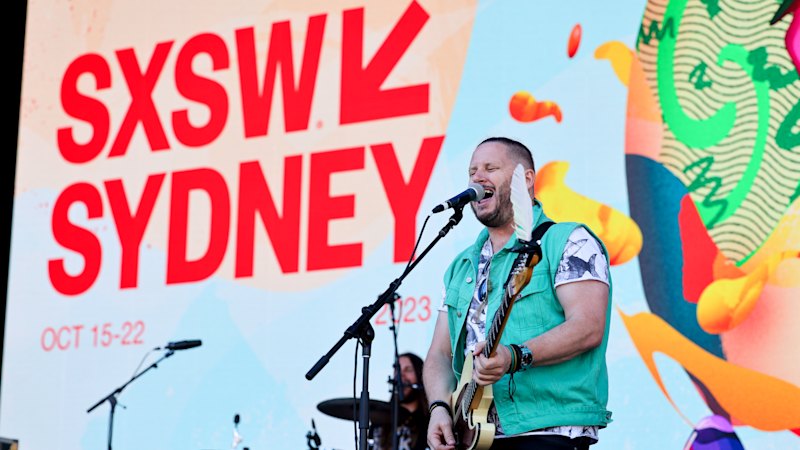


In the middle of the track, he throws his electric guitar to the side, and a crew member catches it (hopefully that was rehearsed). He lights a cigarette and walks off stage, only to reappear behind the stalls, facing the crowd on the lawn, like a magician.
His cover of Changes, which he’s been performing across the tour, is an emotional one. The violins, cello, drums, keys and guitar enhance the weight of the performance, emphasising Yungblud’s intimate connection with Ozzy Osbourne. He also makes a passionate plea to support the “Women, Life, Freedom” movement in Iran.
At the end of the show, he yells to the crowd to meet him in 30 minutes by the pond and the crowd disperses through the trees to find the obscure location.
He arrives eventually, making his way through the sea of dedicated fans.
Reviewed by Vyshnavee Wijekumar
CIRCUS
Ten Thousand Hours ★★★★
Gravity and Other Myths, Arts Centre Melbourne, until January 25
When I first saw Gravity and Other Myths at the Adelaide Festival in 2019, I was impressed by their fresh and distinctive approach to contemporary circus. In an artistic landscape that had been comprehensively expanded by Brisbane-based Circa over the preceding 15 years, this was a company at ease with itself.

Ten Thousand Hours is a brilliantly crafted hour of circus.Credit: Darcy Grant
Carving out a niche within the broader push to align circus with theatre and dance, it occupied an unadorned, yet intensely playful, corner of the form – one which valued authenticity over theatricality and sought to forge a unique connection between acrobats and audiences.
Ten Thousand Hours is the fruit of this ethos, and it speaks the language of wonder in a wonderfully relaxed accent, even as it invites us to bear witness to the labour involved in acquiring an effortless sense of mastery.
The show takes its name from the amount of practice it supposedly takes – according to the rule Malcolm Gladwell popularised – to become an expert at something.
Traditionally, performers disguise effort onstage; Ten Thousand Hours lets us peek behind the curtain from the start. Taking a leaf from the “post-dramatic theatre” playbook, you’ll enter the auditorium to find acrobats stretching and limbering up in front of a large, electronic 10,000 sign – a monster version of the kind you might see on a radio alarm clock display.

Gravity and Other Myths have carved out their own niche.Credit: Darcy Grant
Seconds tick down, the show begins.
Accompanied by live percussion and synth, the ensemble creates driving momentum in an extended sequence that builds from casual walking around to group tumbling and balance work of almost baroque complexity, weaving through bodily synchronicity and counterpoint and – as the company’s gravity-defying name would seem to demand – achieving every possible variation of a three-high human pyramid.
A game-like atmosphere descends. One performer repeats their warm-up routine in various comedic styles, according to a list of whimsical instructions. Later, the electronic display becomes a scoreboard, keeping a tally of every trick landed or muffed.
And there’s fun acrobatic version of Pictionary or charades, in which an audience member is chosen to draw doodles of performers perched in unlikely positions, while other acrobats turn their backs. Then, the latter must scramble to recreate the original pose from each drawing before a timer runs out.
Loading
Between these ludic set-pieces are imaginative ensemble routines performed with sly insouciance. Imagine that friends of friends walked into your loungeroom and started pulling off mad acrobatic feats, as if it were as natural as saying g’day, and you’ll get an idea of the vibe. Yet we get glimpses, too, of the perspiration – the relentless striving – needed to attain the uncanny physical prowess on display.
Ten Thousand Hours is a brilliantly crafted hour of circus. Children and teens should leave wide-eyed and inspired, and for adult audiences, it’s an exciting way to chill.
Reviewed by Cameron Woodhead
MUSIC
Travis ★★★
Festival Hall, January 10
Scottish band Travis haven’t toured Australia since 2001. The reason, says lively elfin frontman Fran Healy to a crowd loud with expats, was their management: “So we sacked them.”
The four-piece are here to perform their 1999 breakthrough The Man Who, in its jangly, melancholy-pop entirety, followed by a set cherry-picked from their back catalogue.
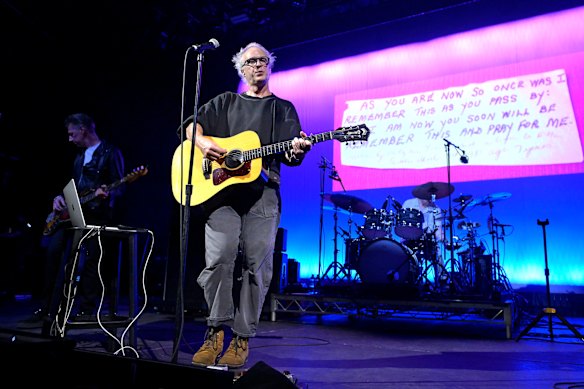
Travis frontman Fran Healey at Festival Hall. Credit: Martin Philbey
A band ticking off a track list can feel perfunctory, but Travis poke fun at this by going full PowerPoint presentation mode – literally. With a laptop on stage, the white-haired Healy introduces each song via a slide show and recollections of it. It sounds like a slog, but his easy charisma makes it a sweet romp through the band’s journey from students in Glasgow to indie pop stars of the early 2000s.
Opener Writing to Reach You was apparently inspired by Healy’s gas heater, Franz Kafka and Wonderwall; The Fear was written above a pub called The Horseshoe (the Scots in the crowd cheer); As You Are is about a poem an old man handed Healy on a train. Before Driftwood, Healy says he came up with the melody while doing the dishes, then plays the original voice memo of it. It’s a lot of fun.
Though Healy is a great raconteur — and his voice remains lovely — Travis’ music still isn’t about much.
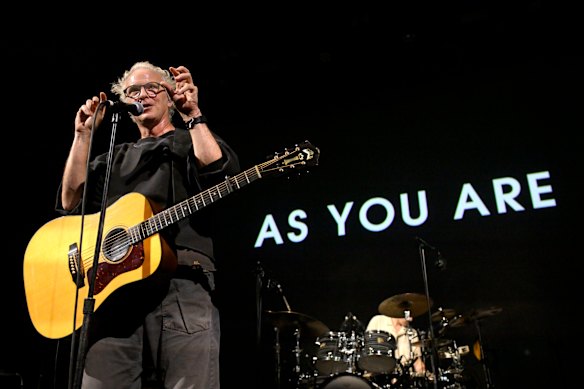
Healey takes the Festival Hall crowd through the stories of the songs from Writing to Reach You.Credit: Martin Philbey
Gaslight, from the band’s 2024 LP L.A. Times, is a response to someone who wronged Healy, but the vague lyrics on screen locate no such venom. Fortunately, there are earworms in Why Does it Always Rain on Me? – which has the crowd pogoing – a stirring Side and closing highlight Sing to keep spirits up.
“It’s less about the songs and more about the memories we attach to them,” says Healy, perhaps a little too insightfully at one point. At least tonight will be a nice one.
Reviewed by Marcus Teague
THEATRE
Blackpill: Redux ★★★
Theatre Works, until January 17
Chris Patrick Hansen’s Blackpill: Redux dives into dark corners of the manosphere. It’s confronting, disturbing, sometimes darkly funny ensemble theatre that explores ‘incel’ culture, how easy it is for boys and young men to be exposed to it, and for them to fall down rabbit-holes into realms of radical, and virulently misogynistic, gender ideology.
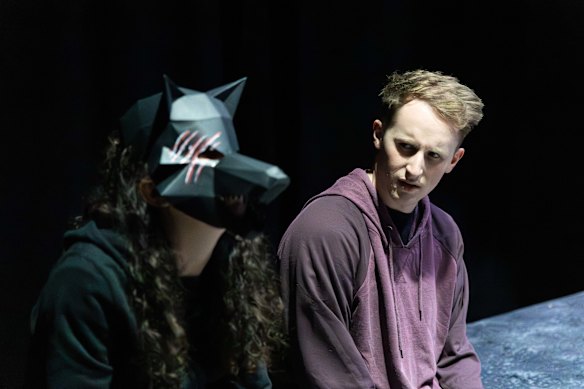
Chris Patrick Hansen’s Blackpill: Redux dives into dark corners of the manosphere.Credit: Chris Patrick Hansen
We follow Eli (Oliver Tapp). He’s having a bad day. Sacked from his job over his behaviour towards Carina (Eleanor Golding), a young woman he met through the Hinge dating app, Eli feels aggrieved by his lack of romantic and career success.
He’s easy prey for a digital underworld which peddles the lie that women are to blame for all his woes. Using references to The Matrix, the incel (“involuntary celibate”) community promotes a weird, gender essentialist conspiracy that women are only sexually attracted to the “alpha”, or High Value Male (Bailey Griffiths), leaving most men (as “beta” males, or worse) irreversibly single.
Being “redpilled” is their internet vernacular for waking up to this “truth”, and when Eli tries relatively innocuous ways to bolster self-esteem – seeking online advice on how to talk to women, or on how to improve his fitness and physique – he’s instead lured towards social media content and interactions that target his vulnerabilities.
With an antagonist in a wolf mask only ever a click or a scroll away, Eli becomes more isolated and disenchanted. The road toward “blackpill” thinking – a nihilistic strain of incel culture which has caused despicable instances of real-world violence – looms.
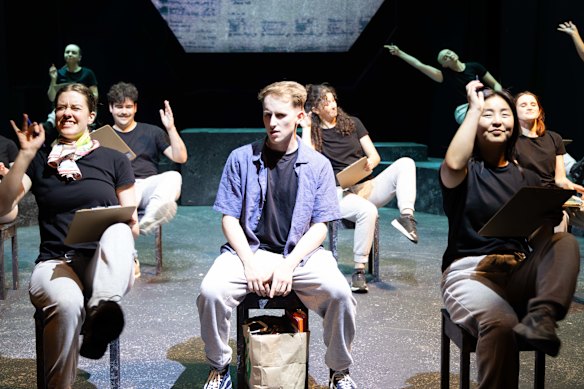
A scene from Blackpill: Redux at Theatre Works.Credit: Chris Patrick Hansen
Hansen’s play portrays Eli’s story in monologues and short dramatic scenes, regularly disrupted by physical theatre, mass choreography, and (usually text-based) projections. The latter give a sense of the acid in the water supply – the digital content Eli is doomscrolling through in idle moments – and works well to promote a sense of disorientation, and unease at the slipperiness of the slope he’s descending.
That’s an energising way to embody an essentially solitary phenomenon, even if ambition can outstrip execution and there are a few scenes where the ensemble work could be tighter. A bigger issue is the caricature heavily utilised in the portrayal of female figures. With one exception, we see them through Eli’s jaded eyes, and although partial truth lurks in the satire – the HR girlboss who fires Eli using managerial care-speak with an Orwellian flavour, say – the play could use a side-mirror to correct its male blindspots.
Blackpill isn’t as slick or entertaining or complete a work as it could be, but it creatively tackles an urgent social problem, while trusting us to think for ourselves about solutions to it.
Reviewed by Cameron Woodhead
MUSIC
Peninsula Summer Music Festival ★★★★
Various venues, January 9-11
It’s a magical alchemy: breathtaking seascapes, manicured vineyards and rugged bush, all counterpointed with fine music. Such is the Peninsula Summer Music Festival.

Sydney-based Ensemble Offspring perform at Peninsula Summer Music Festival 2026.Credit: David Wilkinson
Concerts from the final weekend of the festival confirmed the enduring value of its core commitments to strengthening cultural ties with First Nations peoples and encouraging young artists.
Among the thermal pools of Peninsula Hot Springs, Sydney-based Ensemble Offspring presented Every Plant Has Its Dreaming, an exploration of five Indigenous food sources, narrated by Uncle Peter Aldenhoven with music by Noongar man Aaron Wyatt.
Using violin, cello, flute, clarinets and percussion, Wyatt evoked the chocolate lily, garawang apple berry, murnong daisy, durable lomandra and the karkalla bush banana with music that interwove reflective moments full of childlike playfulness and wonder together with bursts of rhythmic energy.
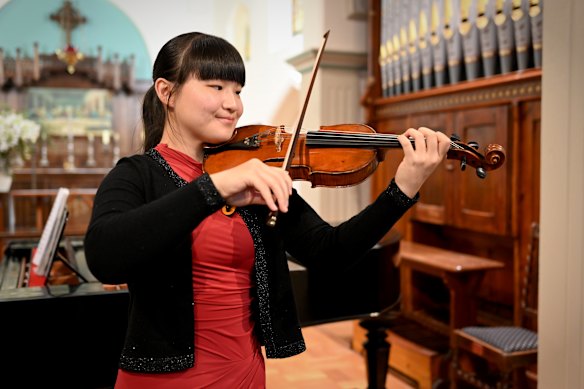
Theonie WangCredit: David Wilkinson
Young artists on the bill eagerly presented sizeable programs in the intimacy of St John’s Flinders.
Former Australian Youth Orchestra concertmaster Theonie Wang, partnering with her pianist mother Mizusa, presented an atmospheric realisation of Amy Beach’s Romance. Spinning ardent, well phrased melodic lines, Theonie used this arch-romantic idyll to contrast the alluring dark chocolate tone of her violin’s lower register with its silvery upper brilliance.
In Beethoven’s monumental Kreutzer Sonata, mother and daughter maintained admirable forward momentum, finding particularly memorable characterisation in the third and fifth variations of the second movement.
Members of the recently formed Cedar Collective (violinists Lachlan MacLaren and Jessica Leigh, violist Sebastian Coyne and cellist Sarah Wang) revelled in the challenges of ambitious and interesting choices.
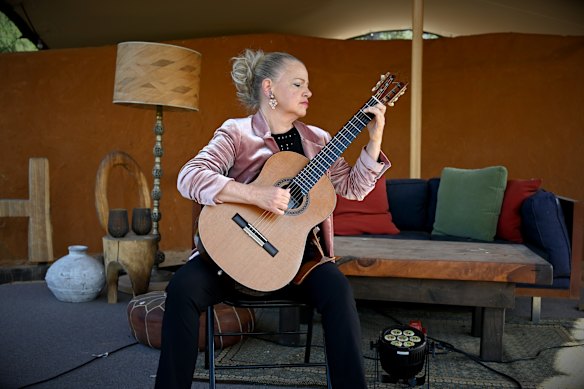
Karin SchauppCredit: David Wilkinson
Their perceptive versatility brought ebullience to Haydn’s String Quartet in G major Op. 76 No. 1, finely calibrated timbres to the stark but intriguing postmodern soundscape of Plan and Elevation by Pulitzer prize-winning composer Caroline Shaw, and rapture to Fanny Mendelssohn’s String Quartet in E-flat major, notably in the third-movement Romanze.
Back at the Peninsula Hot Springs, Brisbane-based guitarist Karin Schaupp brought her customary finesse and persuasive artistry to works chosen to resonate with the natural surroundings. Australian compositions including the recently composed neo-baroque Suite in D by Phil Moran, Infinity by Tara Lynam and the amusing, very apt Frog Ballet from Richard Charlton’s Kingfisher Dances rubbed shoulders with works from Spain, Brazil and Scotland.
Once again, co-directors Melissa Doecke and Ben Opie have united a suite of satisfying artistic experiences with the natural glories of the Mornington Peninsula. In the words of Ira Gershwin, “Who could ask for anything more?”
Reviewed by Tony Way
MUSICAL
Saturday Night Fever ★★
The Athenaeum, until January 25
A pop-cultural touchstone of the late ’70s, Saturday Night Fever was the film that made John Travolta a megastar and turned disco into a global phenomenon.
Its soundtrack album remains one of the bestselling in history, with all those chart-topping bangers from the Bee Gees defining the sound of a musical genre that never really goes out of style.
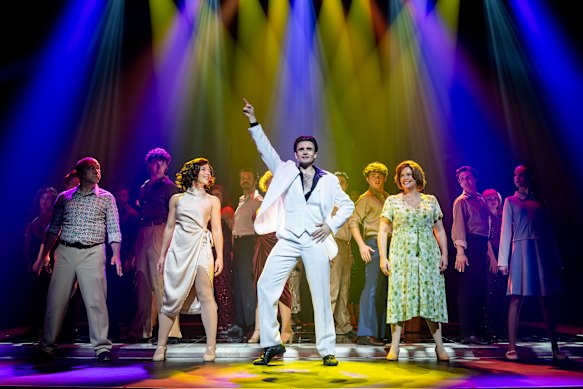
Ethan Churchill (centre) strikes an iconic pose as Tony Manero with the cast of Saturday Night Fever.Credit: Ben Fon
The songs alone should make a jukebox musical an appealing proposition, though the transition from screen to stage isn’t exactly a smooth move. If you’ve only seen the PG version of the film, you might not be aware of just how dark the storyline gets in the R-rated release: gang violence, gang rape, family violence, suicide, pervasive male chauvinism and misogyny.
Young Italian-American Tony Manero (Ethan Churchill) is stuck in an uninspiring job. His home life is tormented by a violent alcoholic father (George Kapiniaris), and his friends are toxic in the masculinity stakes: brawling with rival ethnic gangs and hanging at a local discotheque trying to seduce young women into having sex with them.
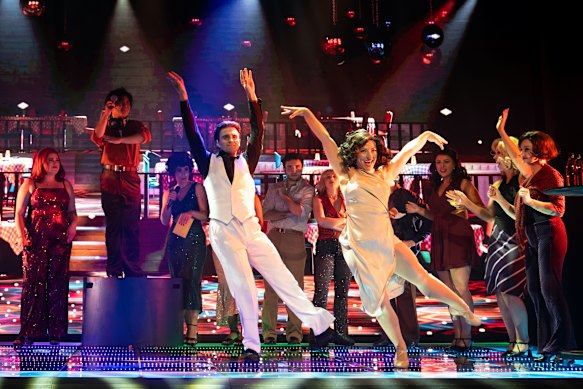
Churchill and Regan Barber on the dancefloor in Saturday Night Fever. Credit: Ben Fon
Tony seeks an outlet in a disco dancing competition, discarding his first partner Annette (Izzi Green) for Stephanie (Regan Barber), a better dancer with ambitions to move to Manhattan. Meanwhile, Tony’s brother (Matthew Casamento) leaves the priesthood, and Brooklyn’s mean streets claim their due in misery.
This national touring production from Drew Anthony Creative does feature numbers that pay affectionate, hedonistic homage to disco favourites. Still, the fun factor is seriously undercut by the way the show strives to press the songs into dramatic service, sandwiching the music between competing and contradictory demands.
The musical tones down the heaviest material, yet it attempts to lend a naturalistic authenticity to a world of disaffected, working-class Brooklyn youth. It largely fails, with many over-earnest, quickly sketched scenes serving as little more than flimsy filler between songs.
A few musical arrangements do work well theatrically – Green’s plaintive rendition of If I Can’t Have You neatly channels the angst of an unrequited crush, for instance. Others look and sound terribly awkward. It’s no shade on Sam Hamilton to say that the Bee Gees’ Tragedy is a ridiculous accompaniment to his character’s suicide.
Loading
Barber’s sassy Stephanie out acts Churchill, who could use more comedic and charismatic gloss in the Travolta role, and the thing that might have carried the musical through its humdrum sequences – the magnetism, the spectacle, the epiphanic transcendence of losing yourself in dance – doesn’t quite make itself felt on the cramped Athenaeum stage.
Saturday Night Fever does provide visual interest – elaborate projections, colourful period costume, spots of impressive choreography – and it isn’t so awful you want to “burn that mother down”, as they say in Disco Inferno. But there’s little synergy between music and storytelling, and it isn’t a jukebox musical I can heartily recommend.
Reviewed by Cameron Woodhead