
Remember me








 CryptoSlate preferred on
 After losing 63% of its value over several tough months and challenging investor confidence, XRP made a strong comeback in April.
XRP’s recovery is driven by new privacy features for institutions, major retail adoption in Asia, and renewed interest in exchange-traded funds.
Cryptorank data shows XRP is on track for its first positive monthly close since September 2025.
With investors showing more interest in riskier assets, XRP has risen over 2% in April to $1.35 at the time of writing.
The price increase reflects big changes in where money is flowing and how investors feel. SoSoValue reports that US-based XRP exchange-traded funds saw about $12 million in net inflows in April, a big turnaround from March, when worries about the economy led to over $31 million in outflows.
This demand is not limited to the US. CoinShares data shows that global XRP exchange-traded products have seen about $20 million in net inflows this month.
While institutions are buying, many retail traders on social media seem worn out.
Santiment data shows that negative feelings about XRP, often called fear, uncertainty, and doubt (FUD), have reached their third-highest point in two years.
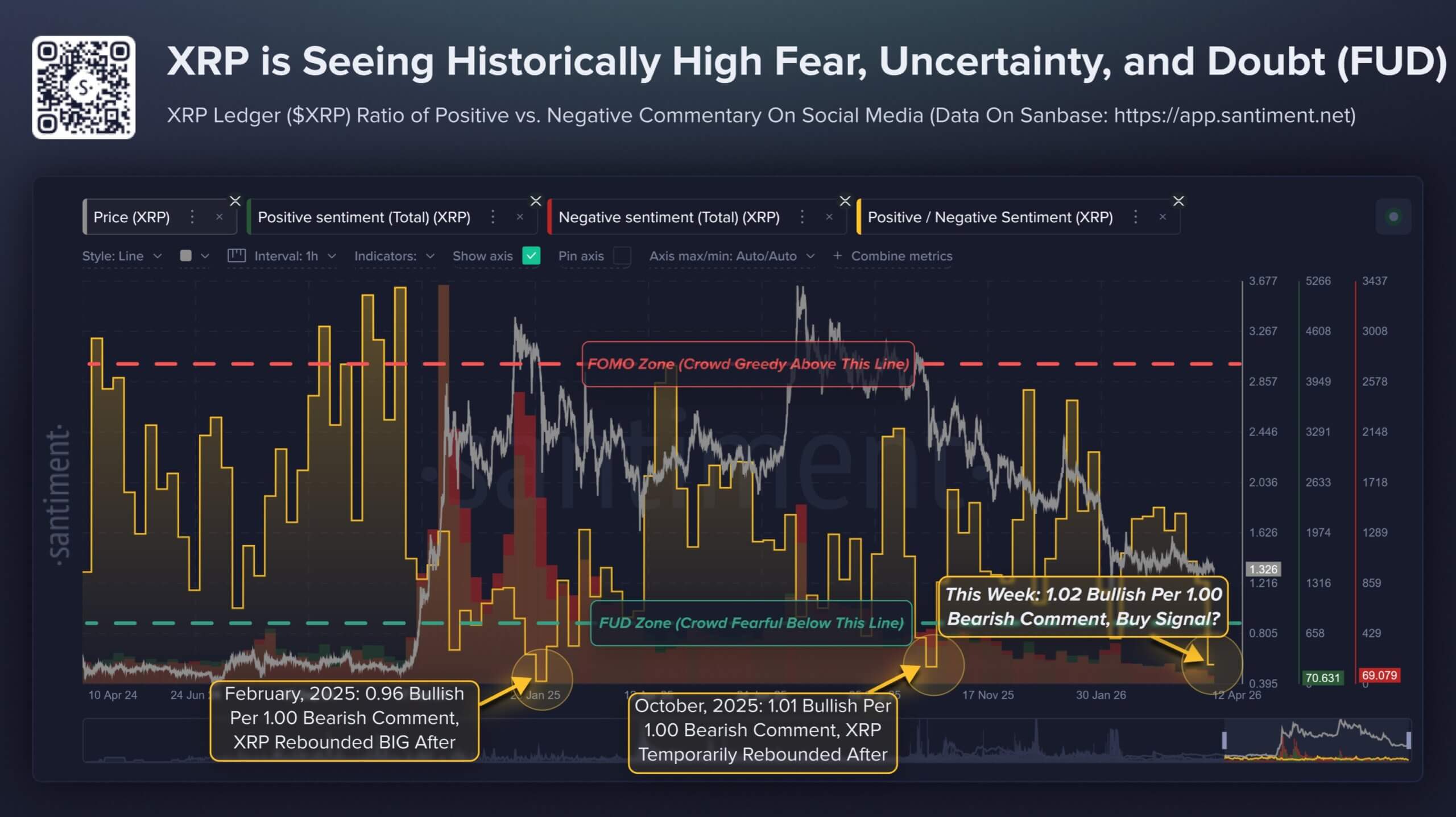 XRP Market FUD Levels (Source: Santiment)
In the past, when retail traders were this negative, it often signaled a good buying opportunity. After many gave up during the nine-month decline, analysts now view this as a low-risk time to buy, which is helping drive the current rally.
Despite the difficult bear market in late 2025 and early 2026, CoinShares data shows that XRP is now the third most popular digital asset for global institutional inflows this year, behind only Bitcoin and Solana.
Analysts say this new financial support is due to major changes to the XRP Ledger, especially new privacy features and more options for regular users.
XRPL adds programmable privacy and attracts more institutionsPublic blockchains have long been too transparent for many traditional financial institutions.
All transactions, counterparties, and wallet balances are visible to everyone, which makes it easy for competitors and trading bots to track trading strategies and company money movements.
To address this, XRPL now uses zero-knowledge (ZK) proofs. This cryptographic method allows someone to prove a transaction is valid without revealing the details.
XRPL Commons and Boundless collaborated to build a RISC-V ZK verifier, which now runs directly on the ledger.
With this upgrade, XRPL becomes the first public blockchain to offer programmable privacy and compliance controls built into its core.
The rollout will take place in stages. ‘Smart Escrows' are planned for the second quarter of 2026 and will require a valid zero-knowledge proof before releasing funds. After that, ‘Smart Vaults' will launch, enabling fully private financial systems.
Institutions will be able to verify transactions against Know Your Customer and sanctions databases before settlement, keeping the data hidden from the public while remaining auditable by regulators upon request.
This has major implications for enterprise adoption. The infrastructure supports stablecoin payments, over-the-counter trades, and cross-chain swaps, while keeping amounts and counterparties confidential.
It also lets users use zero-knowledge identity tools, like zkPassport, to prove compliance without revealing personal data.
Odelia Torteman, director of corporate adoption at XRPL Commons, said:
“XRPL has always been built for institutional finance…we are making confidential, compliant execution native infrastructure on XRPL, unlocking a category of enterprise use cases that simply wasn't possible before.”
Bridging Japanese retail and legacy bankingWhile privacy upgrades attract Wall Street, large-scale retail integration in Asia has created a strong foundation for the asset's utility.
Earlier this month, Rakuten, the Japanese e-commerce and financial services giant, officially added XRP to its Rakuten Wallet ecosystem.
 Related ReadingWhy Japan's biggest e-commerce giant entering crypto is a really big deal
Apr 18, 2019 · Joseph Young
The rollout goes beyond a simple exchange listing, exposing the platform's 46 million active users to the token and allowing them to purchase XRP using accumulated loyalty points.
Even more importantly, consumers can now spend XRP at over 5 million affiliated merchants throughout Japan.
With about $23 billion in loyalty points circulating in Japan, the Rakuten integration connects closed-loop rewards systems with everyday digital commerce, turning previously isolated points into liquid crypto capital.
Simultaneously, institutional testing of the network's cross-border payment capabilities has accelerated.
Recent reports among XRP supporters suggest that a group of Japanese banks recently finished a live pilot program comparing XRP settlements to the traditional SWIFT network for remittances between Japan and Southeast Asia.
Although CryptoSlate could not independently verify the pilot data by press time, supporters claim the tests showed XRP settling cross-border transactions in under four seconds at 60% less cost than traditional systems.
CryptoSlate Daily BriefDaily signals, zero noise.5-minute digest 100k+ readers
Whoops, looks like there was a problem. Please try again.
You’re subscribed. Welcome aboard.
By avoiding the traditional correspondent banking model, which requires banks to keep billions of dollars in pre-funded overseas accounts for foreign exchange, the blockchain alternative offers significant capital efficiency for global lenders.
XRPL’s regulatory protection and proactive securityThe ledger’s technological progress comes at a key moment for U.S. crypto regulation. Recently, the Securities and Exchange Commission's Division of Trading and Markets issued strict guidance on broker-dealer registration requirements for decentralized finance interfaces.
However, developers say that XRPL's unique design protects it from these regulatory challenges.
Unlike Ethereum or Solana, which use third-party smart contracts and centralized front-end interfaces for decentralized trading, XRPL has a built-in decentralized exchange at the protocol level.
Vet, a prominent XRPL network validator, noted on the social media platform X that the network operates as a “shared public square,” handling order books and transaction routing natively without ever taking custody of user funds.
This setup could help XRPL avoid the compliance burdens that threaten third-party DeFi platforms.
To make sure this infrastructure can handle expected increases in volume, Ripple and the blockchain security firm Sherlock launched a $550,000 audit contest on April 13.
The two-week initiative aims to stress-test new protocol features, such as batch transactions, permission delegation, and confidential transfers.
The urgency of the audit shows a move toward proactive, institutional-grade security as new enterprise players get ready to join.
Addressing the quantum computing threatAs the network hardens its smart contracts, developers are also addressing broader existential threats to blockchain security, notably the rapid advancement of quantum computing.
Recent claims by Google about the speed of quantum development have raised concerns that future machines could use Shor's algorithm to reverse-engineer private cryptographic keys from exposed public keys, which could drain blockchain wallets.
However, a recent vulnerability audit of XRPL suggests the network is mostly protected from near-term quantum threats.
This is because XRPL only exposes a user's public key to the network when they send an outbound transaction. Receive-only accounts stay cryptographically protected.
Vet's audit found that about 300,000 accounts holding 2.4 billion XRP have never sent a transaction, making them quantum-safe by default.
A few dormant whale accounts exposed their keys more than five years ago, but they hold only 21 million XRP, which is about 0.03% of the circulating supply.
The ledger also has a built-in “key rotation” feature that lets users change their signing keys without moving their funds to a new address.
“The XRP Ledger is account-based and allows for signing key rotation, so you can rotate keys that sign on behalf of an account without switching the account,” Vet said, noting that this acts as a robust stopgap before the network will eventually adopt fully quantum-resistant algorithms.
In the end, these changes in April, from retail traders giving up, to solving the public blockchain privacy issue, to securing mass distribution, have changed the market story around XRP. The focus has shifted from speculation to building an integrated financial infrastructure.

Comments (0)