
Remember me


Today’s top story: The anticipated geomagnetic storm arrived, and it arrived strong. Perhaps the geomagnetic disturbance arrived a little late since it was anticipated by late on April 17. But at around 21 UTC last night, the Kp index started to increase. At 7:41 UTC this morning of April 18, the threshold of G1 (minor) geomagnetic storming was reached. It did not stay there for long as at 8:25 UTC April 18, a G2 (moderate) storming was registered. All this is caused by the fast solar wind coming from a huge coronal hole we’ve been tracking. In addition, arrival of a co-rotating interaction region (CIR), a place between us and the sun where slower solar wind is overtaken by the fast solar wind from this coronal hole. This combination pushed Earth’s magnetic field to geomagnetic storming levels. Periods of more of G1 (minor) and G2 (moderate) activity might extend through April 19.
Aurora hunters, good luck n clear skies Auroral display sightings are possible this weekend. Share your beautiful photos of the auroras with us.
Past 24 hours of sun news (11 UTC April 17 – 11 UTC April 18)Flare activity: Solar flare activity continued at low levels, thanks to an isolated C-class flare. Total flare production of the day was of 7 flares: one C-class and 6 B-class (weak) flares.
Strongest flare: A C1.6 from AR4416 in the northwest sparked this morning at 7:04 UTC on April 18. Lead flare producer: Active region AR4416 get the honors of lead flare producer of the period. This sunspot region produced six out the seven flares of the day. Our previous hero AR4419 produced only one B flare this time.Sunspot regions:The Earth-facing side of the sun today continued showing 3 numbered active regions. Active region AR4419 retains its beta-gamma magnetic configuration and continues dominating as the largest in extent. The remaining two numbered active regions show simpler alpha or beta configurations.
Blasts from the sun? Over the past day, available coronagraph imagery showed no Earth-directed coronal mass ejections (CMEs).
Past 24 hours in space weatherSolar wind: Over the past day, solar wind speeds ranged the low levels. But starting at 21 UTC on April 17 speeds started to increase to reach moderate-high levels. The interplanetary magnetic field (IMF) peaked moderate. Interestingly, the Bz component started weak shifting north to south. But starting around 21 UTC on April 17 it started climbing stronger and shifted southward for the rest of the period.
Currently, at the time of this writing, the Bz component points southward. As always, a southward orientation favors auroral activity.
Earth’s magnetic field: Earth’s magnetic field from very quiet levels to active levels. Late on April 17, Kp values ranged from 0 to 1. But starting at around 21 UTC on April 17, Earth’s magnetic field started to register some activity and went up first to Kp2 then Kp3 to finally jump to Kp5 when a G1 (minor) geomagnetic storm was registered, threshold reached at 7:41 UTC on April 18. Later on, Kp6 or G2 (moderate) geomagnetic storm was registered, threshold of Kp6 level reached at 8:25 UTC on April 18.
What’s ahead? Sun–Earth forecastFlare activity forecast: Forecasters keep numbers and anticipate low-to-moderate activity. The chance of a C-class flare continues at 75%. Meanwhile, chances for M-class flares hold at 25%. In addition, X-class (strong) flare chances hold at 5%. AR4419, with its beta-gamma configuration on the northeast, promote these numbers. It is the main driver behind these predictions.
Geomagnetic activity forecast:
G1 and G2 geomagnetic storm are here! And these conditions may be extended during the weekend. Aurora hunters, clear skies and good luck!
April 18: G1 (minor) and G2 (moderate) geomagnetic storm levels (Kp = 5 – 6) disturbed Earth’s magnetic field this morning. This conditions may be extended through the day with more events of G1 and G2 storming periods. All this is caused by the arrival of a co-rotating interaction region (CIR) and the early arrival of fast solar wind from a coronal hole . April 19: Subsequently, unsettled-to-active conditions should prevail as fast solar wind from a coronal hole continues arriving. In fact, levels may reach G1 (minor) and even G2 (moderate) storm thresholds during this weekend. April 20: Quiet-to-unsettled conditions may return as effects from the fast wind and CIR combination start to wane.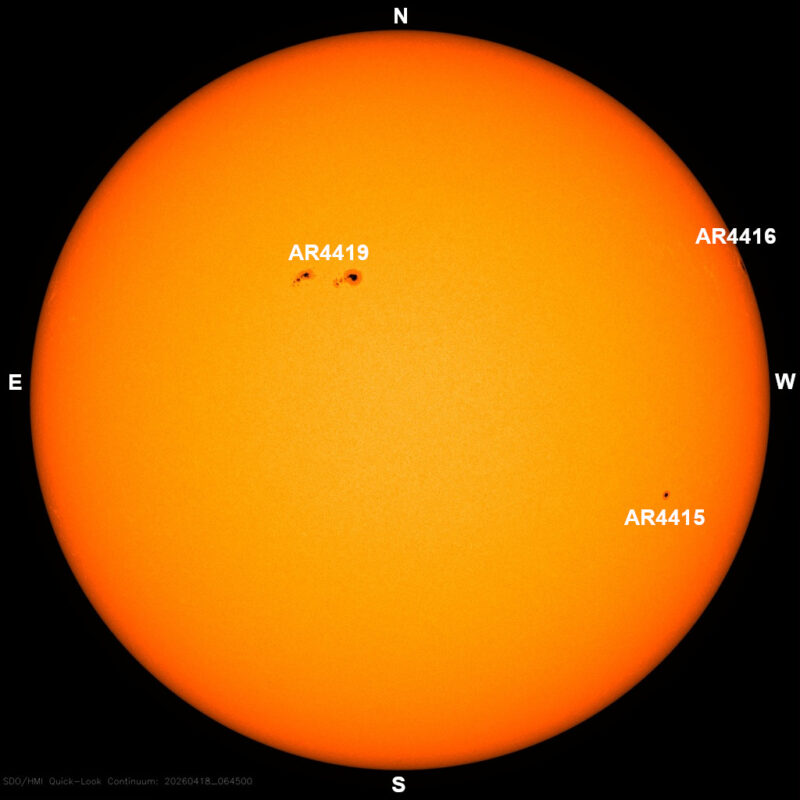 This image shows sun activity – with the most active regions labeled – as of 6 UTC on April 18, 2026. Original image, without labels, via NASA SDO. Courtesy of NASA/SDO and the AIA, EVE, and HMI science teams, with labeling by EarthSky. Armando Caussade posted today’s sun. Why are east and west on the sun reversed?
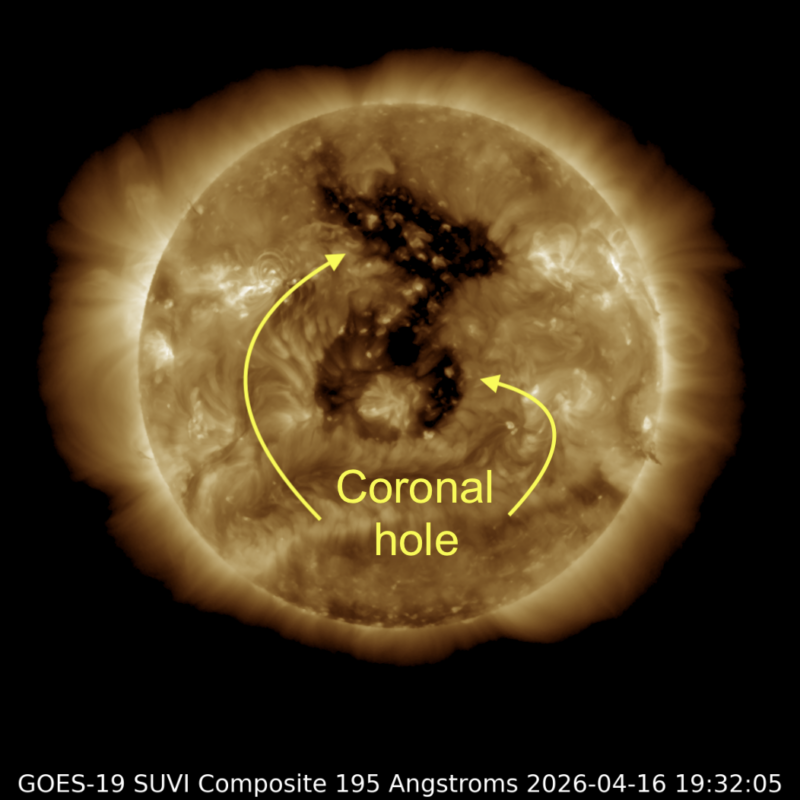
 Sun news for April 16-17, 2026. A huge coronal hole has been moving across the sun’s visible face this week. It now sits in a geoeffective position, where it’s capable of affecting Earth with its fast solar wind. Aurora chasers at higher latitudes, this weekend could be your chance. Image via NOAA/GOES.
Sun news April 17: Huge coronal hole now faces Earth
Sun news for April 16-17, 2026. A huge coronal hole has been moving across the sun’s visible face this week. It now sits in a geoeffective position, where it’s capable of affecting Earth with its fast solar wind. Aurora chasers at higher latitudes, this weekend could be your chance. Image via NOAA/GOES.
Sun news April 17: Huge coronal hole now faces Earth
Today’s top story: The huge coronal hole we’ve been tracking – since it emerged on the sun’s northeast earlier this week – is now in a geoeffective position. In other words, it faces Earth directly, so that its fast solar wind is streaming our way. We should soon notice its arrival through disturbances in Earth’s magnetic field.
Forecasters anticipate the arrival of a co-rotating interaction region (CIR), a place between us and the sun where slower solar wind is overtaken by the fast solar wind from this coronal hole. This combination might push Earth’s magnetic field to unsettled-to-active levels, with periods of G1 (minor) geomagnetic storming. And we can’t rule out the possibility of G2 (moderate) activity. These conditions might extend through April 18.
So aurora chasers, take note! Auroral display sightings are possible this weekend. Clear skies!
Past 24 hours of sun news (11 UTC April 16 – 11 UTC April 17)Flare activity: Over the past day, solar flare activity jumped to low levels, with a notable increase in flare production. In total, the sun produced 16 flares: 5 C-class and 11 B-class (weak).
Strongest flare: A C4.2 from AR4419 in the northeast sparked at 4:42 UTC on April 17. Lead flare producer: For a second day in a row, AR4419 stood as the sole flare producer during the period, firing all 16 events.Sunspot regions: Currently, the Earth-facing side of the sun shows 3 numbered active regions. Notably, newcomer AR4419 retains its beta-gamma magnetic configuration and continues dominating flare production. Meanwhile, the remaining two numbered active regions show simpler alpha or beta configurations.
Blasts from the sun? Over the past day, available coronagraph imagery showed no Earth-directed coronal mass ejections (CMEs).
Past 24 hours in space weatherSolar wind: Over the past day, solar wind speeds averaged low levels. Meanwhile, the interplanetary magnetic field (IMF) stayed weak. Interestingly, the Bz component followed a very similar pattern to yesterday, a true space weather déjà vu. Specifically, it pointed southward late yesterday.
However, it turned northward around 20 UTC on April 16 and remained that way for 9 hours before swinging south again. Currently, at the time of this writing, the Bz component points southward. As always, a southward orientation favors auroral activity.
Earth’s magnetic field: Throughout the past day, Earth’s magnetic field continued at very quiet levels, even quieter than yesterday. Kp values ranged from 0 to 1. As of this morning at 11 UTC on April 17, the Kp index sits slightly above level 0.
What’s ahead? Sun–Earth forecastFlare activity forecast: Today, forecasters anticipate low-to-moderate activity. Specifically, the chance of a C-class flare sits at 75%. Meanwhile, chances for M-class flares hold at 25%. In addition, X-class (strong) flare chances hold at 5%. Notably, active region AR4419, with its beta-gamma configuration on the northeast, is the main driver behind these predictions.
Geomagnetic activity forecast:
Auroral displays are expected this weekend! Indeed, G1 to G2 geomagnetic storm levels are possible. Aurora hunters, stay alert!
April 17: Later in the day today, Earth’s magnetic field might start to appear disturbed. Specifically, expect unsettled-to-active conditions (Kp 3–4), with a chance of reaching G1 (minor) geomagnetic storm levels (Kp = 5). In addition, forecasters also anticipate possible G2 (moderate) storm levels. Ultimately, a co-rotating interaction region (CIR) and the early arrival of fast solar wind from a coronal hole should drive this activity. April 18: Subsequently, unsettled-to-active conditions should prevail as fast solar wind from a coronal hole continues arriving. In fact, levels may reach G1 (minor) and even G2 (moderate) storm thresholds. April 19: After that, expect quiet-to-unsettled conditions as effects from the fast wind and CIR combination start to wane. As you read this, the new moon will have just crossed nearly in front of the sun. That happened at 11:52 UTC (6:52 CDT) today. So you won’t see the moon in our sky today. This image is from early this morning, from the GOES-19 satellite, in geostationary orbit. The satellite – equipped to hide the sun’s brightness behind an obscuring disk – captured by an edge of Earth and also the moon. This weekend, the young moon will reappear in our sky, near blazingly bright Venus. Look west after sunset. Video via NOAA/GOES.
This image shows sun activity – with the most active regions labeled – as of 6 UTC on April 18, 2026. Original image, without labels, via NASA SDO. Courtesy of NASA/SDO and the AIA, EVE, and HMI science teams, with labeling by EarthSky. Armando Caussade posted today’s sun. Why are east and west on the sun reversed?
Sun news April 16: Wow! A 3rd far-side blast this week
As you read this, the new moon will have just crossed nearly in front of the sun. That happened at 11:52 UTC (6:52 CDT) today. So you won’t see the moon in our sky today. This image is from early this morning, from the GOES-19 satellite, in geostationary orbit. The satellite – equipped to hide the sun’s brightness behind an obscuring disk – captured by an edge of Earth and also the moon. This weekend, the young moon will reappear in our sky, near blazingly bright Venus. Look west after sunset. Video via NOAA/GOES.
This image shows sun activity – with the most active regions labeled – as of 6 UTC on April 18, 2026. Original image, without labels, via NASA SDO. Courtesy of NASA/SDO and the AIA, EVE, and HMI science teams, with labeling by EarthSky. Armando Caussade posted today’s sun. Why are east and west on the sun reversed?
Sun news April 16: Wow! A 3rd far-side blast this week
The sun is putting on quite a show from the far side! At around 11:45 UTC yesterday, we saw a big blast coming over the horizon for the third time in as many days. This time it appeared over the sun’s northwest edge. The absence of any flare on the Earth-facing side of the sun confirms that this event came from the side of our star we cannot see from Earth. As with the previous far-side eruptions this week, NASA’s SOHO spacecraft observed a huge blob of sun stuff – a coronal mass ejection (CME) – launch into space, heading far away from Earth.
Past 24 hours of sun news (11 UTC April 15 – 11 UTC April 16)Flare activity: Solar activity edged up slightly from very low to low levels over the past day, thanks to a pair of C-class flares. In total, the sun produced 13 flares: 2 C-class (common) and 11 B-class (weak).
Strongest flare: C1.2 from AR4419 in the northeast, sparking at 0:53 UTC on April 16. Lead flare producer: AR4419 was the only flare producer during the period.Sunspot regions: Currently, the Earth-facing side of the sun shows 3 numbered active regions. Newcomer AR4419 retains its beta-gamma magnetic configuration. Meanwhile, the remaining two numbered active regions show simpler alpha or beta configurations.
Blasts from the sun? During the period, two coronal mass ejections (CMEs) occurred on the Earth-facing side of the sun. First, one CME accompanied a B7.9 long-duration flare from AR4419 in the northeast at 7:30 UTC on April 15. Second, a filament eruption in the southeast occurred at 9:40 UTC on April 15. Currently, analysis and modeling are ongoing for both events. But initial results suggest no Earth-bound solar stuff.
Past 24 hours in space weatherSolar wind: During the period, solar wind speeds continued at low levels. Meanwhile, the interplanetary magnetic field (IMF) stayed weak, with a brief peak at moderate levels early this morning. The Bz component pointed southward late yesterday. However, it turned northward around 20 UTC on April 15 and remained that way for 6 hours before turning south. Currently, at the time of this writing, the Bz component points southward.
Earth’s magnetic field: Throughout the period, Earth’s magnetic field continued at very quiet levels. Kp values ranged from 0 to 2. This morning at 11 UTC on April 16, the Kp index sits at level 1.
 Sun news for April 15, 226. We saw yet another big blast from the far side of our sun at around 11:45 UTC on April 15. Unlike the other recent far-side eruptions, this one came from the northwest. GOES-19 SUVI 304 angstrom. Image via NOAA.
 April 15, 2026. NASA SOHO’s LASCO C3 registered this coronal mass ejection (CME) at around 13 UTC on April 15. The event hurled plasma into space primarily from the southeast horizon. In addition, the blast provoked a partial halo event. Image via NASA/SOHO.
Sun news April 15: Another big far-side solar blast
April 15, 2026. NASA SOHO’s LASCO C3 registered this coronal mass ejection (CME) at around 13 UTC on April 15. The event hurled plasma into space primarily from the southeast horizon. In addition, the blast provoked a partial halo event. Image via NASA/SOHO.
Sun news April 15: Another big far-side solar blast
Another big blast from the far side! Yesterday, we reported a huge eruption over the southwestern solar horizon. And today, the sun delivered a second, very similar event. This time, the eruption looked more like a large lifting filament (a long rope of solar materials and magnetic fields). Indeed, it rose dramatically before erupting and hurling plasma into space, although most of the ejecta fell back to the sun. Meanwhile, with the Earth-facing sun still in a lull, our planetary neighbors facing the sun’s far side are watching a very different show than we are!
Past 24 hours of sun news (11 UTC April 14 – 11 UTC April 15)Flare activity: Over the past day, solar activity held at very low levels, with only faint B-class flares. In total, the sun produced 10 flares, all of them B-class (weak).
Strongest flare: B9.5 from AR4416 in the northwest, sparking at 5:15 UTC on April 15. Lead flare producer: AR4416 and AR4419 both fired 5 B-class flares during the period.Sunspot regions: Currently, the Earth-facing side of the sun shows 3 numbered active regions. Notably, newcomer AR4419 developed a gamma component and now carries a beta-gamma configuration. So far, this energetic region has produced only faint B-class flares. However, it has potential for more. Meanwhile, the remaining two numbered active regions show simpler beta configurations.
Blasts from the sun? Notably, the coronal mass ejections (CMEs) registered during the period are not heading toward Earth.
Past 24 hours in space weatherSolar wind: During our observation period, solar wind speeds held at low levels. Meanwhile, the interplanetary magnetic field (IMF) stayed weak throughout. In addition, the Bz component pointed mostly northward, with only a few weak southward peaks. Overall, no significant space weather activity occurred.
Earth’s magnetic field: Throughout the period, Earth’s magnetic field stayed very quiet. Kp values ranged from 0 to 1. Currently, at the time of this writing (11 UTC on April 15), the Kp index sits slightly above level 1.
 Sun news for April 14-15, 2026. This video from NOAA’s GOES-19 SUVI instrument captures a second big blast from sun’s far side in as many days, erupting in the same southwestern area as yesterday’s dramatic event. Indeed, two big blasts in two days from the same area is no coincidence: there is almost certainly a fiery active region just behind the horizon. Video via NOAA/GOES.
 Sun news for April 15, 2026. This video from the LASCO C2 coronagraph aboard the SOHO spacecraft reveals yet another fiery event from the far side, this time in the opposite direction from yesterday’s southwestern blast. Specifically, just after yesterday’s eruption, LASCO C2 registered a new burst of activity on the northeast side of the sun. Video via ESA/NASA SOHO.
Sun news April 14: Huge far-side blast rocks the sun
Sun news for April 15, 2026. This video from the LASCO C2 coronagraph aboard the SOHO spacecraft reveals yet another fiery event from the far side, this time in the opposite direction from yesterday’s southwestern blast. Specifically, just after yesterday’s eruption, LASCO C2 registered a new burst of activity on the northeast side of the sun. Video via ESA/NASA SOHO.
Sun news April 14: Huge far-side blast rocks the sun
The Earth-facing sun is taking a breather, but the far side tells a different story. Specifically, a huge blast erupted over the southwestern solar horizon yesterday evening. Notably, no corresponding flare activity appeared on the solar disk as seen from Earth, confirming that the event originated on the far side. As a result, the resulting coronal mass ejection (CME) is not heading our way. However, it may reach our neighbor Mars by April 18!
Past 24 hours of sun news (11 UTC April 13 – 11 UTC April 14)Flare activity: Over the past day, solar activity continued at low levels. In total, the sun produced 8 flares: 1 C-class (common) and 7 B-class (weak).
Strongest flare: C1.2 from AR4414 in the northeast, fired at 11:37 UTC on April 13. Lead flare producer: AR4414 topped the list, firing 4 B-class flares during the period.Sunspot regions: Currently, the Earth-facing side of the sun shows 4 numbered active regions. Notably, all of them carry either alpha or beta magnetic configurations. In addition, two newcomers received official numbers during the period: AR4418, located almost exactly at the center of the Earth-viewed sun, and AR4419 on the northeast limb (edge).
Blasts from the sun? The huge blast observed around 18 UTC on April 13 on the southwest originated from the far side. As a result, the resulting coronal mass ejection (CME) is not Earth-bound. Meanwhile, available coronagraph imagery showed no other Earth-directed CMEs over the past 24 hours.
Past 24 hours in space weatherSolar wind: During the period, solar wind speeds slowly decreased, dropping from moderate to low levels. Meanwhile, the interplanetary magnetic field (IMF) stayed weak throughout. In addition, the Bz component remained weak and mostly northward-oriented, with only a few weak southward peaks. Overall, no significant space weather activity occurred.
Earth’s magnetic field: Throughout the period, Earth’s magnetic field stayed quiet. Kp values ranged from 0 to 2. Currently, at the time of this writing (11 UTC on April 14), the Kp index sits slightly above level 0.
 Sun news for April 13-14, 2026. This video from NOAA’s GOES-19 satellite captures a dramatic far-side eruption observed around 18 UTC on April 13. Notably, with no flare activity visible on the Earth-facing solar disk, the event clearly originated from the far side of the sun. However, much of the actual eruption remained hidden behind the solar horizon, meaning what we see here represents only a fraction of the true scale. Video via NOAA/ GOES.
 Sun news for April 14, 2026. This animation shows a NASA ENLIL solar wind model tracking a coronal mass ejection (CME) launched by a huge far-side eruption on April 13. See it blasting out toward the red dot of Mars? Video via NASA.
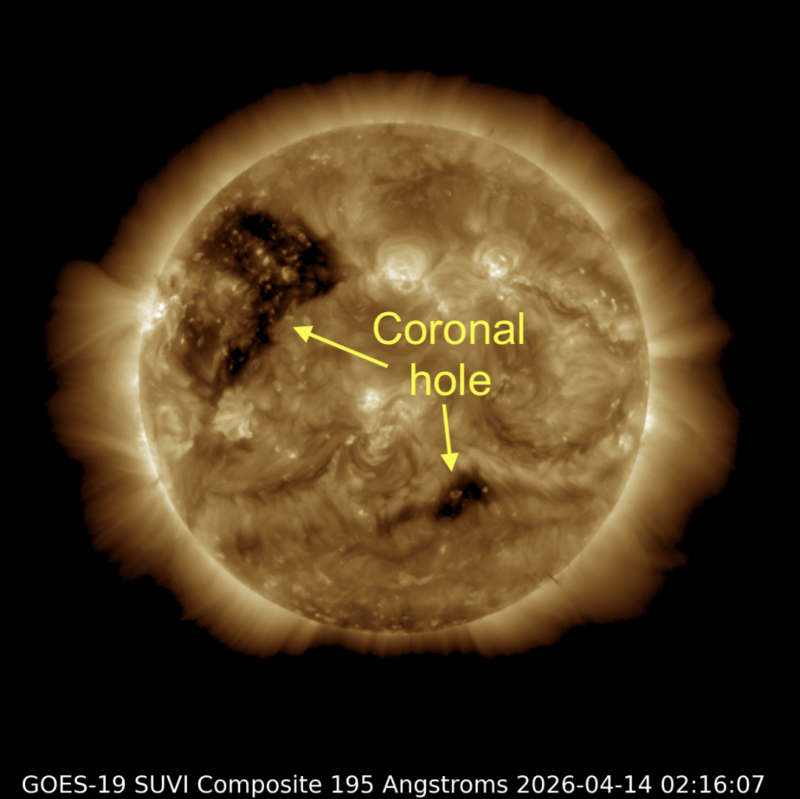 Sun news for April 14, 2026. This video from NOAA’s GOES-19 SUVI instrument reveals a huge coronal hole that has emerged from the east, covering nearly the entire northeast solar quadrant. Video via NOAA/GOES.
Sun news April 13: Sun quiets down as solar wind eases
Sun news for April 14, 2026. This video from NOAA’s GOES-19 SUVI instrument reveals a huge coronal hole that has emerged from the east, covering nearly the entire northeast solar quadrant. Video via NOAA/GOES.
Sun news April 13: Sun quiets down as solar wind eases
Over the past 24 hours, the sun took a breather. Specifically, flare production dropped to very low, with only B-class background flares recorded. Meanwhile, the strength of the solar wind reaching Earth’s magnetic field waned. However, a coronal hole crossing the center of the Earth-facing sun could deliver a fresh blast of fast solar wind our way by April 15, potentially lifting geomagnetic activity to active levels and giving high-latitude skywatchers the chance to spot auroras.
Past 24 hours of sun news (11 UTC April 12 – 11 UTC April 13)Flare activity: Solar activity stayed very low, with only B-class flares recorded. In total, the sun produced 12 B-class flares during the reporting window.
Strongest flare: B7.2 from AR4417 at 14:48 UTC on April 12. Lead flare producer: AR4417 topped the list, firing 5 of the 12 tracked flares. In addition, AR4416 contributed 3 flares, with the remaining 4 originating from unnumbered background regions. Notably, all flares during this period were sub-C-class, reflecting a notable quieting of the solar disk as AR4417 approached the west limb.Sunspot regions: Currently, the Earth-facing solar disk shows 3 numbered active regions, though activity stayed subdued across all of them. Notably, AR4417 (beta), the most prolific flare producer of recent days, is rotating near the western limb and nearing departure from the Earth-facing disk.
Blasts from the sun? Over the past 24 hours, forecasters detected three coronal mass ejections (CMEs) in coronagraph imagery. However, none should impact Earth.
Past 24 hours in space weatherSolar wind: Over the past 24 hours, solar wind speeds steadily declined, reflecting the waning influence of a coronal hole high-speed stream. Meanwhile, the interplanetary magnetic field (IMF) stayed weak. In addition, the Bz component fluctuated between north and south, too modest to drive significant geomagnetic activity. Overall, forecasters expect a gradual return toward background solar wind conditions over the next day or two.
Earth’s magnetic field: Throughout most of the period, Earth’s magnetic field stayed quiet, with Kp values ranging from 1 to 2. However, a single unsettled interval of Kp 3 occurred between 12:00–15:00 UTC on April 12.
 Sun news for April 12-13, 2026. The sun releases a constant stream of charged particles, called the solar wind. The solar wind originates in the outermost layer of the sun’s atmosphere, the corona, when plasma is heated to a point that the sun’s gravity can’t hold it down. The strength of the solar wind reaching Earth over the past day has eased, but a fresh burst of fast wind could arrive in a few days. Images via NASA SVS.
The sun in recent days
Sun news for April 12-13, 2026. The sun releases a constant stream of charged particles, called the solar wind. The solar wind originates in the outermost layer of the sun’s atmosphere, the corona, when plasma is heated to a point that the sun’s gravity can’t hold it down. The strength of the solar wind reaching Earth over the past day has eased, but a fresh burst of fast wind could arrive in a few days. Images via NASA SVS.
The sun in recent days
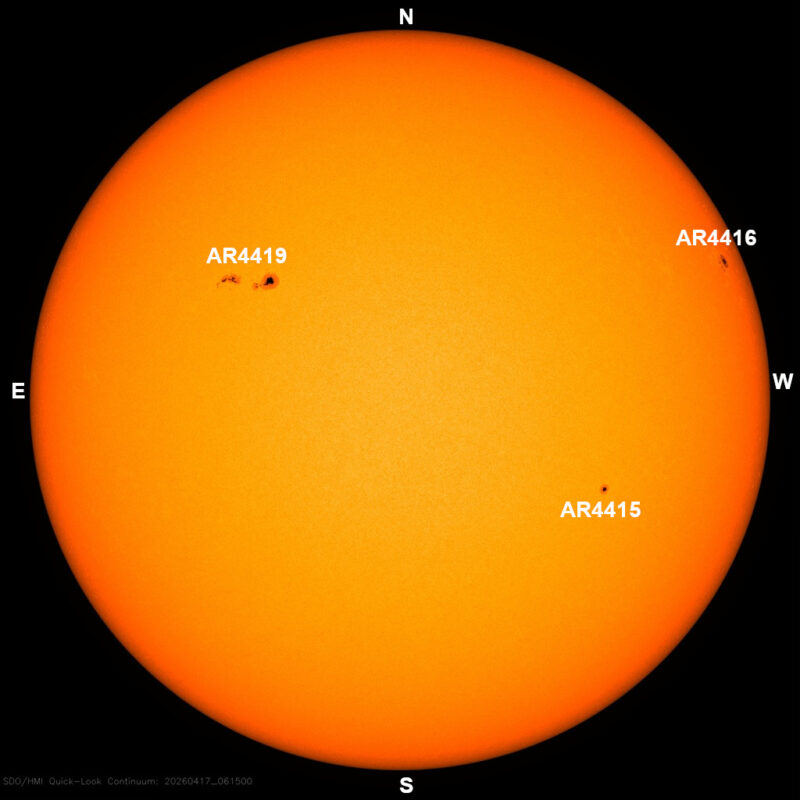 This image shows sun activity – with the most active regions labeled – as of 6 UTC on April 17, 2026. Image via NASA SDO.
[/caption]
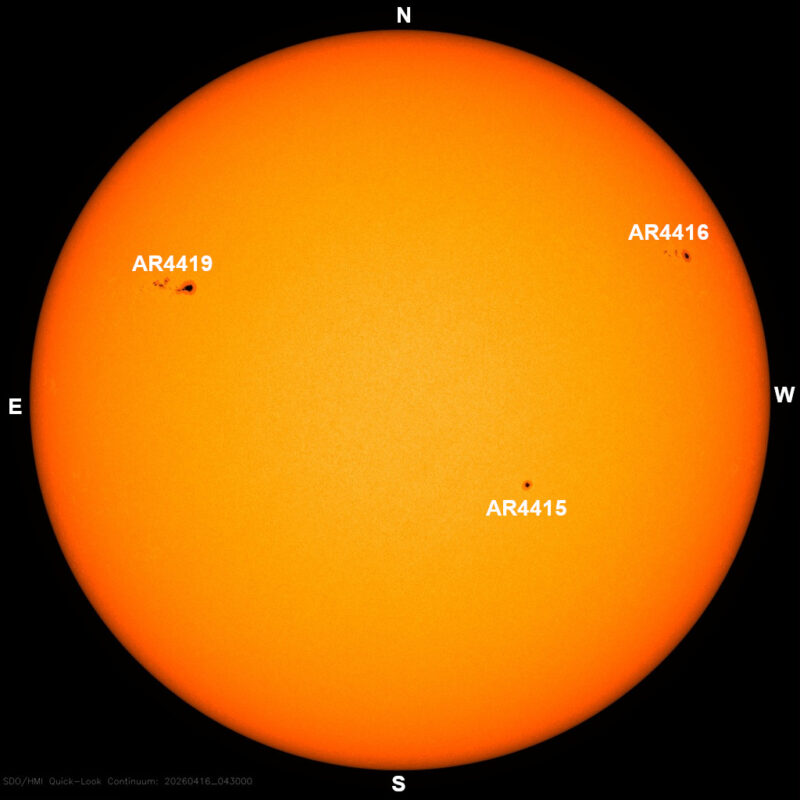 This image shows sun activity, with the most active regions labeled, as of 5 UTC on April 16, 2026. Image via NASA SDO.
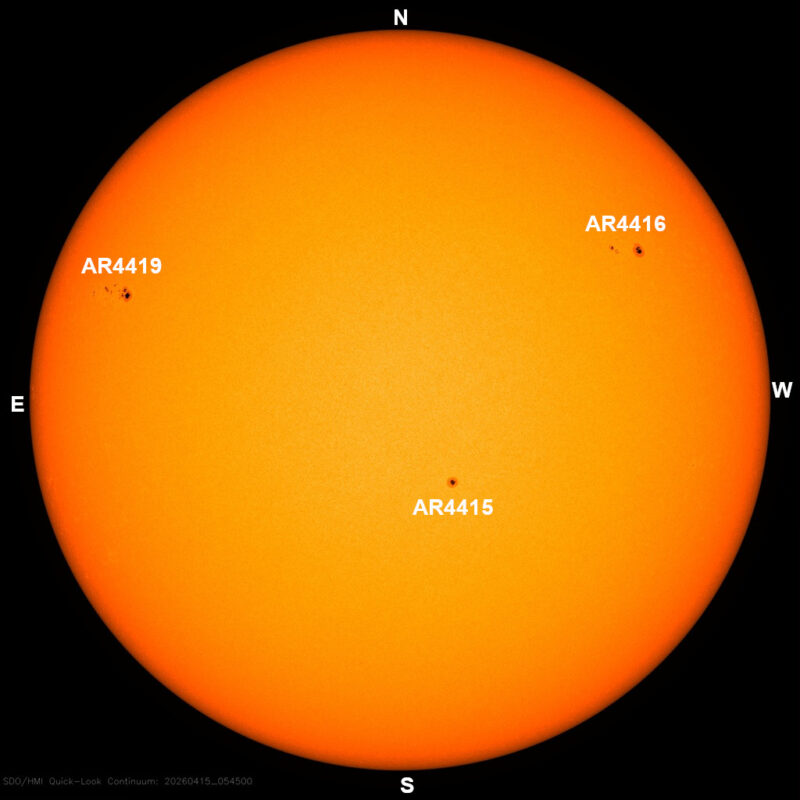 This image shows sun activity – with the most active regions labeled – as of 5 UTC on April 15, 2026. Image via NASA SDO.
Earlier sun images
This image shows sun activity – with the most active regions labeled – as of 5 UTC on April 15, 2026. Image via NASA SDO.
Earlier sun images
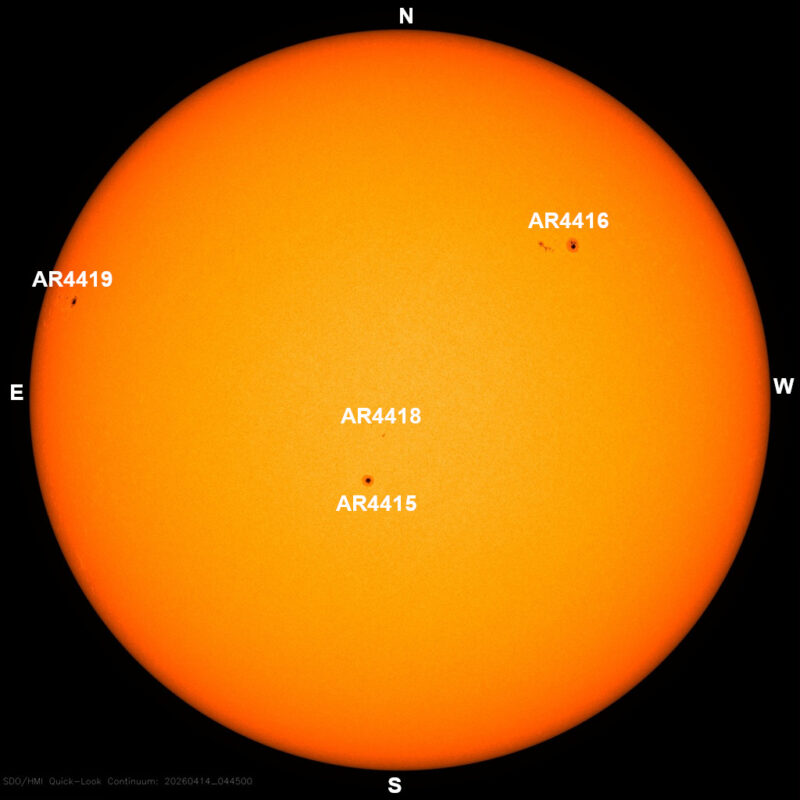 This image shows sun activity – with the most active regions labeled – as of 4 UTC on April 14, 2026. Image via NASA SDO.
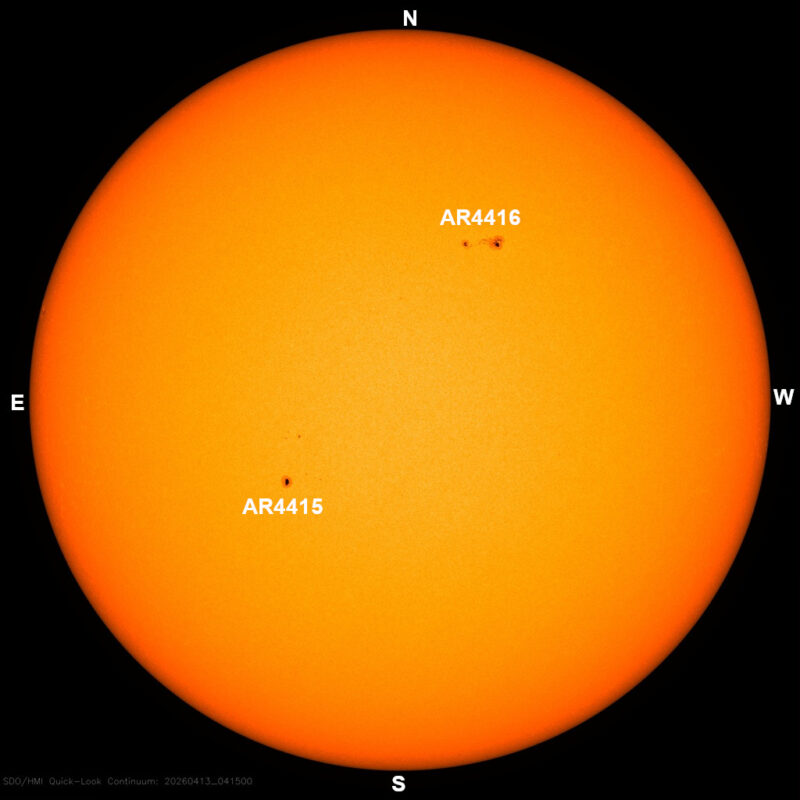 This image shows sun activity – with the most active regions labeled – as of 4 UTC on April 13, 2026. Image via NASA SDO.
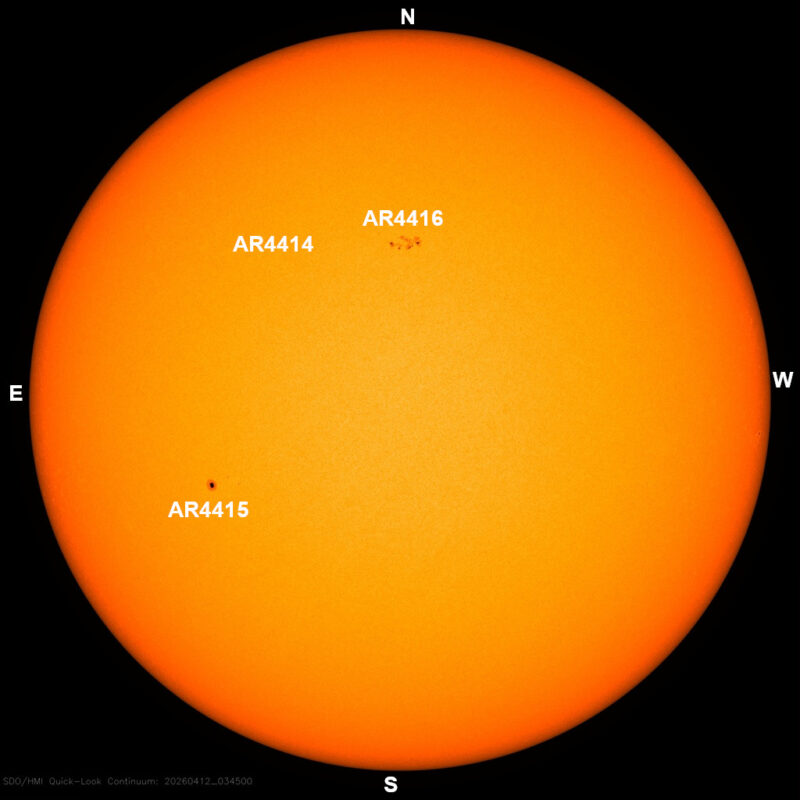 This image shows sun activity – with the most active regions labeled – as of 3 UTC on April 12, 2026. Image via NASA SDO.
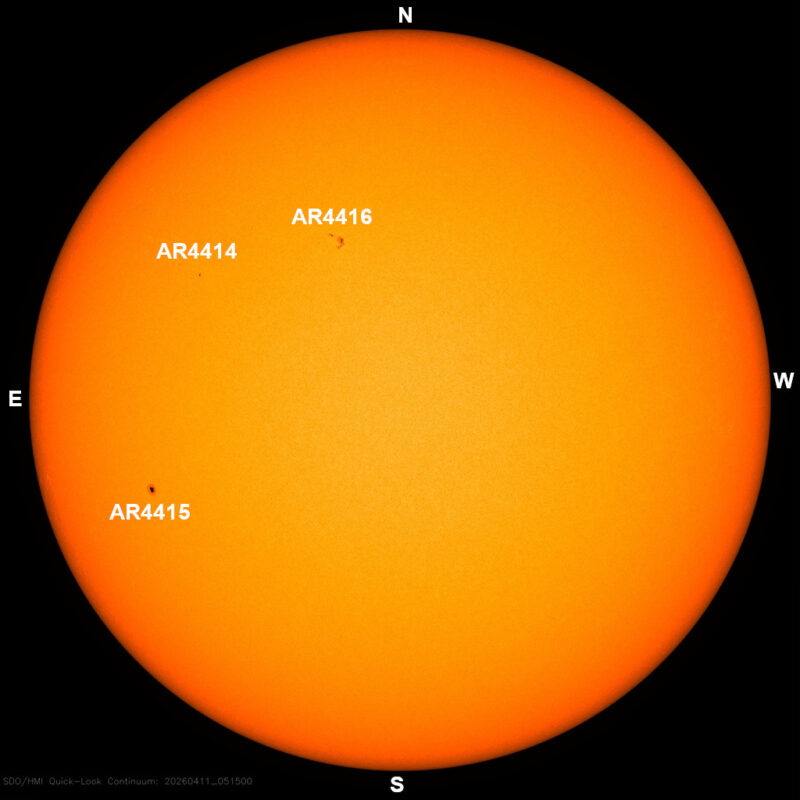 This image shows sun activity – with the most active regions labeled – as of 5 UTC on April 11, 2026. Image via NASA SDO.
Sun images from our community
This image shows sun activity – with the most active regions labeled – as of 5 UTC on April 11, 2026. Image via NASA SDO.
Sun images from our community
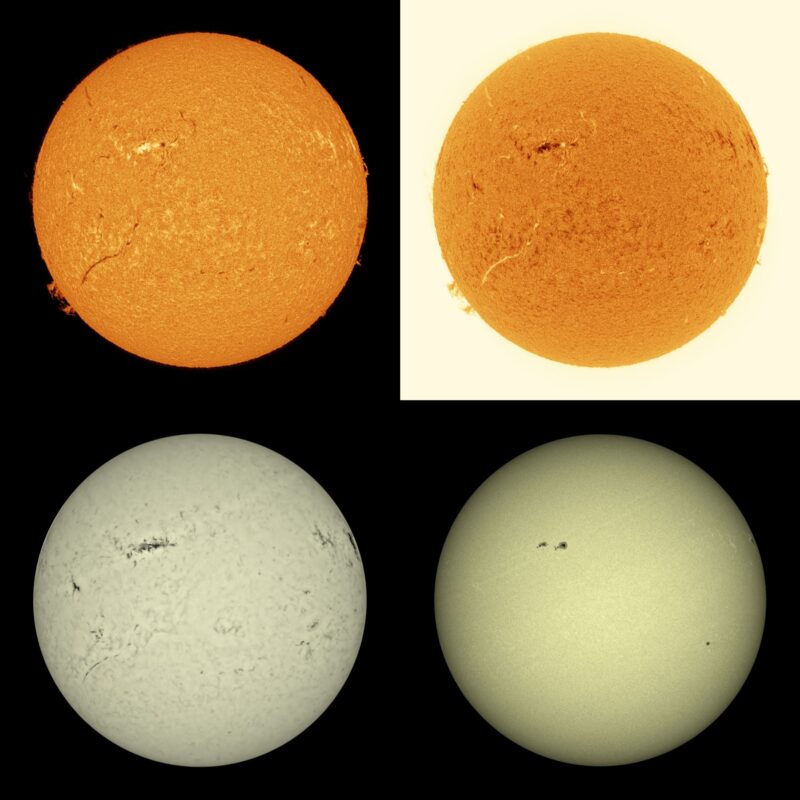 View at EarthSky Community Photos. | Mario Rana in Hampton, Virginia, captured these filtered images on April 17, 2026. Mario wrote: “The sun in hydrogen-alpha, helium D3, and iron.” Thank you, Mario!
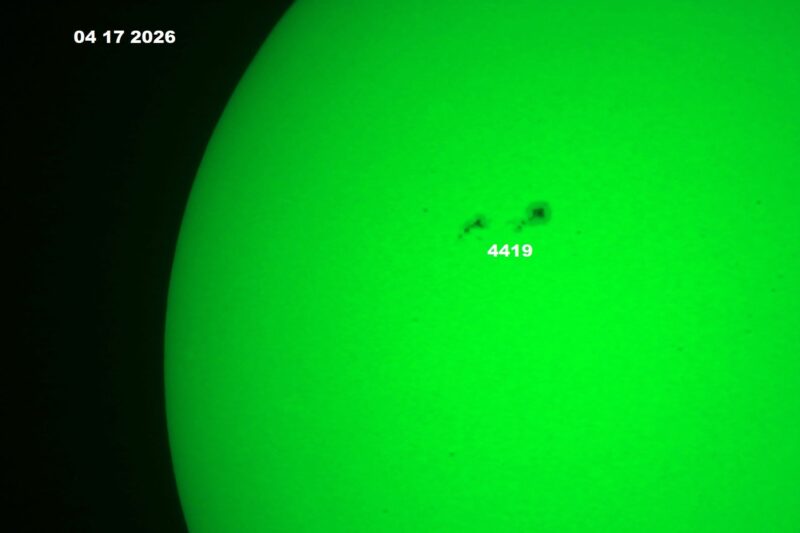 View at EarthSky Community Photos. | Victor Rogus in Sedona, Arizona, captured this filtered image on April 17, 2026. Victor wrote: “This morning through clear skies we see the largest sunspot on the solar disk. It is, AR4419. And we see that AR4419 has a ‘beta-gamma’ magnetic field that harbors energy for M-class solar flares.” Thank you, Victor!
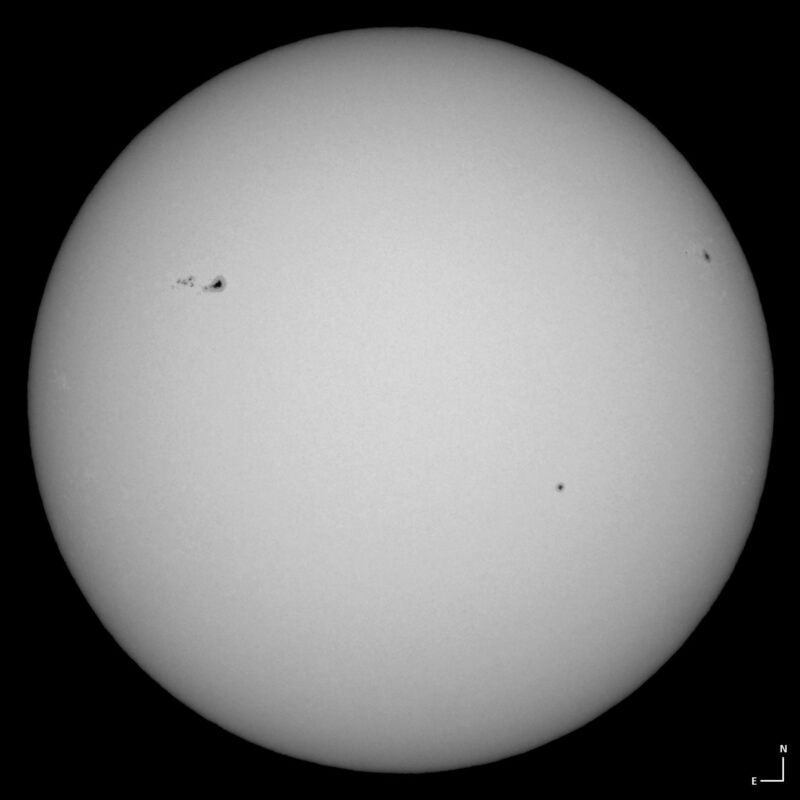 View at EarthSky Community Photos. | Patricio León in Santiago, Chile, captured this filtered image on April 16, 2026. Patricio wrote: “AR4419 has evolved to be the dominant spot of the solar face in terms of size, complexity and magnetic configuration. Nevertheless, parameters of solar and auroral activity stay firmly close to basement level.” Thank you, Patricio!
More sun images from our community
View at EarthSky Community Photos. | Patricio León in Santiago, Chile, captured this filtered image on April 16, 2026. Patricio wrote: “AR4419 has evolved to be the dominant spot of the solar face in terms of size, complexity and magnetic configuration. Nevertheless, parameters of solar and auroral activity stay firmly close to basement level.” Thank you, Patricio!
More sun images from our community
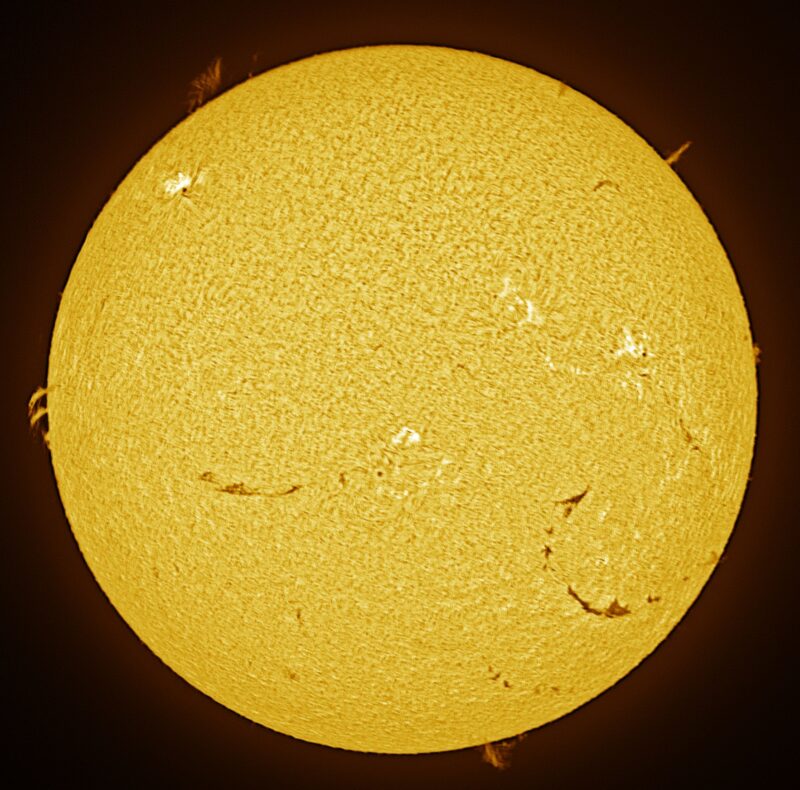 View at EarthSky Community Photos. | Jim Militello in Tucson, Arizona, captured this filtered image on April 14, 2026. Jim wrote: “Hydrogen-alpha image of the sun showing sunspots, active regions, filaments, and some nice prominences.” Thank you, Jim!
We sometimes feature sun images obtained using hydrogen-alpha filters. Read why.
Bottom line: Sun news for April 17, 2026: A huge coronal hole now faces Earth. CIR and fast solar wind may spark G1–G2 storms this weekend. Aurora chasers, stay alert!
Comments (0)