
Remember me
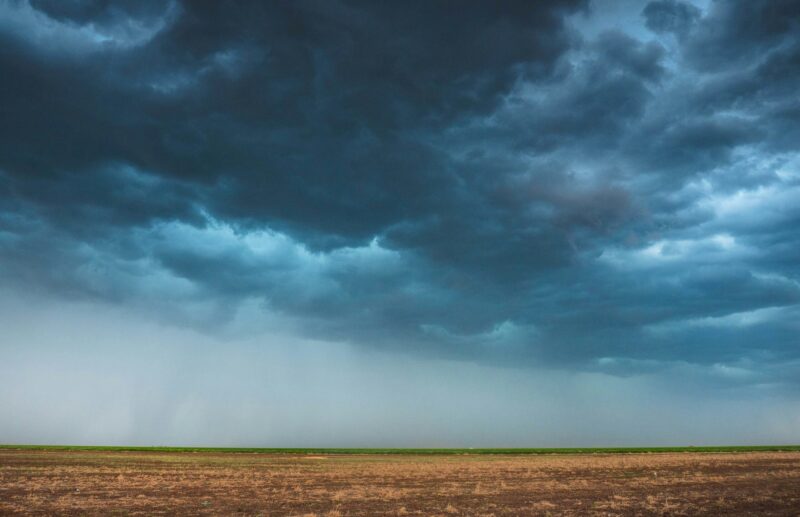






On Wednesday, April 15, 2026, a rare waterspout formed off the coast of Seattle in Puget Sound. The broad rotation from a storm in the area spawned the waterspout. Seattle also experienced pea-sized hail during this storm. Fortunately, the waterspout stayed offshore and never became a tornado.
What is a waterspout?A waterspout is just a tornado that forms over open water. A tornado over an ocean, lake – or even a river – is considered to be a waterspout. Waterspouts are typically weaker than most tornadoes. And they’re usually short-lived. But they can be destructive. Let’s look at some images and videos of waterspouts and learn more about how they form.
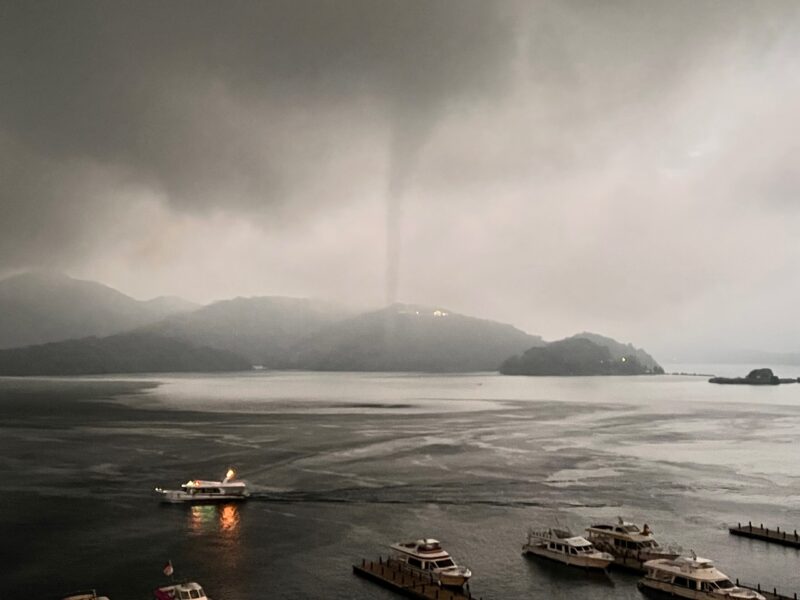
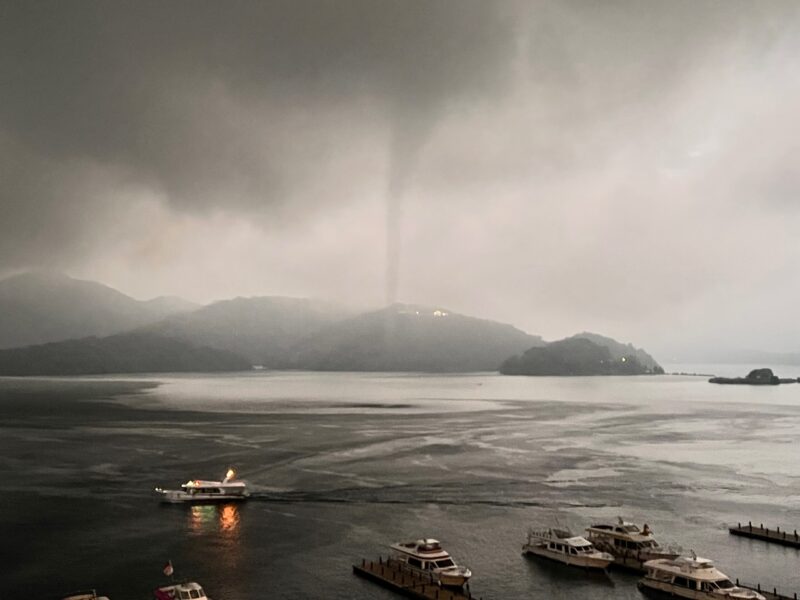 View at EarthSky Community Photos. | Bob Kuo captured this waterspout over Sun Moon Lake in Taiwan, from a hotel balcony, on November 16, 2023. Thank you, Bob! Read more about waterspouts below.
When and where do waterspouts form?
View at EarthSky Community Photos. | Bob Kuo captured this waterspout over Sun Moon Lake in Taiwan, from a hotel balcony, on November 16, 2023. Thank you, Bob! Read more about waterspouts below.
When and where do waterspouts form?
Waterspouts typically occur in tropical regions, but they can form almost anywhere. For example, waterspouts have occurred in the Great Lakes, off the western coast of Europe, in the Mediterranean Sea and in the Baltic Sea.
In the U.S., the most common place to see waterspouts is along the Florida Keys and in the Gulf of Mexico. Waterspouts most often happen in the late spring and summer months, generally forming after 2 p.m. in the afternoon. Florida is the most tornado-prone area in the United States, and many of those move on or off shore as waterspouts. It’s not unusual to see 400 to 500 waterspouts a year in this area, with many that go unreported. In rare instances, more than one waterspout can form from a storm offshore.
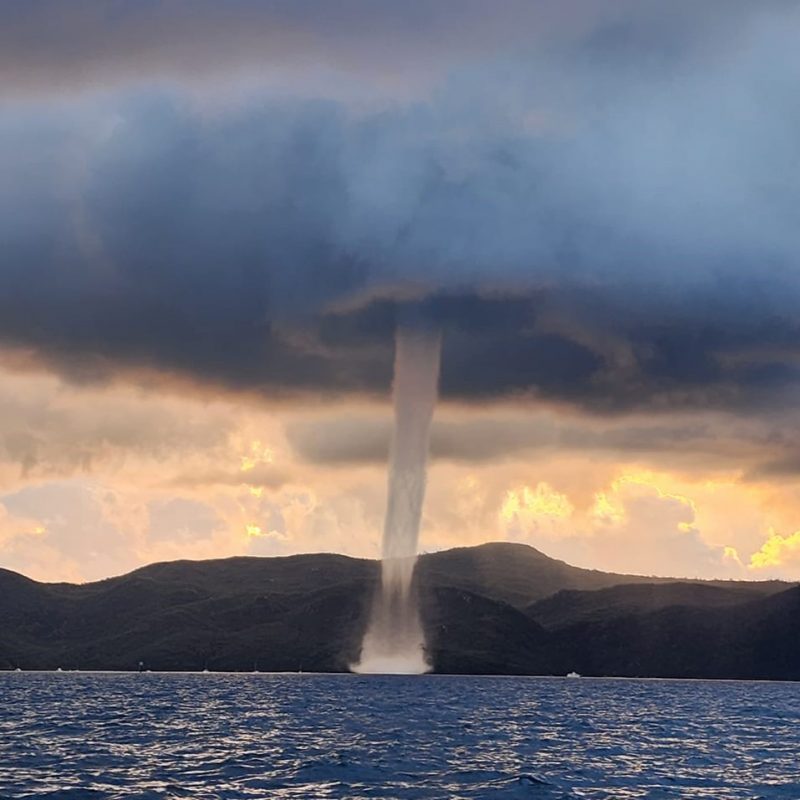 Catch My Drift Charters captured this image of a waterspout in the Whitsunday Islands of Australia on April 11, 2023. Used with permission.
Can a waterspout be destructive?
Catch My Drift Charters captured this image of a waterspout in the Whitsunday Islands of Australia on April 11, 2023. Used with permission.
Can a waterspout be destructive?
Waterspouts are typically weaker than tornadoes. But, as seen in the videos below, they can still cause a decent amount of damage. If you’re boating in the ocean, you’ll want to monitor the weather to avoid waterspouts. For instance, you might avoid being in the ocean around the Florida Keys in the afternoon or evening, when there’s a chance for thunderstorms at the coast. If you’re on a boat or ship and a waterspout develops, try to navigate around the area by going at right angles to its path. The National Oceanic and Atmospheric Administration (NOAA) recommends that those on boats or ships monitor special marine warnings issued by the National Weather Service.
And – of course – it’s highly recommended that you avoid navigating through a waterspout. They can cause damage and could hurt or kill you.
In fact, there are two types of waterspouts we commonly see: a fair-weather waterspout and a tornadic waterspout.
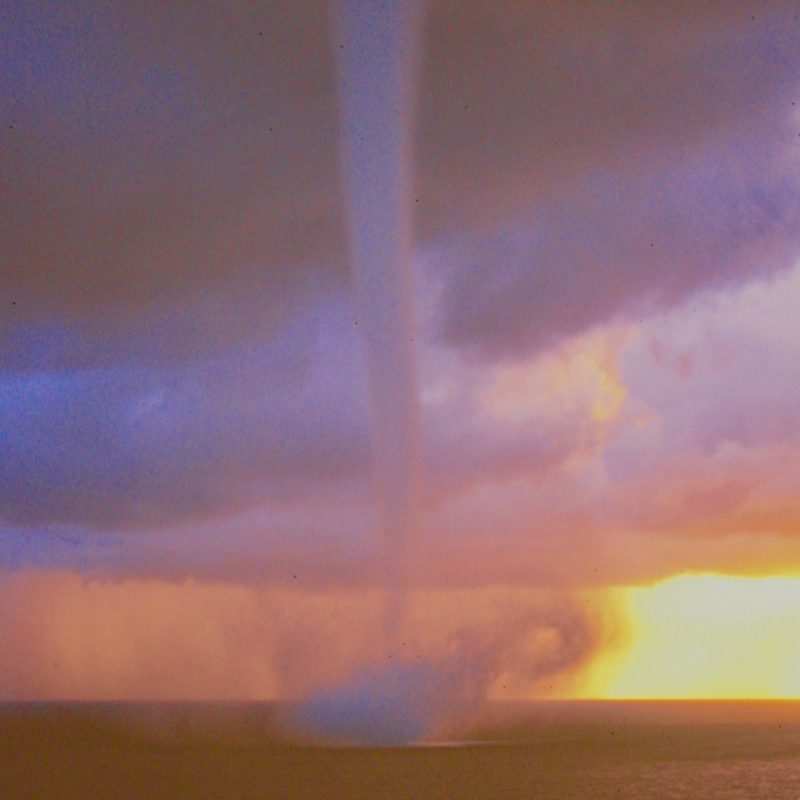 View at EarthSky Community Photos. | Mark Rutkowski said on July 3, 2020, that he caught this sunrise waterspout in the Atlantic Ocean near Miami. Thank you, Mark!
Fair-weather waterspouts
View at EarthSky Community Photos. | Mark Rutkowski said on July 3, 2020, that he caught this sunrise waterspout in the Atlantic Ocean near Miami. Thank you, Mark!
Fair-weather waterspouts
Fair-weather waterspouts form during relatively calm weather. They typically form along the dark, flat bases of a line of developing cumulus clouds. Air begins to circulate at the surface of the water and develops upward. Unlike tornadic waterspouts, which tend to happen in the afternoon, fair-weather waterspouts typically occur in the early to mid-morning hours, and sometimes in the early afternoon. Everyone associates tornadoes and waterspouts with thunderstorms, but when fair-weather waterspouts form, they typically occur during light wind conditions. Because of this, these waterspouts don’t move much.
There are five stages that occur for fair weather waterspouts. Here are the stages:
The formation of a disk on the surface of the water, known as a dark spot A spiral pattern on the water surface A formation of a spray ring When the waterspout becomes a visible funnel: the waterspout! The last and final stage of the life cycle is when the waterspout decays. When the waterspout decays, it likely does so because a cool rain falls near the spout. This cool air typically disrupts the supply of warm, humid air that allows the waterspout to keep going. Tornadic waterspoutsTornadic waterspouts are simply tornadoes that form over water or move from land to water. They typically occur with afternoon and evening thunderstorms. You need two main ingredients for tornadic waterspouts: warm, moist air and an unstable atmosphere. Trade winds from boundaries can also influence the formation of this kind of waterspout.
Unlike fair-weather waterspouts, tornadic waterspouts typically develop downward in a thunderstorm and begin to appear initially as funnel clouds. The storms that develop these waterspouts are usually non-supercell thunderstorms. According to NOAA, a supercell thunderstorm is defined as:
… a large severe storm occurring in a significant vertically sheared environment; contains quasi-steady, strongly rotating updraft (mesocyclone); usually moves to the right (perhaps left) of the mean wind; can evolve from a non-supercell storm; and contain moderate-to-strong vertical speed and directional wind shear in the 0-6 km [0-3.7 miles] layer.
Supercell thunderstorms are what produce large, violent tornadoes. In non-supercell thunderstorms – like those that produce waterspouts – tornadoes that form are due to a boundary layer. Spin ups that do occur in the storm are generally short-lived. Obviously, every waterspout is different and some could last longer than others.
Waterspout videosCheck out the amazing video below of a waterspout pushing ashore on Grand Isle, Louisiana, on May 8, 2012. There’s spectacular footage of multiple waterspouts and a tornado hitting the coast around four minutes into the video. Scary stuff! FYI: Do not try this at home! If you know a tornado is about to strike near you, go inside and take shelter. It’s not the tornado itself that will hurt or kill you. Instead, it’s the flying debris in the air that’s dangerous.
Bottom line: Waterspouts can be harmless as long as you understand and avoid them. If you live along the coast, you should treat all waterspouts as you would tornadoes on land. Waterspouts form off non-supercell thunderstorms and are often short-lived. Some waterspouts can reach the coastline and become tornadoes, so it is important for everyone to monitor the weather as it evolves.
Comments (0)