
Remember me


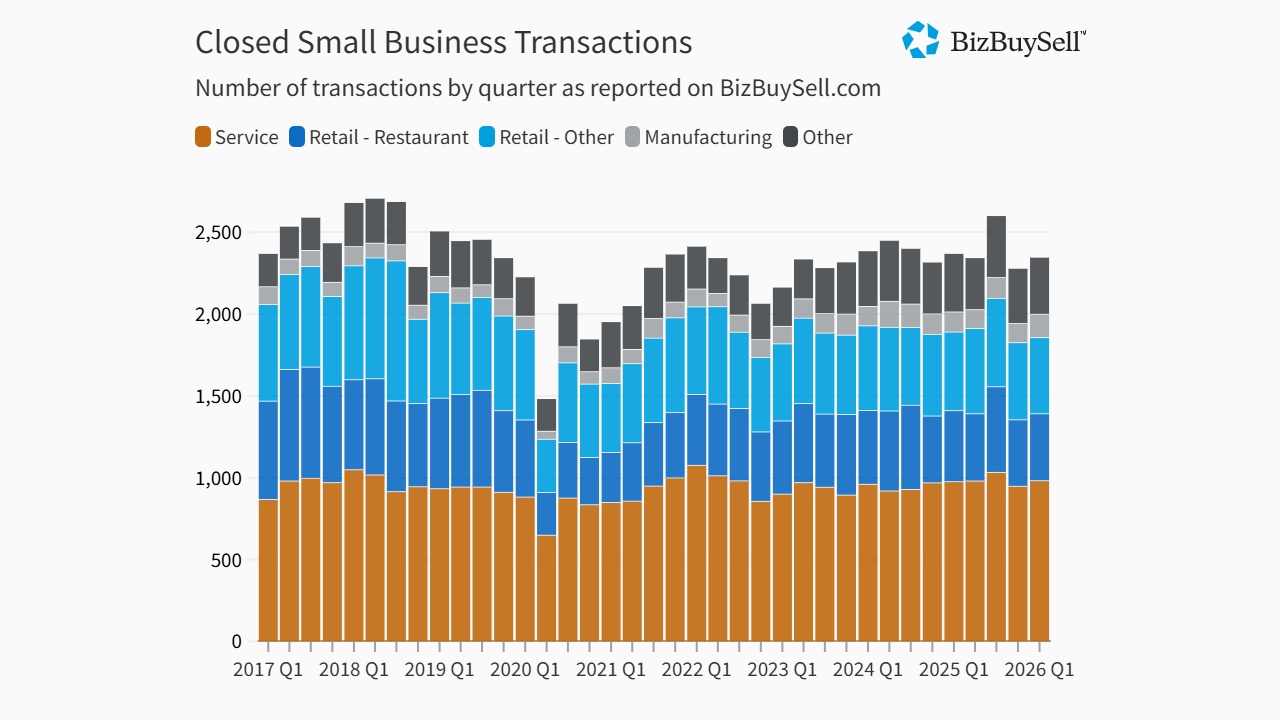








The market for buying and selling small businesses appears to be settling into a new rhythm in 2026, but stability has not made the process easier. If anything, competition for quality businesses has intensified, financing has grown more complicated, and buyers are becoming far more selective.
That is one of the clearest takeaways from BizBuySell’s latest Insight Report, which paints a picture of a business acquisition market where quality matters more than quantity. For small business owners thinking about eventually selling, acquiring a competitor, or simply understanding how their company may be valued in today’s environment, the report offers signals worth watching.
Small Business Deals Hold Steady, But Buyers Want Stronger CompaniesIn the first quarter of 2026, 2,345 businesses changed hands with a combined enterprise value of $2 billion. Transaction volume slipped 1% year over year, though it rose 3% from the previous quarter, helped in part by deals delayed during the federal government shutdown that closed in early 2026.
What stands out is not a booming surge in deal count, but where buyers are placing their money.
Strong businesses with reliable cash flow, resilient margins, and scalable models are commanding attention and premium valuations. Meanwhile, companies with flat or declining performance face heavier scrutiny, longer sales cycles, and more negotiation pressure.
“It is a bifurcated market. Strong, cash-flowing businesses are in high demand, and the current environment clearly favors sellers. At the same time, businesses with flat or declining performance tend to face more scrutiny and longer timelines, creating a more favorable environment for buyers in those situations,” said Jason Ward of TruView Business Advisors in Texas.
For small business owners, that split carries major implications. Buyers may still be active, but they are no longer paying broadly rising prices across the board. They are rewarding performance.
Median sale price held flat at $350,000 compared with a year ago, but fundamentals improved beneath the surface. Median cash flow climbed 3% to $165,256. Median revenue rose 2% to $713,404. Average cash flow multiples also edged higher to 2.7x.

That suggests buyers are still willing to pay up—but primarily for businesses they see as low-risk, efficient, and positioned for growth.
“There are more buyers looking for quality deals and doing more research and asking tougher questions before submitting an offer. I see less demand for businesses valued at less than $1 million,” said Justin W. Sandridge of Murphy Business Sales – Charlotte.
 Financing Changes Add Friction to Business Sales
That tougher diligence process may feel familiar to many owners, even outside M&A. Investors, lenders, customers, and even vendors have become more demanding in an uncertain economy. The same caution is now showing up in business sales.
For owners preparing an exit, this could mean focusing less on revenue growth alone and more on improving transferable value—clean books, recurring revenue, documented systems, strong margins, and defensible market positions.
Those fundamentals may matter even more as financing grows harder to secure.
New SBA Rules Are Reshaping Deal StructuresOne of the report’s more significant themes centers on stricter Small Business Administration 7(a) lending standards, which are reshaping transactions. Nearly half of brokers surveyed said lending conditions are making deals harder to complete.
“The 5% seller down payment maximum, with full stand-by, is causing buyers to reconsider financing options and become a bit more cautious,” said Michael Finley of Infinity Business Brokers in Florida. “It is also making sellers nervous about offering 5%.”
That matters because many acquisitions at the lower middle-market level rely heavily on SBA-backed financing. When lending tightens, deal structures often have to evolve.
Seller financing, for example, is becoming increasingly important.
Sixty-one percent of buyers surveyed hope seller financing will be included in deals, not simply as a convenience but often as a practical necessity.
“Seller financing shows belief in the business,” said Patrick Murray, a buyer planning to purchase in Oklahoma.
For sellers, that may require a mindset shift. Financing support is increasingly becoming part of how deals get done, not just a negotiating concession.
Another lending change could also affect who can buy businesses. Since March, updated citizenship requirements for SBA 7(a) and 504 loans have narrowed access for green card holders and foreign nationals.
“The SBA new rules not to loan to green card holders limited the number of buyers,” said Wen Karkhanis, Los Angeles-based business broker at BTI.
For owners hoping to maximize exit options, a smaller buyer pool could affect timelines or deal structures, especially in markets where international buyers were previously active.
Corporate Refugees and Private Equity Enter the MarketYet even as traditional financing tightens, the buyer pool itself is evolving.
The report notes rising participation from private equity firms, former corporate professionals, and what some brokers call “corporate refugees”—buyers leaving or pushed out of traditional employment and seeking ownership.
Nearly half of buyers surveyed identified as corporate refugees, up from 44% in the previous quarter.
“More buyers are coming from corporate backgrounds, often driven by burnout or job concerns, and they’re focused on stable, cash flow businesses,” Ward said.
That trend could be especially relevant for service businesses, which appear to be attracting intense demand.
Service Businesses Remain Especially AttractiveService businesses represented 42% of all transactions in the quarter. While deal volume grew only modestly, valuations and financial performance rose much more sharply.
Median service business sale prices jumped 13% to $350,000. Cash flow rose 7%. Revenue climbed 8%.
Much of that demand is centered on businesses with recurring revenue and resilience.
“We’re seeing the strongest buyer demand in service-based businesses and technology-driven platforms, particularly those with recurring revenue and strong cash flow,” said Carson Bomar of Exit Game Plan. “Buyers are prioritizing businesses with predictable income, lower exposure to tariffs, and the ability to adjust pricing to offset inflation. In addition, niche B2B services, especially in areas like healthcare support services and specialized SaaS, are attracting significant attention from both strategic buyers and private equity groups.”
That could offer encouragement to many small business owners operating in home services, business services, health support, and software-enabled niches.
AI Is Becoming Part of the Business Valuation ConversationThose sectors may be benefiting from another growing factor in valuations: AI readiness.
Artificial intelligence emerged as a notable theme in the report, not simply as an operational tool but increasingly as a factor in how businesses are evaluated.
Sixty-three percent of small business owners surveyed say they actively use AI. Among adopters, 83% say it has improved performance.
Most cite productivity, automation, and cost reduction as major drivers.
For owners preparing for eventual sale, that matters.
Technology adoption—once a secondary consideration—may increasingly influence perceived scalability and efficiency.
Buyers appear to be paying attention.
“We’re seeing a meaningful uptick in inquiries from corporate professionals who’ve been laid off and are exploring business ownership,” said Caleb Seegers of Exceptional Business Advisors. “Buyers are also actively thinking about how AI tools can reduce operating costs post acquisition, and it’s changing how they evaluate deals and project proformas.”
For smaller businesses, this could mean investments in automation, AI-enabled workflows, and operational efficiency may contribute not only to current profitability but future exit value.
And AI isn’t only influencing acquisitions from the seller side.
Concerns about job displacement are reportedly pushing some professionals toward business ownership. Thirty-seven percent of buyers cited AI replacing jobs as a motivator.
That may add more demand pressure for acquisition targets seen as durable, cash-generating businesses.
Inflation, Energy Costs and Global Uncertainty Weigh on OwnersStill, the market is hardly operating in a vacuum.
Geopolitical uncertainty and inflation continue weighing on small businesses and transactions alike.
More than 70% of surveyed owners reported effects tied to the U.S.-Iran conflict, particularly through fuel and supply costs.
“Fuel and energy costs keep climbing, but customers aren’t spending more,” said David McDougall, owner of Countertop World in Arkansas.
Many owners report squeezed margins but limited pricing power.
“We raised prices slightly, but we’re careful – being affordable is part of who we are,” said Arthur Littlefield, owner of White Oak Boutique in Colorado.
“Any cost increase gets passed on to the customer. There’s no fat left,” added Joe Prescia, owner of American Joe Handyman in Colorado.
Those pressures are influencing buyer behavior too.
“There is some reluctance to buy due to the war and tariffs,” said one business broker. “However, sellers are also more open to selling due to the same issues, and they have more reasonable expectations around value.”
That dynamic may create opportunities for acquisition-minded entrepreneurs, especially those with capital and patience.
Manufacturing, Retail and Restaurants Show Sector-Specific Strength
Certain sectors also appear showing resilience despite broader uncertainty.
Manufacturing Deals ReboundManufacturing transactions rose 16% year over year, though much of that growth occurred in smaller deals. Quarter-over-quarter figures pointed to stronger momentum, with sale prices and financial performance rebounding sharply.
“We see dramatic growth in buyer responses to manufacturing listings. SBA lenders are also giving better terms and quick approvals on deals in manufacturing and technology,” said Karkhanis.
Retail Buyers Focus on ProfitabilityRetail also showed surprising strength.
Even with acquisition volume down slightly, median sale prices rose 9%, and cash flow improved 6%. Buyers appear rewarding profitability over raw sales volume.
Restaurants With Strong Cash Flow Still Draw BuyersRestaurants presented a similar pattern.
Though transaction volume dipped 6%, businesses that sold fetched higher prices and stronger multiples, suggesting fewer but better-quality offerings reaching market.
For independent operators in these industries, that may be a reminder that well-run businesses continue attracting demand, even in sectors often viewed as challenged.
What Small Business Owners Should Take From the ReportOne broader lesson emerging from the report is that operational discipline increasingly drives valuation.
That has practical implications even for owners not considering a sale.
Improving margins. Documenting processes. Reducing owner dependence. Adding recurring revenue. Using AI or automation to boost efficiency. Strengthening pricing discipline.These are not just “exit prep” exercises anymore. They are increasingly core competitive advantages.
The report also highlights how sophisticated competition for acquisitions has become.
Private equity activity remains active.
“We’re seeing a significant increase in private equity activity, particularly in service-based and recurring revenue businesses. PE groups remain active, but they are being more selective and disciplined in underwriting compared to prior years. There is a continued focus on platform opportunities and add-on acquisitions, with an emphasis on businesses that demonstrate stable cash flow, strong margins, and scalability,” Bomar said.
That may raise the bar for smaller strategic buyers competing for attractive businesses.
But it could also increase opportunities for sellers positioned well.
Outlook for the Rest of 2026According to the report, nearly two-thirds of brokers expect deal volume to rise over the next six months.
“The market is currently characterized by strong buyer demand and limited supply, particularly for high-quality, cash flowing businesses,” said Jason Ward of TruView Business Advisors. “Well performing companies can command premium valuations, while inconsistent businesses face much more scrutiny.”
That “limited supply” factor may be especially important.
High-quality businesses remain scarce.
When demand chases scarce assets, valuations can stay supported even amid uncertainty.
Still, brokers repeatedly stress preparation.
Deals are taking longer.
Financing delays remain common.
Due diligence is tougher.
“We’re seeing solid buyer demand and a healthy pipeline of sellers, but banks have tightened lending and are taking longer, which adds friction to deals,” said Seegers.
Similarly, Shep Campbell of M&A Specialists noted, “Buyer interest and inquiry volume stayed strong, but longer diligence timelines and financing delays offset what could have been a much stronger quarter.”
That may push both buyers and sellers to prepare earlier than in prior cycles.
For would-be buyers, that could mean lining up lenders early, understanding industry eligibility rules, and building realistic deal structures.
For sellers, it may mean getting financials ready long before listing a business.
“The market is balanced. Buyers are disciplined, and sellers who are properly advised and positioned are still achieving strong outcomes,” said Bomar. “The key is aligning expectations with market realities early in the process.”
Quality Is Driving the Small Business Acquisition MarketPerhaps the clearest message from the quarter is that small business acquisitions have become less about chasing deals and more about chasing quality.
That shift may benefit disciplined operators.
Owners who build durable, profitable companies may find stronger buyer interest.
Buyers who understand value—not just price—may still uncover opportunities.
And entrepreneurs considering acquisition as a growth strategy may find this environment rewards preparation more than speed.
As Vipin Singh of Murphy Business Sales – Edison, NJ observed, “The small business M&A market has entered a high confidence phase. Buyers and sellers are no longer waiting for perfect conditions – they’re moving forward based on a stabilized backdrop and clearer expectations.”
For small business owners, whether they plan to buy, build, or eventually sell, that may be the bigger takeaway.
Markets may remain volatile. Financing may stay tight. Competition may intensify.
But businesses with strong fundamentals still appear commanding attention.
More detailed data and sector breakdowns from the report are available through the original BizBuySell Insight Report.
And for owners wondering how today’s buyers might view their own businesses, that may be one of the more practical places to start.
Images via BizBuySell
Comments (0)