
Remember me




On Taylor Sheridan‘s recent series “The Madison,” Kurt Russell exudes such an effortless ease as a big-city millionaire more comfortable fishing in Montana than making deals in New York that one might think the actor is essentially playing himself. It’s a logical assumption, until one remembers that Russell has brought a similar sense of relaxed naturalism to dozens of performances over 64 years on screen, playing characters as varied as the romantic lead in “Overboard,” the homicidal stunt man in Quentin Tarantino‘s “Death Proof,” the firefighter uncovering a conspiracy in “Backdraft,” and even Santa Claus in the “Christmas Chronicles” movies, just to name a few.


Obviously, these characters can’t all be Russell — especially when you factor in antiheroes like Snake Plissken and the good-natured con man of Robert Zemeckis’ “Used Cars” — so the fact that you can never catch him acting is exactly what makes him one of the best actors we have. That seeming “effortlessness” is also why he’s perennially underrated; he’s never been nominated for an Oscar and was only nominated once for an Emmy (for John Carpenter’s 1979 TV movie “Elvis”), and he’s so consistent and prolific that it’s easy to take him for granted — we don’t have to savor individual Kurt Russell performances because there’s usually another great one right around the corner.
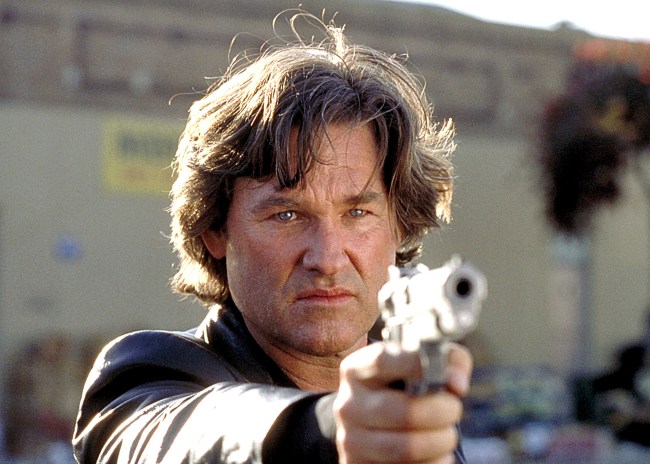
Russell’s work as corrupt LAPD detective Eldon Perry in Ron Shelton‘s 2003 cop drama “Dark Blue” is a case in point, an all-time great performance that is highly specific yet archetypal in the way that William Holden’s performance in “The Wild Bunch” or Ralph Fiennes’ work in “Schindler’s List” is; Russell is playing a character, but he’s also — without forcing it — representing an era and its contradictions. Set against the backdrop of the Rodney King verdict that set literal and psychic fire to Los Angeles, “Dark Blue” is both a time capsule capturing the tenor of racial tensions in its era and a classic morality play exploring the cost of corruption for both victim and oppressor — all of which is embodied in Russell’s fierce, funny, tragic performance.
“Dark Blue” began as an over 100-page treatment by crime novelist James Ellroy called “The Plague Season,” which “Training Day” scribe David Ayer turned into a manageable screenplay, and Shelton honed it into a Peckinpah-esque examination of bad men doing bad things with occasional glimmers of redemption and heroism (usually made possible only by pitting them against even worse men doing worse things). Russell swaggers through the movie with all the cocky assurance of Charlton Heston in Peckinpah’s “Major Dundee,” but with an infectious sense of humor thrown into the mix. The worse Perry behaves, the more he seems to enjoy it — at least until the realization hits him that he has sold his soul and probably can’t get it back.
“Dark Blue” begins as a kind of buddy cop movie following Perry and his younger partner Bobby Keough (Scott Speedman) as they work a robbery-homicide case while the jury in the Rodney King trial deliberates. (The movie was released in 2003, but set 11 years earlier.) Right from the beginning, though, it’s clear we’re a long way from the easily digestible pleasures of “Lethal Weapon” or “Rush Hour” — the casual racism that Perry espouses, combined with the even more casual way in which his corrupt supervisor Jack Van Meter (Brendan Gleeson) manipulates the system, links the cops to something pervasive and unpleasant in 1990s LAPD culture that had been institutionalized by legendary police chief William Parker 30 years earlier.
Shelton, a dramatist who avoids neat simplifications or preachy moralizing, doesn’t explicitly draw a line between Perry and Van Meter’s modus operandi and the uprising that follows the King verdict, but the connection is implicit — when the city burns in the movie’s final act, guys like Eldon Perry are why. What’s interesting about Shelton’s structure is that he reveals fairly early on who the bad guy in the story’s mystery is, allowing “Dark Blue” to become less about plot than about behavior, and allowing Russell to sink his teeth into the greatest part he ever had as a man battling his darkest demons and losing, while the rest of the world — from those closest to him, like his wife (Lolita Davidovich), to the entire city he polices — also pays for his sins and mistakes.
 ‘Dark Blue’©United Artists/Courtesy Everett Collection
After an entertaining turn in the Shelton-scripted sports comedy “The Best of Times” in 1986, Russell had hoped to work with Shelton on the director’s 1988 directorial debut, “Bull Durham,” but the juicy part of minor league catcher Crash Davis went to Kevin Costner instead. It took another 15 years for Russell and Shelton to work together, but it was worth the wait — no director ever made better use of all the actor’s known strengths while also finding new ones. Arrogant, bigoted, and willing to break the law he’s been sworn to uphold on a daily basis, Eldon Perry is, on paper, fairly unlikable; by casting the naturally congenial Russell, Shelton both challenges the audience to find the humanity in the character and finds an external way of conveying Perry’s internal self-justifications and rationalizations.
Like most effective villains, Perry thinks he’s a good guy — he sees himself as an old Western antihero like John Wayne’s Ethan Edwards in “The Searchers,” a gunfighter who does the ugly things necessary to keep society clean. Russell’s inherent charm seduces the audience (we tend to attach to him as an identification figure, no matter what he does, thanks to his star power), but it also shows how this guy sees himself, and explains why he’s been able to get away with heinous crimes for decades. Yet Russell’s likability also throws the character’s crimes into relief, making their horrors and ramifications more striking and unsettling by their contrast with his superficial amiability.
Russell’s best and most enduring performances outside of “Dark Blue” are primarily the ones he gave in his collaborations with John Carpenter, and in most of those (“Elvis,” “Escape From New York,” “The Thing”) he suppresses that natural affability. Only “Big Trouble in Little China” takes advantage of his charming side, and in that case, it’s at the expense of something else — his innate intelligence, which is set aside so that Russell can play one of the all-time great doofuses in American film.
Interestingly, the closest Russell ever came to the emotional notes he plays so well in “Dark Blue” was in Robert Zemeckis and Bob Gale’s “Used Cars,” another film that fully exploits Russell’s all-American good cheer to reveal dark undercurrents underneath. Since that movie is a satire and not a tragedy, however, it only goes so far — Shelton pushes Russell’s persona beyond the good-natured cynicism of “Used Cars” to the limits of what the audience will accept from a movie star.
Russell’s work here makes an interesting point of comparison with Denzel Washington’s performance in the Ayer-scripted “Training Day”; the fact that Washington’s Alonzo Harris is more overtly, flamboyantly evil feels less risky and audacious than what Russell is up to, because it’s easier for the audience to both revel in his excess and keep him at a distance; Perry and “Dark Blue” are less melodramatic than Alonzo and “Training Day,” which probably made Shelton’s film less commercial but also makes it more difficult to shake off.
 Kurt Russell and Ron Shelton on the set of ‘Dark Blue’©United Artists/Courtesy Everett Collection
Russell’s performance gains even more power from all the other great performances that surround it; one of many things Shelton has in common with Peckinpah, as well as Preston Sturges, is a gift for populating his movies with vivid supporting players down to the day players. As both a writer and director, he knows how to suggest entire relationships, inner lives, and histories in just a couple of scenes, as he does here in the relationship between Perry and his wife.
Lolita Davidovich only has two scenes with Russell (aside from the climactic finale, in which they don’t interact aside from a few shared glances), but in those two scenes, we get an entire portrait of a failed marriage. There’s a remarkable economy to Russell and Davidovich’s performances, as they show how a marriage can sometimes move from affection to hostility in just one sentence; the domestic scenes also convey Perry’s cluelessness and self-absorption from perspectives beyond what the cop story allows, laying the groundwork for the film’s final reveal of Perry as a tragic figure with shades of another Shelton protagonist, Tommy Lee Jones’ Ty Cobb.
“Cobb” was the first time Shelton worked with the widescreen 2.35:1 aspect ratio, and he must have liked what he saw because he used it again on all of his subsequent features. In “Dark Blue,” Shelton uses the wider frame to both contextualize Russell as part of a corrupt brotherhood — as in his elegantly composed early scenes between Russell and other LAPD officials and functionaries — and isolate him from the community as his world begins disintegrating around him. The tensions and contradictions in Russell’s character and performances are echoed in Barry Peterson’s cinematography, which somehow makes Perry’s burning Los Angeles beautiful without glamorizing it; the locations are run down, the situations menacing, and the behavior disgraceful, but it’s all lit atmospherically in the classic noir tradition.
Peterson’s work is on full display in a new physical media edition of “Dark Blue” from the Australian label Imprint. Their limited edition boxed set contains 4K UHD and Blu-ray editions of the film, showcasing a new restoration derived from the original 35mm negative, along with new interviews with Shelton, Davidovich, and other key personnel as well as various archival extras and a new audio commentary by film noir scholars Alain Silver and James Ursini. Silver and Ursini seem to understand the historical context in which this film was operating, capturing the malaise of its era just as the post-WWI noir films captured the zeitgeist of theirs. It’s something that was lost on contemporary viewers when “Dark Blue” came and went from theaters, but the greatness of “Dark Blue” and its central performance feel more self-evident than ever on this new disc.
The limited edition ‘Dark Blue’ 4K UHD and Blu-ray boxed set will be released by Imprint on April 29.