
Remember me







The second season of “Beef” takes place in a more polished, curated environment than the road-rage incident that sets off Season 1. But fights are just as integral to the Netflix show created by Lee Sung Jin, and the series’ sound team needed to do even more meticulous work building visceral senses of anger, stress, and dread that slowly swallow up the characters and steer them into making a compounding set of poor decisions. Boiling-over tension is a lot harder to do when you can’t rely on screaming car horns.
The first fight between on-the-rocks elder millennials Josh (Oscar Isaac) and Lindsay (Carey Mulligan), witnessed by the young betrotheds Austin (Charles Melton) and Ashley (Cailee Spaeny), creates the toxic connection between the couples and sets off everything else that happens on the show. So crafting the sound of it — replayed on an iPhone multiple times later in the series — required a blend of what Isaac and Mulligan shot on the day. It also required sound effects work for the offscreen action of Josh and Lindsay throwing things around their perpetually half-finished B&B, and ADR work from Isaac and Mulligan later.


“It was this very intricate dance of where to enhance it and where to feather things in. Maybe we need a little bit more intensity here when Ashley and Austin are first approaching. Maybe we need crashes and shouting in between Ashley and Austin having this conversation,” supervising sound editor Christopher Gomez told IndieWire. “It was a meticulous process of going through all those beats with Sunny [Lee’s nickname] to figure out where we are going to hear their voices.”
 ‘Beef‘ COURTESY OF NETFLIX
“We want to ease into this fight,” re-recording mixer Penny Harold agreed. “There’s this really cool shot within the fight that’s a dolly shot that hands off to a handheld [camera], and sonically we wanted to do something there — we hear the kids approaching and then it’s an explosion of the actual argument when the camera moves, so we feel that handoff as well. We worked with Sunny for a long time to get that moment right.”
Some of the finesse behind the sound design, just by the very nature of streaming, was about finding the right level of emphasis that would work in multiple listening environments. “People have their washing machines and dishwashers going in the background, so you don’t want things to be distracting,” re-recording mixer Andrew Lange said. “If we want something subtle, we have to dial it in. But then we’ll always check on different speakers just to make sure — is this going to be lost once it’s playing in people’s living rooms?”
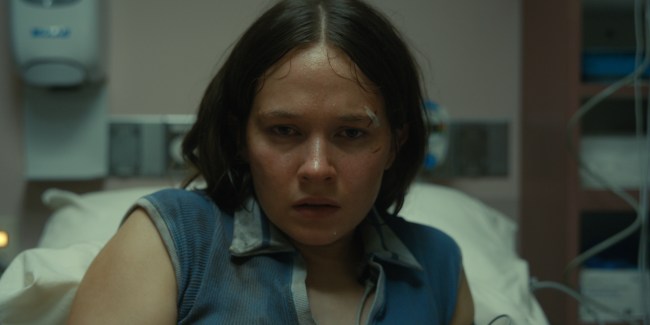
The trick for “Beef” Season 2 is that it often grows the sound, starting from a place of really delicate subtlety and building and building until the pressure of a moment is inescapable. Until sound effects, tones, and grating atmospheres rub right up against the dialogue. One moment where the sound really gets to play (and torment) the characters is Episode 4: Ashley and Austin are stuck in the hell of an emergency room, where Ashley ends up with a lot more angst about medical debt and one less ovary.
 ‘Beef’ COURTESY OF NETFLIX
Really, the entrance to that hell is a shot of a vending machine full of only red Gatorade, and the sculpting work that the sound team did to blend the grating atmospheric noise of the ER, Finneas’s tense score, and the key sound effects that connect us to Ashley’s fear and pain. The music and sound are pushed up right against the dialogue, and Lange, in particular, threaded the sound of a heart monitor to guide us through the wormhole that is the surgery.
“Our sound effects editor, Jerry Lafuente, slowed down the heartbeat on the heart monitor there and did some initial pitching down. Then I put a fun plate reverb on that and adjusted the pitch to match the tone, the key, of Finneas’ music,” Lange explained.
“It is definitely a unique challenge: Making it immersive, but not bombarding [the audience] with sounds for the sake of putting sounds there,” Gomez said.
Sound levels, then, and the kinds and quality of sounds, almost always tie into the characters’ frustrations and messy desires. Lange also did a lot of pitch work on a weed-whacker that annoys the shit out of Josh during a phone call in Episode 2, for instance, and the entire sound team had a lot of fun making the climactic fight sequence in Episode 8 much less impressive than a standard action scene.
 ‘Beef’ COURTESY OF NETFLIX
“The fight scene was this challenge of, all right, it’s this really cool one-shot with all this interesting choreography, but the story is that they’re not supposed to be good at fighting. It still has to sound tight and purposeful because if it wasn’t tight, it would just sound like a mess. But we had to make that sound cool and fun and loud without making it sound like ‘John Wick,’” Harold said.
The key to making a fight not sound like “John Wick” is to make it sound light. “There’s just these meager hits of Ahsley clubbing the guy, but they’re not very heavy,” Gomez said. “Sunny wasn’t afraid to let us take chances with the sounds. And it’s a big balancing act between the sound and the music, too.”
The goal of “Beef” Season 2, for the sound team, was to be grounded and also as dynamic as possible. “It’s not something you often get to play around with on television because, like [Lange] said, you’re taking into consideration different listening environments. But Sunny’s not afraid to take big swings,” Harold said.
Especially if those swings are designed to sound very, very pathetic.
“Beef” Season 2 is now streaming on Netflix.