
Remember me







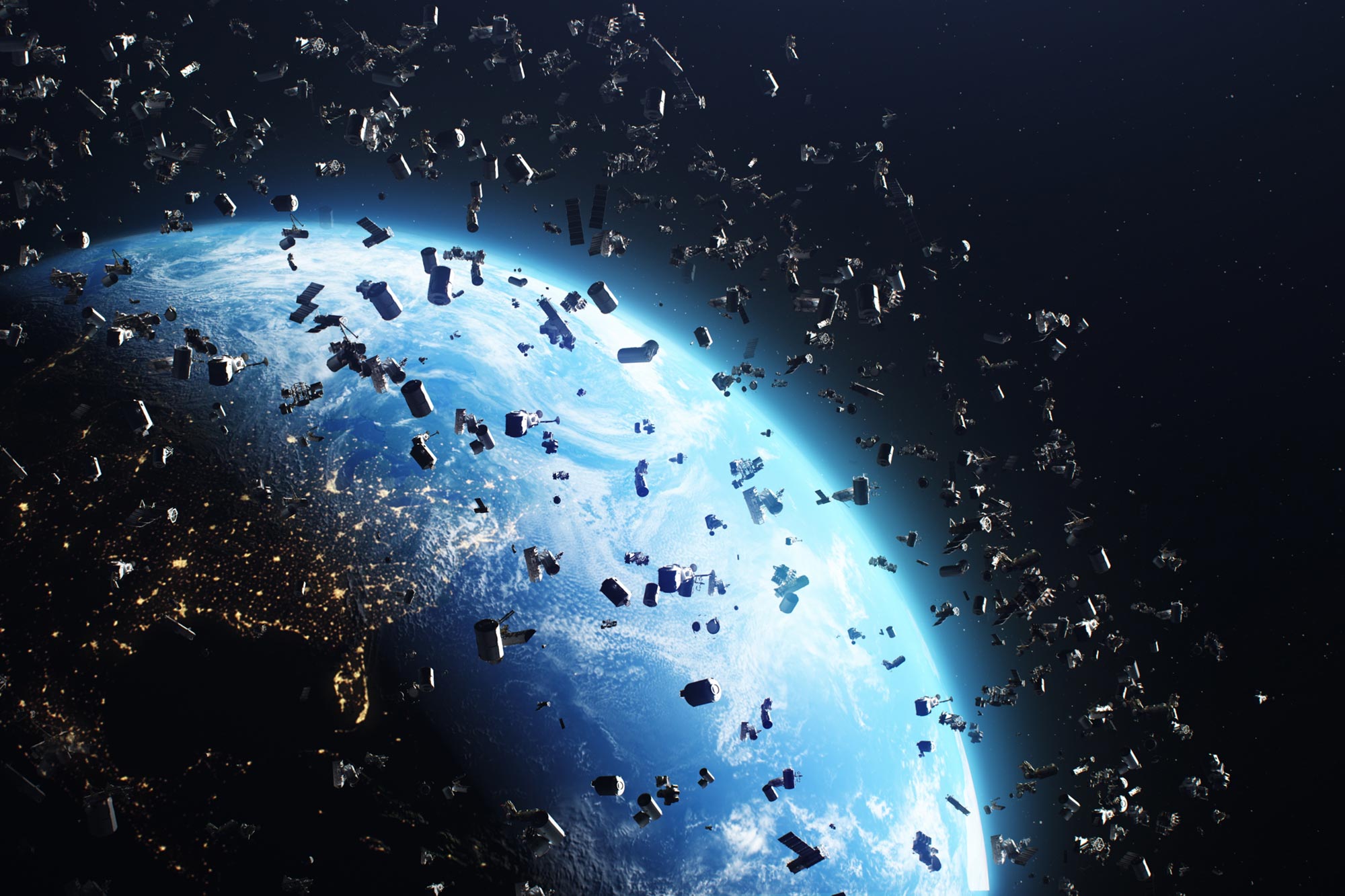 A new study suggests that modern satellite networks may be far more fragile than they appear, with the risk of orbital collisions rising sharply if control systems are disrupted. Credit: Shutterstock
A new study warns that if satellite operators suddenly lose control during a major disruption, a catastrophic collision in orbit could happen in as little as 2.8 days.
A major solar storm does not need to smash satellites apart directly to create a crisis in orbit. It may only need to interrupt the tracking, commands, and avoidance maneuvers that keep today’s crowded satellite environment under control.
That risk is growing as low Earth orbit fills with mega constellations, large networks of satellites launched and replaced in rapid cycles. These spacecraft support internet access, communications, weather monitoring, navigation, and other services. However, they also add congestion to an orbital region where objects travel at roughly 17,000 miles per hour (27,000 kilometers per hour).
A new paper led by Sarah Thiele, who began the work as a PhD student at the University of British Columbia and is now at Princeton, attempts to measure how fragile this system has become. The study introduces a metric called the Collision Realization And Significant Harm (CRASH) Clock, which estimates how long it could take for a serious collision to occur if satellites could no longer maneuver or if operators lost reliable awareness of where objects were.
The result is alarming. Using satellite catalog data from June 2025, the researchers calculated that if operators lost the ability to send commands for avoidance maneuvers, a catastrophic collision could occur in around 2.8 days. A broader version of the CRASH Clock, based on all resident space object interactions, was 5.5 days. Back in 2018, before the rapid expansion of mega constellations, that value was 164 days.
Solar storms as a systemic threatSatellites in low Earth orbit do not simply coast along fixed paths. They depend on station keeping, tracking updates, and collision avoidance maneuvers. According to SpaceX’s most recent biannual report cited in the study, Starlink satellites performed 144,404 collision avoidance maneuvers between December 1, 2024, and May 31, 2025. That averages 41 maneuvers per satellite per year, or one avoidance maneuver every 1.8 minutes across the Starlink network.
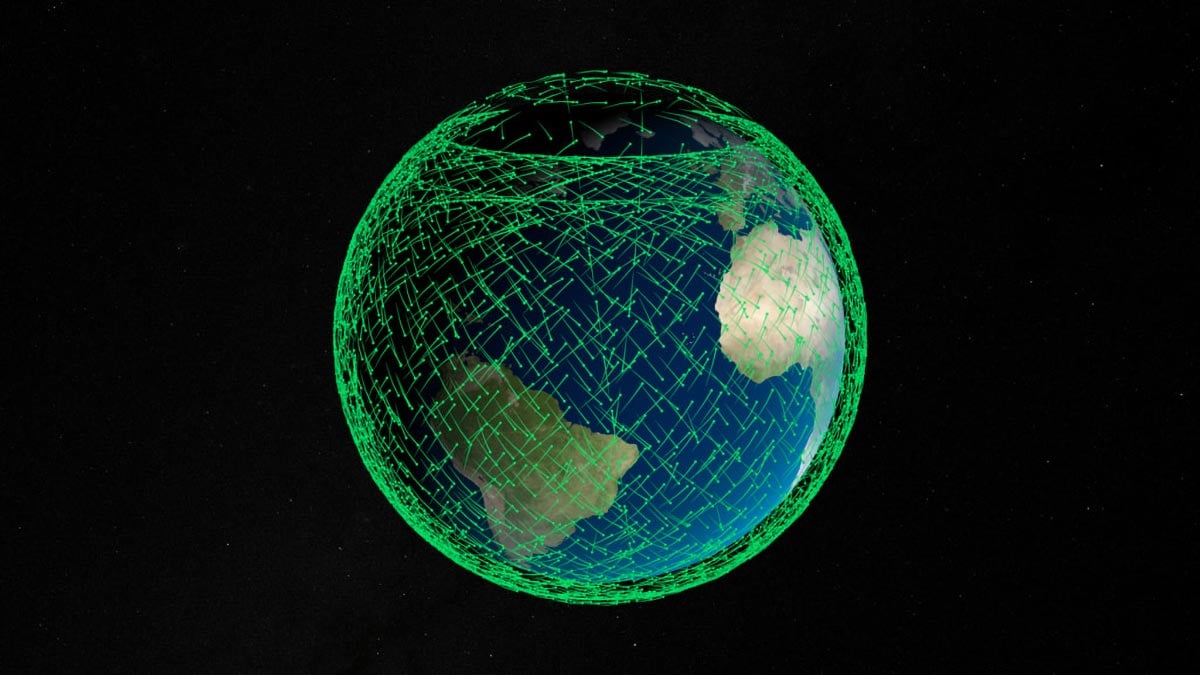 Paths of Starlink satellites as of Feb 2024. Credit: NASA Scientific Visualization Studio
During a major solar storm, this carefully managed system can become harder to control. Solar storms heat Earth’s upper atmosphere, causing it to expand. That increases drag on satellites, pulls spacecraft away from predicted paths, forces operators to use fuel to maintain altitude, and makes orbit forecasts less reliable.
The May 2024 “Gannon Storm” showed how disruptive this can be. Nearly half of all active satellites in low Earth orbit maneuvered because of increased atmospheric drag. The study notes that widespread repositioning, combined with unpredictable drag, made collision assessment during and after the storm much harder.
The danger grows if a storm also disrupts navigation, communications, or ground control. In that case, satellites may be harder to track just as they become less able to respond.
Why one collision mattersKessler syndrome is the most well-known version of this kind of catastrophe, where cascading collisions fill orbit with debris and eventually make it extremely difficult to safely launch or operate spacecraft. But that runaway scenario would take years or decades to fully unfold.
To highlight the much more immediate danger, the researchers introduced a new metric called the Collision Realization and Significant Harm (CRASH) Clock, which estimates how quickly a major, debris-generating collision could become possible if active satellite control and coordination were disrupted.
Even one high-speed impact can have lasting consequences. A collision between large objects can create thousands of fragments, each becoming another hazard. Today’s debris environment is still shaped by China’s 2007 anti-satellite test involving Fengyun 1C and the 2009 collision between Iridium 33 and Kosmos 2251.
The new study finds that the densest parts of today’s satellite networks are now especially concerning. Starlink’s main shell, around 550 kilometers (342 miles) above Earth, reaches densities more than an order of magnitude higher than the peak in tracked debris near 800 kilometers (497 miles).
A shrinking margin for errorThe researchers estimate that across all of low Earth orbit, close approaches within 1 kilometer (0.62 miles) occur every 36 seconds. Encounters involving at least one satellite occur about every 41 seconds, while those involving Starlink and another resident space object occur about every 47 seconds.
A close approach is not the same as a collision. Operators weigh distance, uncertainty, object size, and collision probability before deciding whether to move a satellite. Still, the frequency of these encounters shows how dependent orbit has become on fast, accurate, coordinated control.
Major solar storms are rare, but they are not hypothetical. The May 2024 Gannon Storm was the strongest geomagnetic storm in decades. The Carrington Event of September 1859 was at least twice as intense, according to the paper, and included two strong storms within a few days.
If a Carrington-scale storm occurred today, it would hit a world that relies heavily on satellites for communications, timing, Earth observation, weather forecasting, military operations, disaster response, finance, and navigation. It would also strike an orbital environment far more crowded than it was even a decade ago.
Beyond collision risk, mega constellations also contribute to debris, reentry hazards, interference with astronomy, and atmospheric pollution.
The study does not call for eliminating satellites, but it highlights a critical vulnerability. Low Earth orbit now relies on constant, precise control, and if that control is disrupted, the window to prevent a major collision could be just days.
Reference: “An orbital house of cards: Frequent megaconstellation close conjunctions” by Sarah Thiele, Skye R. Heiland, Aaron C. Boley and Samantha M. Lawler, 10 December 2025, arXiv.
DOI: 10.48550/arXiv.2512.09643
Never miss a breakthrough: Join the SciTechDaily newsletter.
Follow us on Google and Google News.