
Remember me
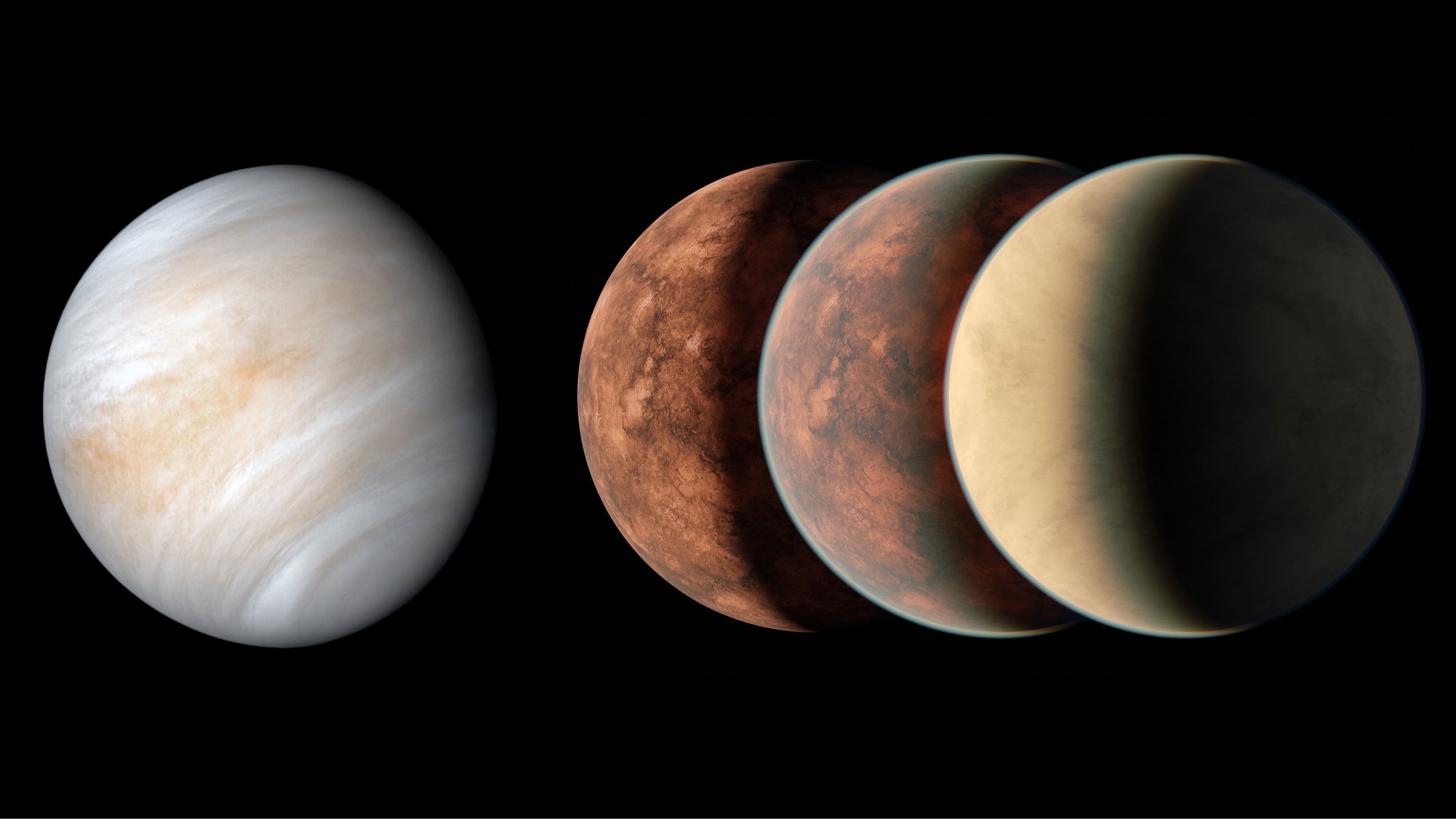





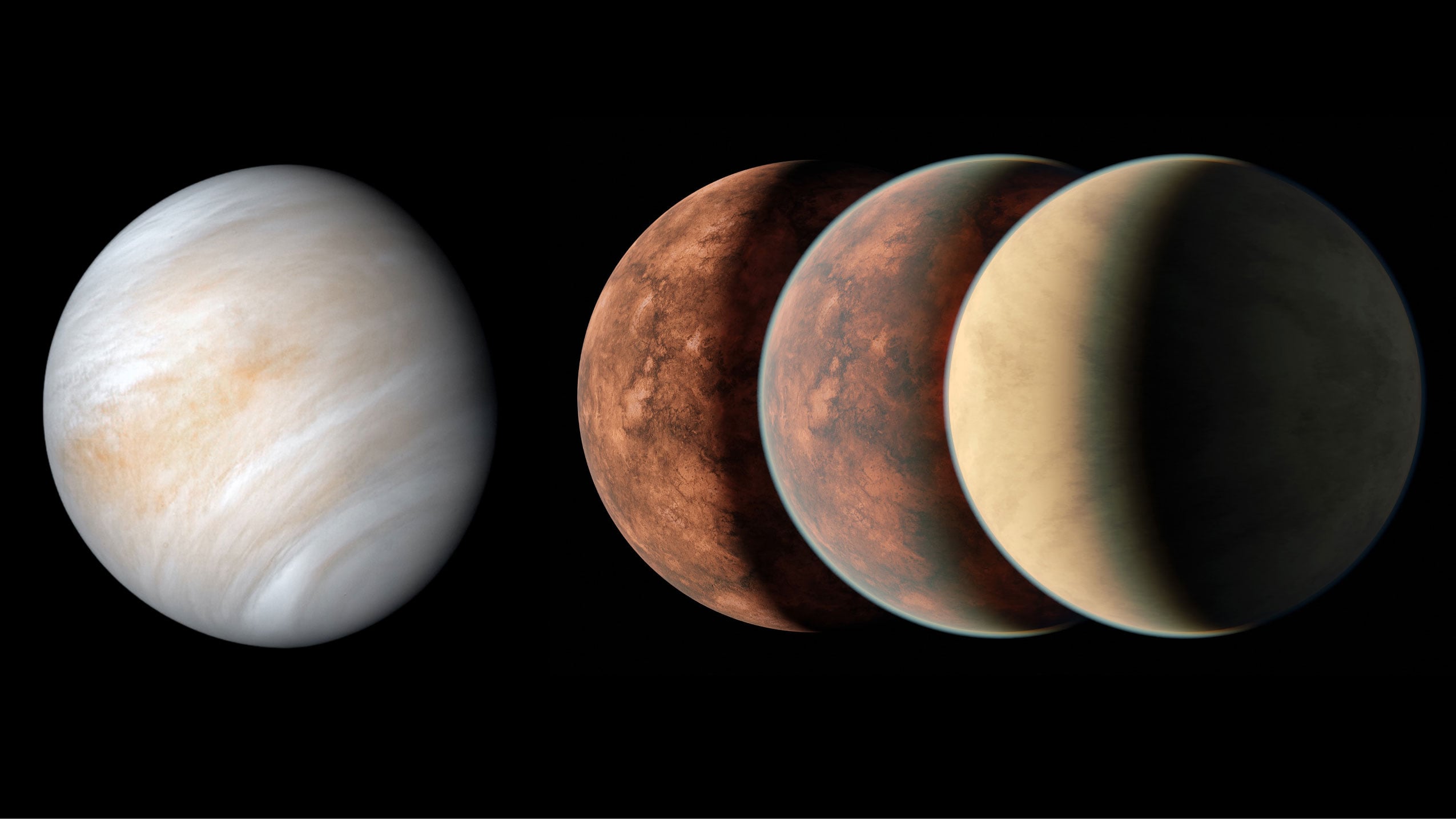 This image of Venus taken by NASA’s Mariner 10 spacecraft (left) is paired with an artist’s depiction of three possible atmospheres on a recently discovered exoplanet, Gliese 12b. This new University of Washington study explores how much surface water a planet needs to support life. Credit: NASA/JPL-Caltech/R. Hurt (Caltech-IPAC)
New research suggests that many planets previously considered promising for life may, in fact, be far less hospitable.
A distant planet might sit in the perfect orbit for life, with temperatures just right for liquid water. But if that world is too dry, it could still be completely uninhabitable. New research suggests that many so-called “desert planets” may be far less promising than they appear. But new research suggests many of these dry worlds are far less likely to support life than previously thought.
A study from the University of Washington finds that an Earth-sized planet needs a surprisingly large amount of water, at least 20 to 50% of Earth’s ocean volume, to maintain long-term surface habitability.
Astronomers have confirmed more than 6,000 exoplanets, with billions more expected to exist across the galaxy. Many fall within the habitable zone, where temperatures could allow liquid water. But being in the right location is only part of the story. A planet also needs stable climate controls, and those depend heavily on how water interacts with its geology and atmosphere.
“When you are searching for life in the broad landscape of the universe with limited resources, you have to filter out some planets,” said lead author Haskelle White-Gianella, a UW doctoral student of Earth and space sciences.
Water Alone Is Not EnoughWhile water is essential, it does not automatically make a planet habitable. In this study, researchers took a closer look at planets with only small amounts of water to better understand their potential for life.
“We were interested in arid planets with very limited surface water inventory — far less than one Earth ocean. Many of these planets are in the habitable zone of their star, but we weren’t sure if they could actually be habitable,” White-Gianella said.
The findings, published in Planetary Science Journal, show that habitability depends on the geologic carbon cycle — a water-driven system that moves carbon between a planet’s atmosphere and interior over millions of years, helping regulate surface temperature.
On Earth, carbon dioxide released by volcanoes builds up in the atmosphere before dissolving in rainwater. This rain reacts with surface rocks, and runoff carries carbon into the ocean, where it settles on the seafloor. Plate tectonics then push carbon-rich ocean crust beneath continents. Over long timescales, this carbon returns to the surface as mountains form.
If a planet does not have enough water to sustain rainfall, this cycle breaks down. Carbon removal through weathering slows, while volcanic emissions continue. As a result, carbon dioxide accumulates in the atmosphere, trapping heat. Rising temperatures cause remaining water to evaporate, triggering a cycle of warming that eventually makes the planet too hot for life.
“So that unfortunately makes these arid planets within habitable zones unlikely to be good candidates for life,” White-Gianella said.
Modeling Arid ExoplanetsAlthough scientists can detect signs of surface water, rocky exoplanets are still difficult to observe directly. To overcome this, the research team used advanced computer simulations to study how water behaves on dry, desert-like worlds.
Earlier models of the carbon cycle focused mainly on cooler and wetter planets. These models included evaporation caused by sunlight but often left out other factors such as wind. White-Gianella improved these models to better represent dry environments by refining estimates of evaporation and precipitation.
“These sophisticated, mechanistic models of the carbon cycle have emerged from people trying to understand how Earth’s thermostat has worked — or hasn’t — to regulate temperature through time,” said senior author Joshua Krissanen-Totton, a UW assistant professor of Earth and space sciences.
The study also highlights that the carbon cycle on arid planets has not been well studied. The results suggest that even planets that start with surface water can lose it over time, shifting from potentially habitable to uninhabitable as the carbon cycle becomes unstable.
Venus as a Nearby ExampleA nearby example may be Venus. This planet is similar in size to Earth, likely formed at about the same time, and may once have had comparable amounts of water.
Today, however, Venus has surface temperatures similar to a wood-fired pizza oven. Standing there would feel like being crushed by 10 blue whales, White-Gianella said.
Scientists have long debated why Earth and Venus evolved so differently. White-Gianella and Krissanen-Totton suggest that Venus, being closer to the sun, may have started with slightly less water than Earth. This difference could have disrupted its carbon cycle. As carbon dioxide built up in the atmosphere, temperatures rose, leading to the loss of water and any possible life.
Future missions to Venus aim to uncover what happened to the planet and whether it ever supported life. These findings may also help scientists better understand distant exoplanets.
“It’s very unlikely that we will land something on the surface of an exoplanet in our lifetime, but Venus — our nextdoor neighbor — is arguably the best exoplanet analog,” White-Gianella said.
The team hopes that data from upcoming missions will help confirm their models.
“This has implications for a lot of the potentially habitable real estate out there,” Krissanen-Totton said.
Reference: “Carbon Cycle Imbalances on Arid Terrestrial Planets with Implications for Venus” by Haskelle T. White-Gianella and Joshua Krissansen-Totton, 15 April 2026, The Planetary Science Journal.
DOI: 10.3847/PSJ/ae4faa
This study was funded by the National Science Foundation, the NASA Astrobiology Program and the Alfred P. Sloan Foundation.
Never miss a breakthrough: Join the SciTechDaily newsletter.
Follow us on Google and Google News.