
Remember me







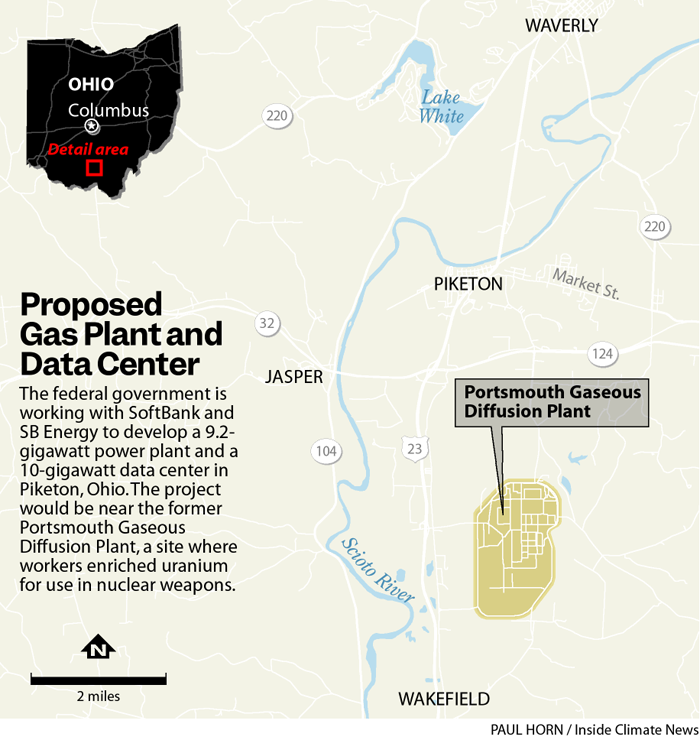
PIKETON, Ohio—At the edge of Appalachia, on a site where crews have worked for decades on nuclear waste remediation, the Trump administration aims to build the largest power plant and data center in the country.
It would be a logistical feat, and energy analysts warn that the whole plan could fall apart.
But there was little hint of the challenges when U.S. Commerce Secretary Howard Lutnick took the stage here in March to announce the project, with AC/DC’s “Back in Black” as his walk-on music.
In five words, Lutnick explained how negotiations for such a large endeavor came together in a few months. “We’re operating in Trump time,” he told the crowd ahead of a ceremonial groundbreaking.
The numbers were staggering: SoftBank of Japan would work with the U.S. government to build a 9.2-gigawatt, $33 billion power plant to serve a proposed 10-gigawatt AI data center on the same Piketon-area campus. It would be the start of something even larger, with a potential investment over several decades of up to $1.5 trillion, according to SoftBank.
The project, called PORTS Technology Campus, is unusual in its size and financing method, and political leaders want to put it on a fast track to open while President Donald Trump is in office. But the next steps are likely to be slow as developers work to acquire permits, procure gas turbines and address many other details, any one of which could cause long delays, analysts said.
And this is before getting into bigger questions of whether the project makes economic or environmental sense.
SB Energy, a SoftBank subsidiary, is leading the development, and has said that construction on the data center will begin this summer with plans to open the first phase of 800 megawatts by 2028.
For the power plant, SoftBank “has reserved sufficient gas turbines from multiple sources including GE Vernova for this project,” an SB Energy spokesperson said.
Asked about the project’s challenges, a Department of Energy spokesperson said the administration is “fully committed to completing the PORTS Technology Campus” and already has the first portion of funding from Japanese partners in hand.
“Unlike the previous administration’s Green New Scams and stalled infrastructure efforts, the PORTS Technology Campus is shovel‑ready and will deliver jobs and lasting economic opportunities for southern Ohio,” the spokesperson said in an email.
This optimism is in contrast to the analysis of electricity-market experts.
“The whole thing doesn’t add up,” said Ric O’Connell, executive director of GridLab, a nonprofit that provides technical expertise on the electricity grid to policymakers and advocates.
O’Connell thinks the power plant’s high costs will make the project difficult to justify outside of a moment in which the Trump administration is seeking attention for big projects. Due to inflation on key components, the project would cost $3,586 per kilowatt, two to three times the cost of a combined-cycle gas plant two years ago.
“They’re just smiling and waving for the cameras, and then, as soon as Trump’s out of power, the [power plant is] going to get scaled way down or killed,” O’Connell said.
Regulatory filings show the initial steps as developers seek permits. The utility American Electric Power has submitted a pre-application for a 50-mile transmission line across southeastern Ohio that would serve the power plant. The docket already includes three public comments urging the Ohio Power Siting Board to reject the project because of potential damage to farms and disruption to an Amish community.
There are no filings yet for the plant itself or a gas line to serve the plant.
For decades, the major employer in Piketon was the nearby Portsmouth Gaseous Diffusion Plant, which produced enriched uranium from 1956 until 2001, initially for nuclear weapons. The plant reduced employment over the decades, resulting in the loss of some of the region’s best jobs. The Department of Energy now manages the 3,700-acre industrial area as part of a long-term plan to remove hazardous waste.
 Tony Montgomery, a Pike County commissioner, speaks to reporters about PORTS Technology Campus, a large investment in his community. Credit: Dan Gearino/Inside Climate News
The new power plant and data center would sit next to the remediation project.
“This is a small community, kind of a poor, rural area, and for a project like this to come back to this site, this is a game changer for us and it’ll keep our community alive, keep our community viable,” Tony Montgomery, a Pike County commissioner, said to reporters at the groundbreaking.
If the results fall short of the hype, it would be far from the first time for Piketon, a village of about 2,300. Local leaders have seen several would-be saviors from the government and private sector who have made assurances about investment and jobs at the gaseous diffusion site, but haven’t delivered.
“There’s still some doubt,” Montgomery said. “You know, we hear from folks, ‘Hey, I’m not going to believe anything until something happens,’ and that’s understandable.”
Administration officials focused on the opportunities and downplayed the risks.
“What this means for the community in southern Ohio in the short term is just thousands and, pretty quickly, tens of thousands of jobs,” Chris Wright, the U.S. energy secretary, said in an interview with a local TV station at the groundbreaking ceremony. “So we need hard-working people that are keen to build America back. It’ll drive up wages in the area. It’ll generate enormous tax revenues for local communities and schools.”
Wright gave assurances that the project would not increase electricity and gas bills for consumers, citing Trump’s recent executive order that says data center companies should cover the costs of their infrastructure. And SoftBank has said it will pay $4.2 billion for the transmission line connection between the project and the regional grid.
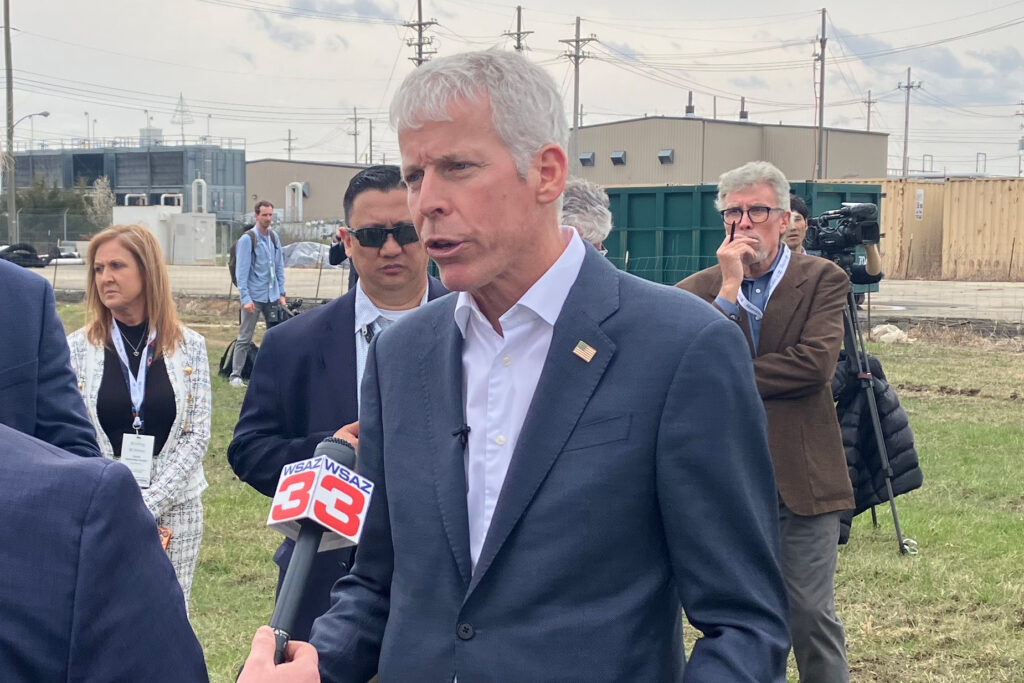 Energy Secretary Chris Wright speaks to reporters on March 20 following the PORTS Technology Campus groundbreaking. Credit: Dan Gearino/Inside Climate News
But energy analysts say a plant of this size can’t help but affect supply and demand for gas turbines and gas, raising prices.
There is a “Sherman tank-sized hole” in the idea that consumers will be protected, said Mike Hogan, a senior advisor for the nonprofit Regulatory Assistance Project who has prior experience developing gas power plants. He anticipates that high gas demand—from this project and other new plants being built—will lead to substantial increases in heating and electricity costs for the public.
“I don’t doubt consumers can be protected to some extent from some of the effects, but it’s goofy to think they can be protected from all or even most of the effects,” he said.
An Unusual Trade DealThe power plant and data center are outgrowths of trade talks between the Trump administration and Japan.
In April 2025, Trump announced new tariffs on nearly every major trading partner and encouraged governments to negotiate. Japan and the United States reached an agreement last July in which Japan would pay $550 billion for projects in the United States selected by the Trump administration. Japan would receive concessions, including a reduction in the tariff from 24 percent to 15 percent.
Under a memorandum of understanding, the United States and Japan would split any profits 50-50 until Japan earned enough to meet certain benchmarks. After that, 90 percent of the profits would go to the United States. Japan is essentially giving the United States a loan rather than taking ownership of the investments, according to an analysis from the Federal Reserve Bank of St. Louis.
The agreement is a reset of the U.S.-Japan trade relationship. The countries have a long history of direct investment driven by the private sector. But this is different because both governments are taking a central role, said Mireya Solís, director of the Center for Asia Policy Studies at the Brookings Institution, a think tank.
“It’s not only that the government of Japan is going to provide the funds, but on the U.S. side, you’ll have the president making the ultimate decision on giving the green light to the project,” she said. She’s unaware of any precedent for such terms.
 SoftBank CEO Masayoshi Son speaks ahead of the March 20 ceremonial groundbreaking for PORTS Technology Campus near Piketon, Ohio. Credit: Dan Gearino/Inside Climate News
The Peterson Institute for International Economics issued a report in January questioning whether the deals negotiated under pressure by Trump are likely to be fully implemented.
In Japan’s case, the trade deal calls for payment by the end of the Trump administration, which is a shorter timeline than in some other countries and increases the likelihood that the pledge will be fulfilled, said Gregory Auclair, a co-author of the report and a statistician at the Peterson Institute. Japan has other reasons to stick to its end of the deal, including a long-term security relationship with the United States, he said.
But what happens when Trump is no longer in office?
“When the next administration comes in, they could have just a different DNA from the current administration, and all bets are off,” Auclair said.
“A Really, Really Hard Thing”The power plant has an advantage over other large energy projects because it already has full funding. But that still leaves many logistical and regulatory obstacles.
Soon after the Ohio announcement, ClearView Energy Partners, a power sector research and consulting firm, wrote that the main constraints on the project would be supply chain bottlenecks and long waits for grid connections, not financing.
Timothy Fox, who leads ClearView’s electricity practice, said in an interview that he thinks the parties involved in the Ohio plant are earnest in wanting to see it built, but he sees major challenges ahead.
“It’s highly ambitious,” he said about the plant. “But accomplishments don’t necessarily follow ambition.”
Fox would like to see more details about the power plant’s gas turbines. Demand for turbines is so high that some developers are waiting years for orders and sometimes planning to use less efficient models because better options are not available. A turbine’s efficiency and durability are key factors in determining a plant’s cost to operate.
Fox also has questions about how the plant will procure sufficient gas. A 9.2 gigawatt plant that’s running 90 percent of the time would consume 1.2 billion cubic feet of gas per day, he said. To make that happen, the plant would need a pipeline and contracts with producers. Building a pipeline is complicated and takes time.
For context, Ohio produced 5.9 billion cubic feet of gas per day in 2024, the most recent year available from the Energy Information Administration. It would be a logistical challenge to add demand for 1.2 billion cubic feet of gas, without even accounting for other natural gas power plants in various stages of planning and construction in the region.
It’s difficult to imagine the project getting built by January 2029, said Susan Tierney, a senior advisor for Analysis Group, an economic consulting firm. She has decades of experience advising companies, governments and nonprofits and working for state and federal regulators.
“All of these technical things add up to a really, really hard thing that they’re going to try to do,” she said.
This story is funded by readers like you.Our nonprofit newsroom provides award-winning climate coverage free of charge and advertising. We rely on donations from readers like you to keep going. Please donate now to support our work.
For example, she noted the complexity of obtaining a reliable and safe water supply when the project is in an area with a history of nuclear contamination. Local media outlets, including Cleveland.com and WKRC television in Cincinnati, have reported recently about the area’s long-term health hazards.
Also, the plant’s developer needs to work with PJM Interconnection, the regional grid operator, to get approval to connect to the grid. This could take years, as PJM’s technical staff determines how to maintain reliability as this plant and many others begin operating in a complex system.
“This is a major, major undertaking by all the electrical engineers, if they follow standard practice, and I don’t know why they would not, because the grid operator does not want to be in charge of an outage,” Tierney said.
Inherent RiskThe Ohio power plant and data center are each essential to the project, with one providing electricity for the other. Both parts are large and complex and will need to clear logistical and regulatory hurdles.
The result is an accumulation of risk that makes it difficult to foresee the whole thing being completed on time or on budget, said Hogan of the Regulatory Assistance Project. He sees familiar elements in the national rush to build gas plants and data centers, reminding him of the power sector boom-and-bust in the late 1990s and early 2000s.
“The parallels are kind of spooky,” he said.
In the time it will take to obtain permits and build the Ohio plant, the AI economy could change in major ways that would affect the need for the project, Hogan said. He expects AI data centers to become more energy-efficient and more flexible at powering down when needed.
For now, data center developers are racing to grab a share of a market that has yet to come into focus.
The result is short-term thinking and a high likelihood of bad investments, said O’Connell, the executive director of GridLab.
Other options, including existing natural gas, coal and nuclear plants, have lower electricity costs, as would existing or new wind power, solar power and battery energy storage.
“Willingness to pay is so high that you’re going to see stupid stuff happening,” O’Connell said.
About This StoryPerhaps you noticed: This story, like all the news we publish, is free to read. That’s because Inside Climate News is a 501c3 nonprofit organization. We do not charge a subscription fee, lock our news behind a paywall, or clutter our website with ads. We make our news on climate and the environment freely available to you and anyone who wants it.
That’s not all. We also share our news for free with scores of other media organizations around the country. Many of them can’t afford to do environmental journalism of their own. We’ve built bureaus from coast to coast to report local stories, collaborate with local newsrooms and co-publish articles so that this vital work is shared as widely as possible.
Two of us launched ICN in 2007. Six years later we earned a Pulitzer Prize for National Reporting, and now we run the oldest and largest dedicated climate newsroom in the nation. We tell the story in all its complexity. We hold polluters accountable. We expose environmental injustice. We debunk misinformation. We scrutinize solutions and inspire action.
Donations from readers like you fund every aspect of what we do. If you don’t already, will you support our ongoing work, our reporting on the biggest crisis facing our planet, and help us reach even more readers in more places?
Please take a moment to make a tax-deductible donation. Every one of them makes a difference.
Thank you,
 Dan Gearino
Reporter, Clean Energy
Dan Gearino
Reporter, Clean Energy
Dan Gearino covers the business and policy of renewable energy and utilities, often with an emphasis on the midwestern United States. He is the main author of ICN’s Inside Clean Energy newsletter. He came to ICN in 2018 after a nine-year tenure at The Columbus Dispatch, where he covered the business of energy. Before that, he covered politics and business in Iowa and in New Hampshire. He grew up in Warren County, Iowa, just south of Des Moines, and lives in Columbus, Ohio.