
Remember me


Welcome to Foreign Policy’s Southeast Asia Brief.
The highlights this week: The ASEAN summit looms as frustration with the United States grows, Aung San Suu Kyi gets out of prison, Thailand prepares to take out a massive loan, and Bali faces a trash-tastrophe.
‘Bare-Bones’ ASEAN Leaders Summit
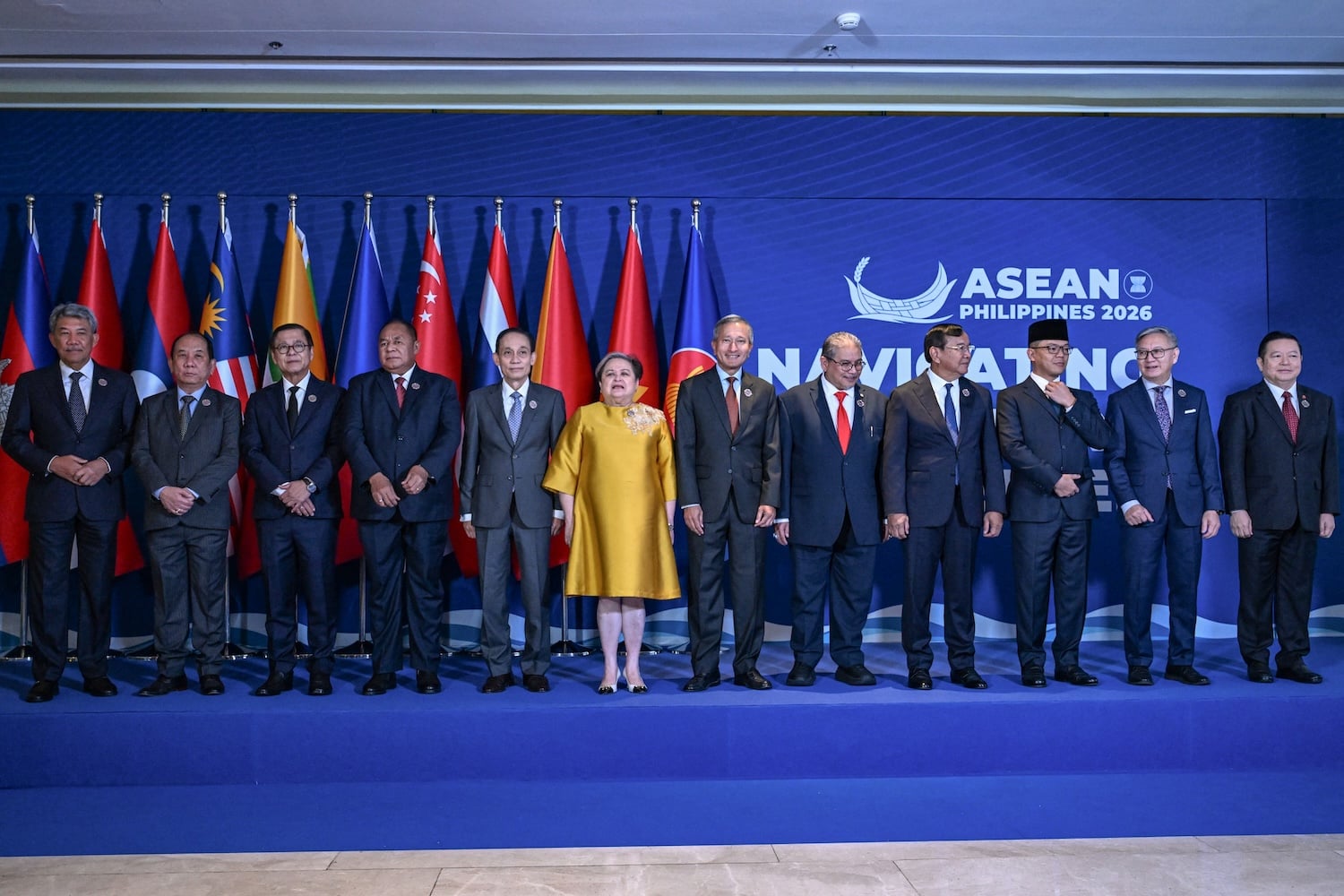
A leaders’ summit of the Association of Southeast Asian Nations (ASEAN) is about to kick off from Thursday to Friday in Cebu, Philippines.
But instead of the usual circus, it will be a “bare-bones” affair, in the words of Philippine President Ferdinand Marcos Jr.
The reason is the ongoing fuel crisis, which the conference will focus on addressing. And attitudes toward the United States, which precipitated the crisis with its strikes on Iran, are turning bitter.
When U.S. President Donald Trump was reelected in 2024, many in Southeast Asia reacted with complacency or even a little pleasure. Trump could be unpredictable, sure—but his first term had worked out OK for Southeast Asia, with many companies relocating production out of China and into the region.
Lectures about human rights, commonplace in administrations led by the U.S. Democratic Party, were expected to drop off. And many bought the “Donald-the-dove” rhetoric, seeing his predecessor—President Joe Biden—as having shoveled weapons to Ukraine and Israel.
A little more than a year into Trump’s presidency, and the mood has changed sharply.
In the crudest terms, this is because Trump has started to affect Southeast Asia’s bottom line.
The effects of his 2025 tariffs were not as bad as feared, but they still shocked many.
This year, an influential survey found that a majority of movers and shakers in ASEAN said that if they were forced to pick between the United States and China, they would pick China. And that poll was conducted before the start of the Iran war on Feb. 28. While the tariffs were borne better than expected, the blockade of the Strait of Hormuz is threatening the region with serious economic damage.
Highly dependent on the Persian Gulf for its energy supplies, Asia has felt the bite of the fuel crisis first and sharpest. Countries in the region resent paying the economic price for U.S. foreign-policy adventurism. In an interview with the Washington Post last week, Thail Foreign Minister Sihasak Phuangketkeow said the war “should not have taken place.”
He also noted that the United States has not offered Thailand assistance dealing with the fallout.
Still, don’t expect anything remotely as pointed from the ASEAN conference’s official statements.
On April 30, a joint statement by ASEAN’s economic ministers on the situation in the Middle East expressed “deep concern” about “disruptions to key maritime routes.” However, it did not name names, instead merely noting the importance of maintaining international law as well as calling for measures to mitigate the economic fallout.
As a body, ASEAN relies on consensus, which means that its statements only go as far as the most conservative voice in the group. And this year’s chairmanship by the Philippines—the most pro-U.S. member of ASEAN—will further dampen any criticisms.
Behind closed doors, though, conversations will be about managing a crisis that the United States has created, covering topics such as fuel supplies, food prices, and migrant workers in the Middle East.
Some other topics will be on the agenda, too.
Myanmar, frozen out since its 2021 coup, is pushing for normalization, backed by Thailand. Detained former leader Aung San Suu Kyi’s reported transfer from prison to house arrest (more on that below) will be used as ballast for the case.
The Philippines will also renew a push for a joint ASEAN-China code of conduct for the South China Sea. Analysts have suggested that incremental progress on mechanisms to help manage friction—rather than resolve the issue—might be possible.
Lastly, the Thai-Cambodian border dispute may be discussed on the sidelines. Trilateral talks brokered by the Philippines have been proposed. Yet Thailand, which holds the upper hand, appears to be uncompromising.
I’ll be bringing you the inside track from Cebu in next week’s newsletter.
FP Insiders, who belong to our highest membership tier, should also look for an exclusive dispatch delivered to their inboxes on Friday.
Aung San Suu Kyi Saga’s Latest Twist. Aung San Suu Kyi has been transferred from prison to house arrest, Myanmar state media announced on April 30.
The move followed Myanmar’s military junta granting clemency to various imprisoned opposition figures in mid-April, which included a shortening of her sentence.
The former leader was in fact first moved from Naypyitaw prison to a specially built secure house in Naypyitaw some weeks ago, according to a scoop from the Irawaddy.
However, the continued lack of clear information means that Aung San Suu Kyi’s family has raised doubts as to whether she is in good condition, health-wise.
Reuters had reported that her legal team would meet with her over the past weekend, so more information may be forthcoming.
The move to transfer the popular leader is part of the junta’s ongoing campaign to improve its image and gain wider diplomatic acceptance following its January elections, which were widely deemed to be rigged, and a pseudo-transfer of power to civilian rule.
The gambit may well work.
Within ASEAN, Thailand is pushing for normalization. Meanwhile, in the United States, Myanmar just retained the services of notorious Trump-tied lobbyist Roger Stone.
Earlier this year, Reuters reported that the United States was considering shifting its stance toward the junta in return for access to Myanmar’s rare-earth resources.
Treason conviction upheld. On April 30, Cambodian courts upheld former opposition leader Kem Sokha’s treason conviction.
The 72-year-old politician was arrested in 2017, and in 2023, he was convicted and sentenced to 27 years in jail, accused of colluding with the United States to overthrow the Cambodian government.
The trial was widely condemned by numerous human rights organizations.
Various Western countries expressed disappointment with the verdict. This included the United States, which said in a statement that it was “troubled” by the decision.
It further said that “claims of U.S. involvement in schemes against Cambodia’s government are patently false and irresponsible.”
Some commentators within Cambodia have also voiced criticism of the decision, arguing that it promotes political division at a time when domestic and foreign pressures require unity.
 Japanese troops take part in a counter-landing live-fire exercise as part of the annual Balikatan joint military drills in Laoag, Philippines, on May 4.
Japanese troops take part in a counter-landing live-fire exercise as part of the annual Balikatan joint military drills in Laoag, Philippines, on May 4.Ezra Acayan/Getty Images
Japan is making a wider diplomatic push in the region, with a strong focus on defense.
Japanese Defense Minister Shinjiro Koizumi stopped by to observe and meet with Marcos on May 5.
The day before, Koizumi was in Indonesia to sign a new defense cooperation pact. And on Sunday, Japanese Prime Minister Sanae Takaichi touched down in Australia for a three-day visit that focused on defense, critical minerals and broader economic security.
FP’s Most Read This Week
400 billion. The amount in baht, equivalent to about $12.3 billion, that Thailand plans to borrow in an emergency loan to deal with the fallout of the energy crisis.
The spending will have two prongs. The first is a co-payment stimulus scheme in which the government covers 60 percent of the cost of certain staples for eligible groups to blunt cost of living rises, copying measures rolled out during the COVID-19 pandemic.
The second prong concerns energy security, focusing on incentives to help transition away from fossil fuels.
Where’s ASEAN getting its oil from? With Gulf supplies cut off, Southeast Asian countries are turning to the United States, Brunei, Libya, and Russia to make up the shortfall, according to Kentaro Takeda in Nikkei Asia.
Southeast Asia’s most important river, the Mekong, is increasingly polluted by poisonous mine runoff, threatening the region’s breadbaskets and fisheries, write Anton L. Delgado and Aniruddha Ghosal in The Associated Press.
No cocks for the Philippines. Citing animal welfare concerns, Korean Air has banned the transport of live roosters from the United States to the Philippines, where there’s a huge cockfighting industry, according to reporting by AFP republished in the Straits Times.
In Focus: Bali’s Trash-Tastrophe
Bali, Indonesia, renowned as a holiday paradise, is drowning in an ocean of trash.
On March 1, Bali closed its biggest landfill site, Suwung, only to hastily reopen it the next day on a temporary and more limited basis.
Still, trash collection seems to be significantly disrupted. Trash is either piling up on the street or being burnt, releasing foul-smelling smoke.
Local are outraged. In mid-April, hundreds of garbage trucks drove up to the governor’s office, with their drivers demanding to know where they should dump the stuff.
The issue is a long-running one. The Suwung dump is overloaded and was first scheduled to close in 2022. Trash is piled up to 40 meters high, creating risks of landslides or even fires as rotting waste creates methane gas.
In May 2025, the Environment Ministry ordered the landfill’s closure, saying that officials in Bali could be prosecuted if they didn’t comply.
No adequate alternative facilities have been prepared, however. A new waste-to-energy plant that could burn the trash is not scheduled to start operations until 2028.
This is not just a Bali story. Trash management is a massive problem across Indonesia and Southeast Asia broadly.
On March 8, seven sanitation workers were killed in trash landslide in one of the region’s largest dumps, located outside Jakarta.
In the Philippines at time of writing, a fire in a Manila dump has smoldered under the noisome heaps for more than three weeks.
Five hundred residents nearby have been evacuated, and the smoke has drifted over the wider city, rendering the air “acutely unhealthy” in some areas.
Malaysia is battling to stop the import of waste from around the world that is then dumped in the country.
In 2019, BBC investigations found mountains of trash dumped in the jungle.
A United Nations report in 2017 found that growing populations and economies in Southeast Asia meant that ever more trash was being generated, but many countries lacked policies to manage this properly.
Comments (0)