The Pamir Highway is only open some months per year, with passes at 4,280 and 4,655 meters above sea level. The highway is so remote and oxygen-deprived that the actual border crossing lacks checkpoints. Between Tajikistan and Kyrgyzstan stretches a long 22 kilometers of non-maintained road through No Man’s Land.
The Secret Road
The Pamir Highway was planned in 1891 by Lieutenant Colonel Bronislav Grombchevsky, who convinced a Russian Tsar that a road was the only way to win the "Great Game" against the British in Afghanistan-Pakistan-India. In 1912, engineers were dispatched to upgrade a medieval horse-trail through the Himalayas to a full-blown road. But the Pamirs do not surrender easily. Local legend whispers that the mountains exacted a terrible price: not a single engineer or builder returned dead or alive. It wasn't until 1933 that the Soviets constructed "The Secret Road", a military lifeline intended as an escape route from the USSR's into the Orient. The OGPU (KGB) led the construction of the Pamir Highway with slave labour from political opponents. The exact human toll of the road works is unknown. But for comparison, the Karakoram highway through the Himalayas is known to have costed more than 800 lives. The Pamir Highway was only opened in the 1980’s. The pledge to the Tsar was then full-filled, after almost a century, when Russia invade Afghanistan in 1979. The total death toll of the Pamir Highway to Afghanistan remains a public secret.
Kyzyl-Art Pass at 4,280 meters
Since the independence of Tajikistan and Kyrgyzstan, the Kyzyl-Art Pass is one of the highest border-crossing in the world at 4,280 meters altitude. The distance between the two border check-points of Bordöbö and Kyzyl-Art is 22 kilometers. That might seem trivial on a map, but it is an eternity in the Pamirs. The asphalt is from the 1970’s, and as much remains of it as from the USSR. Most of the road has eroded by trucks and landslides. The road has no guardrails. Whilst both left-hand and right-hand vehicles drive here, you can directly recognize the one rigidly having their eyes locked at the road, avoiding potholes, too scared to look into the deep abysses, gasping for oxygen, their brains ruminating on life-questions whether oncoming traffic should be called opponents. The road through No Man’s Land takes an eternity.
The People of the Sun
Long before the crescent of Islam reached the valleys, the Pamiris were the "People of the Sun," adherents of an ancient Zoroastrian fire-worship that still pulses in the veins of their culture. Even today, traditional Pamiri homes (chid) are built as living solar calendars; their skylights consist of four concentric squares representing earth, water, air, and fire, filtering the alpine light into a sacred geometry that has survived for over three millenniums. Old graveyards can still be seen; shrines adorned with horns stand as silent guards against evil spirits.
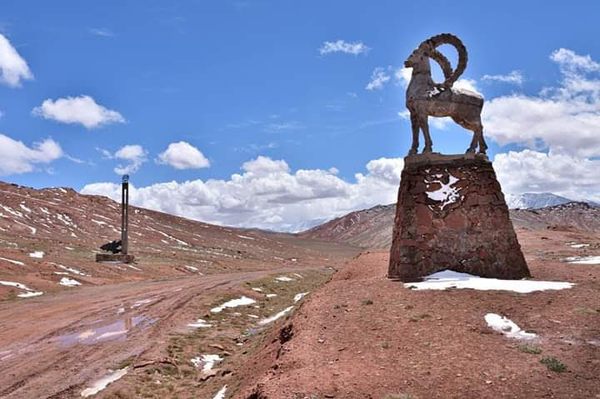
At the actual border stands a surreal monument to this Tajik pride: a statue of the Marco Polo Sheep (locally called “Argali” or scientific name “Ovis ammon polii”), often mistaken for a mountain goat or ibex. With its massive, spiraling horns, this iron beast gazes out over the desolate No Man’s Land, where nations cease to exist.


Comments (0)