
Remember me

Just you and your partner, on a yacht. It’s the dream scenario – but how to ensure you both enjoy it equally? Bluewater sailors share their secrets with Helen Fretter
For many cruising couples the liveaboard life is a shared ambition worked and saved towards for years, before setting off together, alone. For others, the decision to sail two-up is an evolution, borne of an increase in skill and knowledge, and the desire to reclaim peace and privacy on board after sailing with crew. But expectation and reality do not always align, so how do you ensure the experience matches the vision you both held?
We canvassed dozens of cruisers on how to run a happy ship for two. Many knew couples whose relationship did not survive living aboard. All had strategies to avoid the same pitfalls, and generously shared their advice.
Who knows more?Few of our cruising couples had similar levels of sailing experience as each other initially. “A very definite no,” says Miranda Baker on that question. “Elliot had his RYA Yachtmaster Offshore and a ton of experience crewing and teaching sailing. I’d spent six weeks ‘crewing’ a boat through the Whitsundays in my early 20s – but don’t remember the sails ever being raised. I think this disparity worked in our favour because it was clear who would be in charge.” The couple have so far sailed 15,000 miles from New Zealand to Indonesia.
More important was how each pairing developed those skills. “One bit of advice we always give is to make sure you level-up your sailing experience as much as possible,” says Charlotte DC. She and partner JP Baudains are circumnavigating, and also run a brokerage company, often advising new cruisers on bluewater yachts.
“Stressful situations at sea can be even worse when only one person feels like they can be ‘dealing with the boat’ at that time,” she adds. “It makes the other person feel guilty and unimportant.”
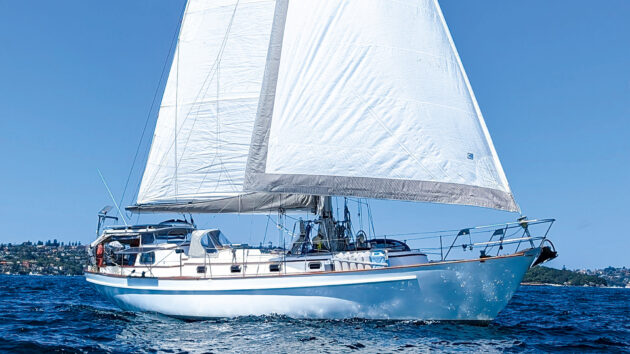
Miranda Baker and Elliot Russo have cruised 15,000 miles on their 1985 steel Mason 48 Fortaleza. Photo: Miranda Baker & Elliot Russo
Get better togetherFundamentally, it’s a safety consideration. “I’d never been on a sailing boat before we met. I quickly decided, however, that if Neil went overboard i wanted to [be able to] sail the boat back to land so i did lots of sailing courses and got my Yachtmaster Offshore before we left,” recalls Helen Smith, who spent four years circumnavigating with her husband, Neil, on their s&s 40, then later bought a Moody 54 which they sailed across the Atlantic.
Kate Ashe-Leonard took a rigorous approach to up-skilling before she and partner Jim Hooper set off on their Catana 47. “Jim had sailed his whole life whereas i had never sailed before.
“In the first few months we divided the sailing quite evenly but i was always under Jim’s watchful eye. After a day of sailing, at anchor we’d discuss the manoeuvres we’d done (for example, raising and dropping the mainsail).
i would type them up into a step-by-step written procedure to make sure i really understood what was going on and why each step is important.”
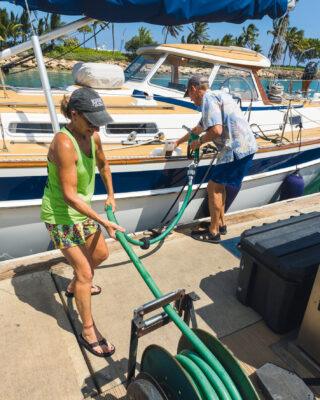
Discuss how you will divide roles – from sailing to maintenance, navigation, paperwork and domestic tasks. Photo: Tor Johnson
But with so many demands on your time when preparing for a voyage, it can be a struggle to get the hours in. “Will grew up cruising offshore with his family. i had little to no sailing experience,” recalls Sarah Curry. “In the years that we were saving to buy our first bluewater boat we sailed locally out of Vancouver for a cumulative three weeks. i focused more on taking navigation courses and reading as much as i could.
“Will’s seamanship and skill is amazing, but i initially struggled as the far less experienced sailor. It’s hard to take direction all the time! i often felt jealous of couples who learned together or had sailing skills at similar levels. In hindsight, i should have used our preparation years to hone my on-the-water skills,” she acknowledges.
It worked out though – the couple have lived aboard for over 10 years, raising twins on board while also running wind vane company Hydrovane.
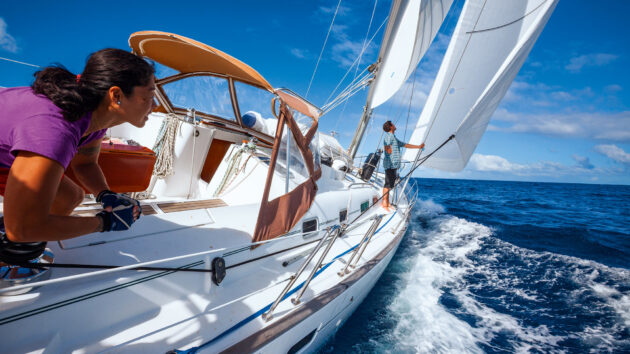
Photo: Tor Johnson
Who does what?There are broadly two schools of thought on how to split roles on board: divide equally, or play to your strengths. The critical thing is to ensure that one member of the team doesn’t end up doing all the sailing and technical jobs, with the other de-skilled.
Janneke Kuysters and Wietze van der Laan were closely matched in their experience levels. “Many couples need to have a clear ‘captain’ role on board. We don’t believe in that. The person closest to the wheel (or on watch) has the best oversight and takes the decisions,” says Janneke.
“Wietze is the better sailor, so he sails the boat while i do everything around it: food, radio, weather, navigation, paperwork, berth reservations, etc. We strongly believe in doing what you’re good at, instead of both wanting to be able to do all the jobs. Despite being together all day, you need to have something to talk about. And having achieved something you’re proud of is good for the ‘catch up’ at the end of the day.”
Article continues below…
“i had a vision that certain areas would be really equal in our roles – everything down to the marine electrics or engine maintenance and so on,” recalls Larissa Clark, who is cruising the Pacific with Duncan Copeland and their two sons.
“i tried to prepare towards that before we left, going on courses where i didn’t have the expertise. Two days into a marine electrics course, where it felt like every chapter ended with the word ‘Fire!’, i decided actually there were areas it was just better to divide and conquer. Electrics is definitely not my strength, but it is very much Duncan’s. But i always like to ask a lot of questions so i can understand the decisions that we’re making, and vice versa.”
Helen Harbour and her husband, David, sail their 46ft Amel ketch around six months of each year. Helen described a typical division of roles among our cruising couples: “i do the planning, navigation and piloting. David does the maintenance. i helm to anchor and pick up buoys. David helms to bring us into marinas. We both do all sailing roles, either together, or on our own. We both stand our own, equal length watches, carrying out all boat handling on our own, night or day.”
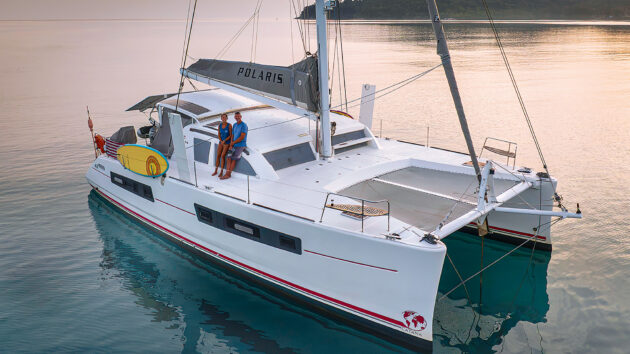
Kate Ashe-Leonard and Jim Hooper have sailed halfway around the world on their Catana 47 Polaris. Photo: Jim Hooper
“More demanding manoeuvres, we make sure that we do together,” observes Miguel and Claire Queiroz, who crossed to the Caribbean in their Fountaine Pajot 47.
“There were no clear cut roles for us. We had a sign above the companionway saying ‘The Captain’s Word is Law’. The only issue was that we both captained on and off, sometimes making it confusing which of us was the law and which of us was the law-breaker!” recall Sarah and Rasmus Haurum Christensen, who have lived aboard their Beneteau 423 for a year.
“We were convinced that a flat structure was the best way, and that turned out to be wholly right. But for longer passages we establish a dedicated captain. This means that if all hell broke loose, this person had the main responsibility and last word.”
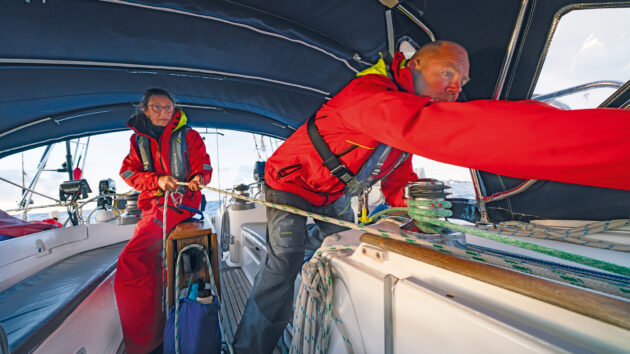
Most double-handed couples sail a large proportion of miles solo, but work together on more challenging manoeuvres. Photo: Nikkey Dawn/SV Freeranger
Domestic dutiesMany couples reported that domestic duties were more equally shared on board than on land. Seasickness is the often unspoken reason why one half of a couple takes on more domestic tasks.
“Wietze gets seasick. Making him cook or get a weather forecast would make him unnecessarily miserable. So he sails the boat outside, i do everything inside,” explains Janneke.
“While we tried to split boat jobs and domestic jobs as evenly as possible, the simple fact is that i don’t get seasick and can knock out a meal in most sea states, whereas i wouldn’t have a clue where to start fixing the watermaker or the generator. It made sense to play to our strengths and skill sets,” says Philippa Steventon, who cruised Europe and the Caribbean with her family on their Bowman 40.
“When we moved onto the boat i volunteered Elliot to deal with the composting loo, a task that involves a trowel. His tax for us living his dream!” adds Miranda.
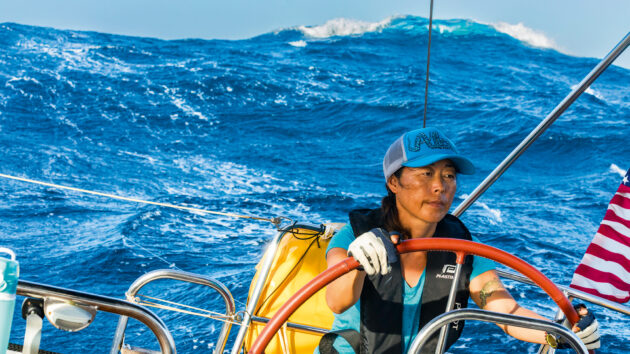
Downwind in big seas – fun sailing, but potentially stressful two-up. Photo: Tor Johnson
What do you both want?Having equal ‘buy in’ is important to mutual happiness. “What is most important is discussing your expectations: what does each person want to get out of cruising? That’s what we see most of the fights are about on other boats. In many cases, one is fulfilling a lifetime dream and the other is going along to keep the relationship going,” says Janneke. “That person is prone to homesickness, boredom and unhappiness.”
“We met so many couples where one – usually the wife – was there because it was her husband’s dream,” seconds Philippa Steventon.
Drilling down into expectations is important. “We are very lucky that we both equally sought this lifestyle, and have similar feelings about the sorts of places we like to go, and the balance between visiting well-known versus more challenging destinations,” explains James and Jayne Pearce, who live on their Garcia Exploration 45 Scout. “If one partner dreams about long bluewater passages, and the other dreams about socialising by a marina pool, then there are going to be some painful misunderstandings!”
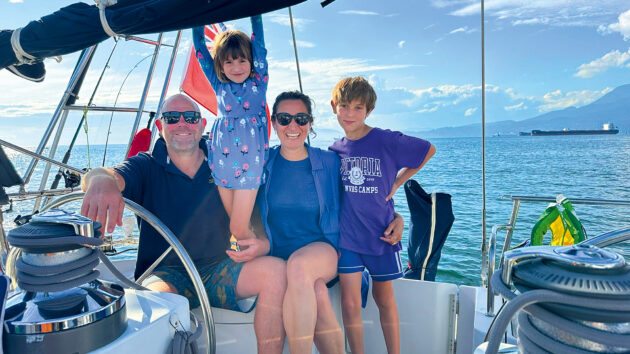
Larissa Clark and Duncan Copeland are cruising the Pacific while running the Free Range Ocean citizen science directory. Photo: Free Range Ocean
But you don’t have to bring equal experience to have equal involvement. “When you start out there will be one of you that is more confident in sailing or handling the conditions than the other. We learned early on that you really need to drive to the level of comfort where you are both happy. That may be a bit frustrating for the more experienced partner, but as time and experience move forward, trust is built allowing confidence to grow,” say Carl and Joanna Greenwood, who have been cruising their Lagoon 42 Rockhopper since 2021.
“Passage planning and weather routing really is a joint process. We both make a decision together as to whether to go or stay. If one of us is uncomfortable about the conditions then we don’t go. This way there are no ‘i told you so’ moments,” they add.
“It’s inevitable you are going to have bad passages and anchorages that don’t work out. But it’s important that it is both of our decisions, never just one person’s, so there’s no blame when things don’t go to plan. When we commit to something we have got to be in it together,” agree Simon McKenna and Soph Snijders, who are sailing their Duncanson 34 Nakama around Australia (and documenting it on their ‘Slim & Soph’ youtube channel).
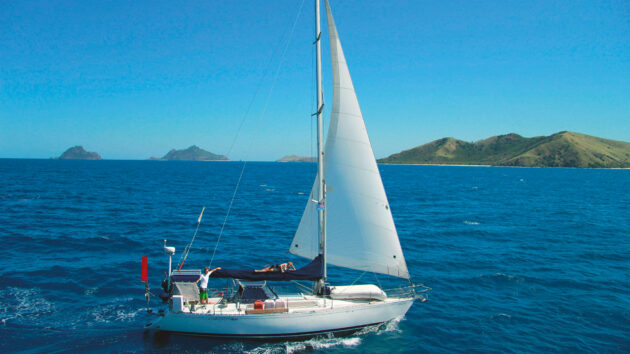
Sarah and Will Curry cruise with their twin boys, and remotely run the Hydrovane windvane company. Photo: Will & Sarah Curry
But big changes can put pressure on the cruising dream at any stage. “Sailing life is a huge undertaking. Working remotely adds a new element of time management. Parenting on board was a natural progression for us but the combination of all three ‘jobs’ landed us in the Red Zone,” recalls Sarah Curry. “We found ourselves in la Paz, Mexico, with toddler twin boys learning to walk on the boat, in the middle of Covid, with emails to answer, while trying to re-visit our favourite anchorages.
“Our challenge was admitting to each other that we weren’t having any fun. We had to slow down for a few years, which is not in our nature.”

Jessy and Chet Chauhan are cruising the world on their Nautitech 46 Open catamaran Navasana. Photo: Sailing Navasana
Problem solvingEvery couple has their flashpoints, largely depending on their boat set-up. One recurring issue our couples reported was handing downwind sails double-handed.
“For us downwind sailing in following seas presents the biggest challenge,” say Eamonn Naughton and Brigid McMahon, who have cruised their Rustler 42 for over seven seasons. “We carry a parasailor for downwind sailing and use a poled-out headsail when winds are in excess of 20 knots. Lowering the parasailor and gybing the pole in heavy seas can be very challenging double-handed. So when the weather gets up we now tend to sail on a broad reach (less than $160^\circ$ twa), gybe when required, and take the hit on course and vmg.”
“Wing on wing is the sail plan we most enjoy and have perfected,” say the Currys. “Our first boat came with a huge spinnaker pole strapped on the side of the deck. It was incredibly cumbersome, and even dangerous, for us to manoeuvre as a couple. We immediately had it mounted on a track on the mast for ease of deployment.
“We practice, practice, practice pole deployment and gybing. A well-balanced boat is essential for self steering, so we take this seriously and always use a pole on our monohulls when reaching or sailing dead downwind.”
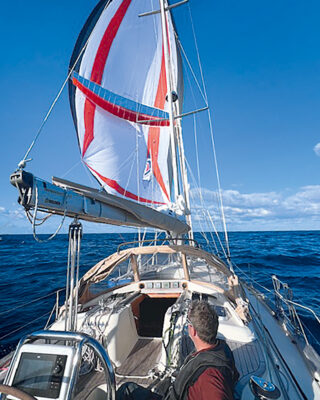
Irish couple Eamonn Naughton and Brigid McMahon sailing their Rustler 42 Mor Toad. Photo: Eamonn Naughton & Brigid McMahon
‘Marriage savers’Some double-handed issues can be solved by changing your gear. “Recently in Raja Ampat, Indonesia, we found it challenging in very tight anchorages where you have to use multiple shore lines,” recall Jessy and Chet Chauhan, cruising their Nautitech 46 Catamaran. “Chet had secured one line but while he was getting the second one attached, a squall came through that pushed the boat towards the reef. Jessy couldn’t use the engines, because the first shore line was under the boat and close to the propellers. We now have floating lines to tie to shore, which should allow Jessy to use the engines at any time.”
But by far the most common point of contention was mooring up. “Bella was Scheel keeled and particularly painful to manoeuvre in close quarters. This meant parking was 100% our biggest source of stress. We really didn’t want to be one of those couples screaming at each other going into marinas so we learned to get really calm and quiet coming in to dock,” says Philippa Steventon. Early preparation, doubling up lines and fenders on both sides, and refusing assistance from well-meaning bystanders helped smooth the process.
Many couples recommended radio headsets, often referred to as ‘marriage savers’. “For moments of potential contention we use headsets. In marinas, sometimes anchoring if it looks tricky, or when Elliot goes up the mast. The headsets have definitely reduced the need for raised voices – now we can whisper our insults at each other,” says Miranda Baker.
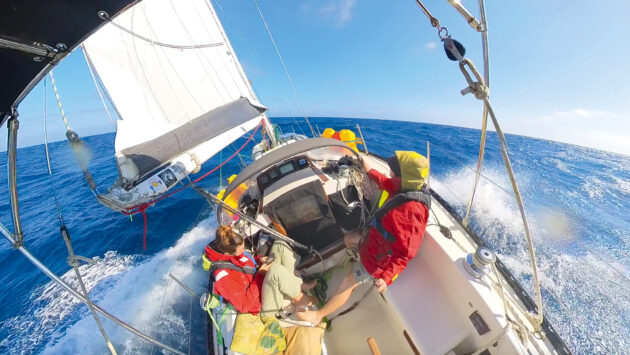
Simon McKenna and Sophie Snijders are rounding Australia on their Duncanson 34 Nakama. Photo: Sailing Nakama
Sarah Haurum Christensen feels there are three options for stress-free berthing: “Figure out some good hand signs and hope you understand each other; yell across 43ft, a rumbling engine and 30 knots of breeze; or buy headsets and dock like pros but look like boomers!
“We established clear hand signs, and yelled, which did not always end well. The most important tip here is to establish a method for dealing with arguments after a manoeuvre, and to debrief if arguments arose.”
Is it worth it?There’s no doubt that living on board will test a relationship like – almost – nothing else.
“We consider this the ultimate Ikea test!” says Sarah and Rasmus. “The Ikea test normally entails building flatpack furniture as a couple, and success means you can do anything together. Try doing plumbing in the bilge together at 0300 in 4m waves because you had a fresh water hose explode!”
Somira Sao and partner James Burwick took a more extreme approach before going sailing with their young children on an Open 40 – continuing as their family grew to six children on a 50ft trimaran. “We were unique in that we never had a land life together in the traditional sense. We did not come from a world where we had to downsize from a four-bedroom house,” Somira explains. “All of our time living together involved an expedition lifestyle – bike packing for 12 months, living in vans etc.
“Before you commit to going sailing, we highly recommend doing some off-grid expeditions together. It’s a good litmus test for what will happen when you’re in a small space on a boat together in the middle of the ocean.”
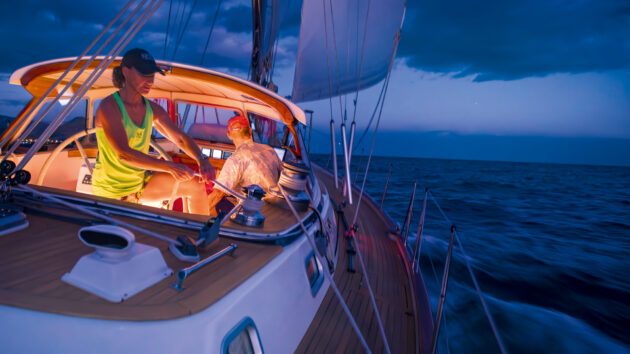
For many couples the shared time together is a huge draw to double-handed liveaboard cruising. Photo: Tor Johnson
Prepare for some teething problems, even if you are experienced cruisers. “On both our long voyages, we have learned that the first three months are the most challenging,” says Janneke Kuysters. “You have to get used to living together on the boat, to being underway all the time and letting go of everything you were used to.
“For many people, their job is part of their identity. So if the job is no longer there, they have to find their new identity as a cruiser. We always advise to give it time and allow yourself to get used to your new way of life before making big changes.”
But the rewards are huge. “We spent 18 months living aboard while completing the World ARC,” says John DiMatteo and his wife Angela. “In addition to sharing a life changing experience (for the better), the biggest benefit was greatly improving how we communicate with each other. It brought us much closer together at an age where many couples start to drift apart.”
“i am glad i didn’t know how scary it can be,” reflects Miranda Baker, whose partner Elliot faced a life-threatening medical emergency in a remote anchorage. “i’m not sure if i’d have put my hand up, and that would have been a shame. This life probably makes or breaks relationships, so i am proud of our resilience as a couple.”
She concludes: “The immersive experience of exploring our planet by sailboat is a wild ride but the reward is equal in measure. We experience a freedom to choose what’s next for ourselves that’s rare for most humans. We are humbled by enormous, star bursting skies and by important things breaking in remote places.
“We have each other’s backs. And, when Elliot and i are very old, we will have a thousand crazy stories to reminisce over and laugh about.”
 If you enjoyed this….
Yachting World is the world’s leading magazine for bluewater cruisers and offshore sailors. Every month we have inspirational adventures and practical features to help you realise your sailing dreams.
Build your knowledge with a subscription delivered to your door. See our latest offers and save at least 30% off the cover price.Note: We may earn a commission when you buy through links on our site, at no extra cost to you. This doesn’t affect our editorial independence.
Comments (0)