
Remember me
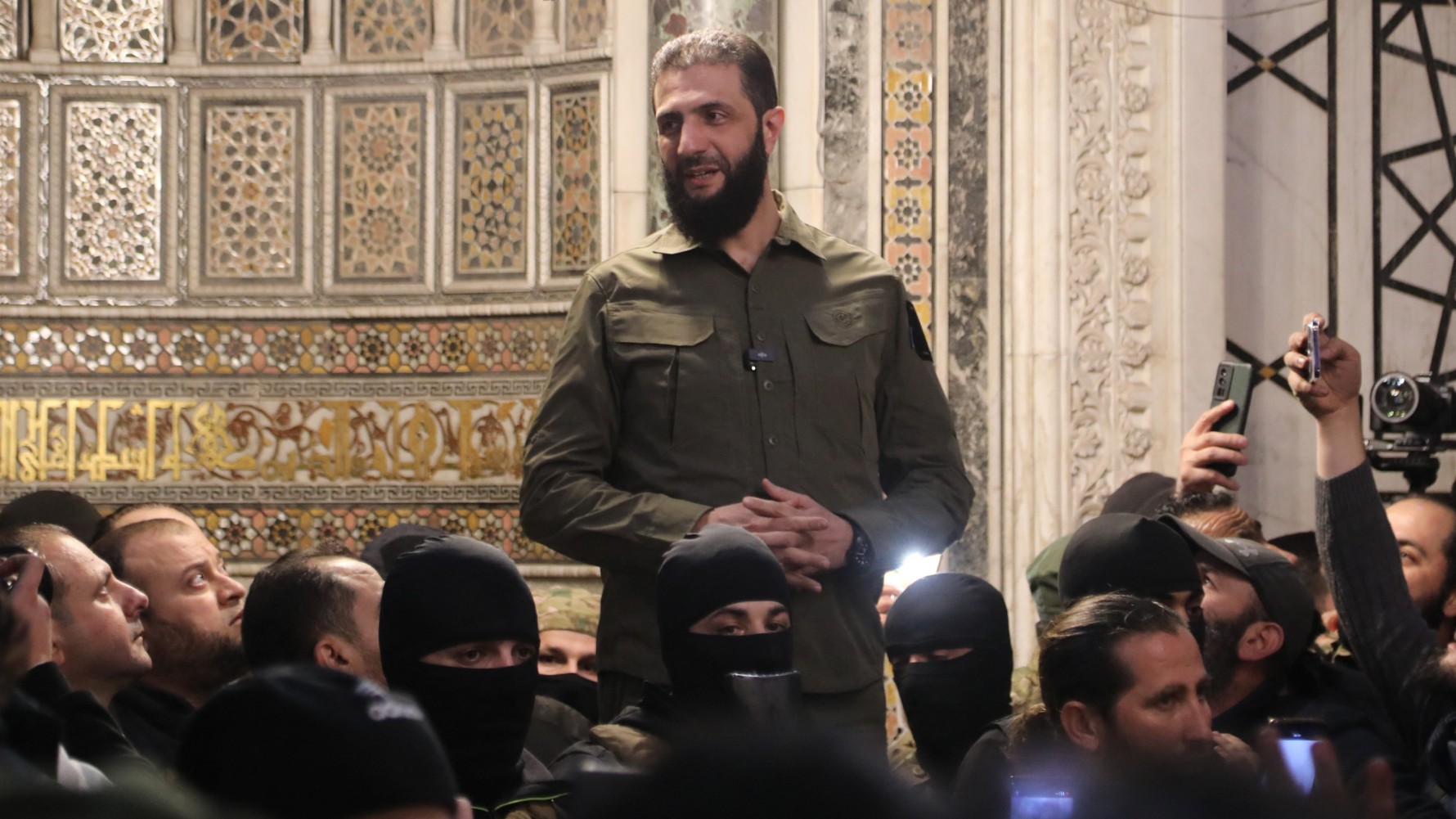
Sharaa's pragmatism and close relationship with Turkey helped open doors, leading to his transformation from jihadist leader to rebel statesman and finally Syrian president
It was the spring of 2019, and Syrian government forces were beginning to push towards Idlib with the help of the Russian air force.
There was an emergency.
Abu Mohammed al-Jolani, the commander of the Hayat Tahrir al-Sham (HTS) group, was sitting with his entourage and some foreign guests, including Turks, at a safe house in the heart of Idlib.
As the night progressed, he opened up, and began sharing some personal stories.
"When I was a child, I once had a dream about my future," he said slowly, with deliberate intensity. "In the dream, I became the Emir of Damascus."
Sign up to get the latest insights and analysis on Israel-Palestine, alongside Turkey Unpacked and other MEE newslettersJolani said the dream was a good omen, a divine clue about his destiny.
He believed that the war against Syrian President Bashar al-Assad would be tough but ultimately winnable. Those close to him, including figures with Salafi backgrounds, said he truly believed in that vision.
Nearly five years later, Jolani has dropped his nom de guerre and is the interim president of the Syrian Arab Republic - the "emir" he once dreamed of becoming.

‘We got rid of a tyrant’: Syria’s tumultuous first year without Assad
Read More »Now going by his birth name Ahmed al-Shaara, the 43-year-old has quickly transformed himself from a "jihadi terrorist" into a statesman.
The change has been stunning, considering his long career in jihadist groups such as Al-Qaeda, spanning from Iraq to Syria.
Since ousting the Assad dynasty, Sharaa has warmly embraced world leaders he once eschewed.
He appears publicly with his wife, has trimmed his beard, has dropped his turban and thobe for a suit and tie, all the while trying to build a new state free of overtly Islamist influence.
But how did this transformation happen?
Turkish and regional officials, Syrian sources, experts, and even Syrian government insiders believe that the change had been unfolding gradually throughout his rule in Idlib, a de facto "proto-state" that, in effect, reshaped Sharaa’s persona.
"Turkey played a practical role in his transformation," a Turkish official who met him years ago, when he was still the leader of HTS, told Middle East Eye.
First engagementsAccording to the official, Sharaa had his own reasons to change. He needed to survive the war and relied on Turkey, as he was cornered in a territory where Ankara was his only lifeline.
His first significant engagement with Turkey began after his group, then known as Jabhat Fatah al-Sham, seized the Bab al-Hawa border gate in Idlib in 2017, a vital passage for UN humanitarian aid.
After Turkey decided to close the crossing, Sharaa established a civilian administration to manage it, distancing his group from direct control.
Although Turkey continued supporting rival opposition groups such as Ahrar al-Sham and Nureddin Zengi against him, Sharaa ultimately emerged as the dominant force in Idlib, forcing Ankara to reconsider its stance.
The Turkish security team that previously handled the Syria file and opposed Sharaa was gradually replaced as he consolidated power.
'Sharaa was eventually convinced by Turkey's messages that Idlib's issue could not be resolved under the dominance of a single faction. That is how Hayat Tahrir al-Sham was born
- Turkish security source
Turkey had additional reasons to engage with him.
Under the Astana process, it was assigned to build observation posts around Idlib, which required establishing a working mechanism with HTS.
"Sharaa was eventually convinced, though reluctantly, by Turkey's messages that Idlib's issue could not be resolved under the dominance of a single faction. That is how Hayat Tahrir al-Sham was born," a Turkish security source familiar with the process told MEE.
Founded in 2017, HTS brought together some of its former rivals, adopted a more Syrian identity, and established a council including other factions, granting it more legitimacy and flexibility to cooperate with or oppose Turkey as needed.
Soon after, the so-called Salvation Government, a civilian administration for Idlib, was created.
Turkey believed that a more civilian and governance-focused structure would ease the legitimacy problem.
"If we establish it this way, we can frame it as a continuation of the Syrian revolution, a defensive struggle and the protection of civilians," a Turkish official said during a meeting at the time.
"Turkey supported the Salvation Government as a model," another security source added.
A new strategyDareen Khalifa, a senior adviser at the International Crisis Group (ICG), said that both Sharaa's decision to open up, and Turkey’s engagement with HTS, happened simultaneously, as both parties sought a new strategy.
"He began changing his messaging toward Turkey's deployment and softened his tone," she said.
"It was clear that he was signalling to Turkey because he needed their help."
Khalifa added that Sharaa understood Turkey was shifting gears, and that Ankara and Moscow’s fragile ceasefire was unlikely to hold.
"When we talk about Turkey, you have to distinguish between the intelligence services and the state institutions like the army," Jerome Drevon, co-author of Transformed by the People: Hayat Tahrir al-Sham’s Road to Power in Syria, told MEE.
"The military and bureaucracy never liked HTS and continued to treat it as a terrorist organisation, arresting its members.
"Only the intelligence branch dealt with HTS pragmatically."
According to Drevon, both sides understood they shared interests.
Turkey wanted Idlib to remain under opposition control, to prevent another massive refugee wave. Nearly 1.9 million people lived there, which could destabilise Turkey. Ankara also wanted to curb threats from foreign fighters.
"They reached a kind of understanding," Drevon said.
When Syrian government forces, backed by Iran-aligned militias and the Russian air force, launched a new offensive in early 2020, Turkey was forced to intervene directly to prevent another refugee influx.
Ankara struck hundreds of Syrian government targets and stationed more than 12,000 soldiers across the province, establishing practical ties with HTS.
These interactions gradually changed the nature of HTS.
"Turkey's influence was indirect but powerful," Drevon said.
"Every time Russia made new demands, like withdrawing heavy weapons or organising joint patrols, HTS had to comply, even if unwillingly."
Some within HTS opposed these concessions, pressuring Sharaa to sideline or purge them.
"HTS had to transform and remove radicals who rejected such compromises," Drevon added. "That was the main impact of Turkey's engagement."
More responsive after jihadist splitsAfter the fall of Bashar al-Assad’s government last December, a senior Turkish official said Ankara managed to influence HTS "through engagement".
Omer Ozkizilcik, a fellow at the Atlantic Council and a longtime Syria observer, described the strategy as "change through engagement".
"For the first time in history, a jihadist organisation labelled as a terrorist group became a legitimate entity through this approach," he told MEE.
The key turning point came when HTS began targeting the Hurras al-Din group, which had remained loyal to Al-Qaeda after Sharaa's split.

Returning to Damascus after years of war, I found hope
Read More »"Sharaa became more responsive to Turkey after confronting Hurras al-Din," Ozkizilcik said. "It proved his claim that HTS had genuinely broken from Al-Qaeda."
Ozkizilcik adds that Turkey understood the division and formulated a policy to divide the dogmatists from the pragmatists in Idlib.
Over time, Sharaa's close associate Shaibani was allowed to enter and leave Turkey and to meet foreign officials there with Ankara’s tacit approval.
Turkish insiders believe Ankara shared intelligence on Hurras al-Din with the United States, which then targeted senior commanders, though Drevon disputes that claim.
Khalifa emphasised that Turkey also cared deeply about how HTS presented itself publicly, encouraging moderation and tolerance toward minorities.
"Turkey had much more leverage than anyone else," she said. "It was important for Ankara that HTS appeared to respect minorities such as Christians and avoided imposing a strict Islamist rule. Turkey did not want to appear as protecting a problematic group."
Recognising these opportunities, Sharaa remained flexible in his outreach, a Syrian source who had tracked him for years told MEE.
"Even though he was harsh toward his opponents in Idlib, he continuously sent messages to the West through Turkey about the Salvation Government for three or four years," the source said.
Outreach to the westBy 2020, Sharaa portrayed himself as a disciplined soldier, claiming he was merely "a servant" of the Salvation Government.
By the end of that year, he had established indirect relations with western countries via Turkey. British and other European officials began meeting him or his representatives to discuss topics like humanitarian aid.
"The important thing is that they can talk," said one Turkish official at the time.
As these contacts expanded, analysts began producing governance-focused reports comparing Idlib's administration with the deteriorating Assad-controlled areas.
Researchers visited Idlib through Turkey, and international engagement increased.
'He is an Islamist who believes that Islam has a political and social role, but he has no clear ideology'
- Jerome Drevon, author on Syria
In 2021, Sharaa, then still going by the name Jolani, gave an interview to PBS Frontline, the first time he was seen in civilian clothing, signalling change.
According to Drevon, Turkey did not organise these expert visits or the PBS interview but allowed them to happen.
"It helped to debunk the idea that HTS was simply an al-Qaeda affiliate threatening international security," he said.
"Ankara didn't micromanage it, but it understood the benefits of engagement."
Khalifa, who was one of the first experts permitted to enter Idlib in 2020, says no one from the Turkish government had tried to interfere with her reporting on the Crisis Group.
Several Turkish officials later said their influence over Sharaa helped him evolve from a jihadist commander into a revolutionary figure focused on protecting civilians in Idlib.
Ozkizilcik said that once Idlib was secured, HTS began building a small functioning state - expelling rival armed groups from urban areas, deploying a police force, collecting taxes, and supporting businesses.
"Money started to enter the province once basic security was guaranteed," he said, describing this as a key step in the group's transformation.
A senior regional official recalled a Turkish envoy advising Sharaa: "You are good-looking. If you want to die, you will be a handsome martyr, but if you want to live, you could be the ruler of Syria."
Drevon noted that the more Sharaa contained radicals within his ranks, the more openly he could express his pragmatic side.
"He is an Islamist who believes that Islam has a political and social role, but he has no clear ideology," he said. "He is more a man of action than of ideas."
A distracted RussiaBy 2022, both Turkey and Sharaa reached a new turning point. Russia’s invasion of Ukraine quickly reduced Moscow’s military presence in Syria, shifting the balance.
At the end of that year, during a conversation at a house in Sarmin, Sharaa reportedly said: "There is little time left before all the knots are untied. The revolution will return to the pre-2015 process."
And indeed, events seemed to unfold that way.
By then, Turkey had already invested in the military academy established under HTS control in Idlib. Books had been translated, training programmes prepared, and full curriculums developed.
The academy drew on the combat experience of fighters from Afghanistan, Mali and Chechnya, and became highly active. Meanwhile, Turkish-backed opposition groups in northern Syria still lacked a military school, though they would establish one by 2023.
'In the operations room, unable to contain himself, he stood up, lifted both hands, and shouted joyfully: 'Bear witness, O people of Damascus! History is being written here!''
- Syrian source
One Turkish official said they were also able to convince some of the British interlocutors to engage with Sharaa and HTS. This eventually led to a role for Jonathan Powell - then the chairman of conflict resolution NGO Inter Mediate, now the UK prime minister's national security adviser - who organised trips and workshops in 2023 to help the group reform itself.
Robert Ford, the former US ambassador to Syria, confirmed the outreach last year during a policy forum.
As HTS expanded its capabilities and strengthened its control, Sharaa began pressuring Ankara for permission to launch new offensives to seize additional territory.
For months, Turkish officials resisted, warning that such action would provoke Russia and trigger another humanitarian catastrophe.
Ozkizilcik said Turkey eventually lifted its veto after reconciliation efforts with Damascus failed and Russian officials began issuing hostile statements. In November 2024, Russia’s special envoy for Syria, Alexander Lavrentiev, said Turkey should "stop acting as an occupying power" in Syria.
"It is very difficult for Damascus to engage in dialogue without guarantees from Ankara regarding the withdrawal of its troops," he added.
The subsequent Astana meeting did not improve the situation. Russia demanded a withdrawal timeline for Turkish forces, prompting Ankara to reconsider.
"The Turkish view then was that HTS could launch an offensive to seize the western countryside of Aleppo and reach the city," Ozkizilcik said.
"No one expected the lightning speed of the operation, which saw city after city fall to Sharaa's forces."
A Syrian source who was with him at the time described Sharaa's euphoria:
"As the Aleppo operation that reignited the revolution advanced, the capture of Qaptan al-Jabal and, one after another, the surrounding villages made Sharaa extremely happy.
"From the operations room, he spoke to units over the radios as they pushed toward central Aleppo. At one point, the offensive stalled on the western front, but fighters, including some Uyghurs, infiltrated through an old water tunnel and resolved the issue.
"Aleppo fell. Sharaa was overjoyed. They turned south. When Hama fell, he became convinced that the revolution would triumph.
"In the operations room, unable to contain himself, he stood up, lifted both hands, and shouted joyfully: 'Bear witness, O people of Damascus! History is being written here!'
"Those around him later said it was the first time they had ever seen him so emotional."
Comments (0)