
Remember me






Listen to this article
Estimated 4 minutes
The audio version of this article is generated by AI-based technology. Mispronunciations can occur. We are working with our partners to continually review and improve the results.
A drug alert has been issued in Thunder Bay, Ont., over a toxic substance first found in Toronto earlier this fall.
The drug, called cychlorphine, is a synthetic opioid that was never clinally approved to be sold on the market.
NorWest Community Health Centres (NWCHC) issued the warning on Wednesday, saying cychlorphine was identified in what was sold as a blue Percocet tablet.
“These counterfeit pills mimic pharmacy-issued tablets in terms of colour, size and stamp numbers or markings on them,” said Brittany D’Angelo, director of mental health and substance use programs at NWCHC.
“It was never approved for human consumption, so its true effects and strengths are unknown, but we presume it to resemble those of other potent opioids like fentanyl.”
The Thunder Bay district continues to have the highest opioid-related death rate in the province, according to the latest report from Ontario’s Office of the Chief Coroner.
It's more than four times the provincial average, at 39.75 per 100,000 population versus 8.35 per 100,000 population.
 Team members at NorWest Community Health Centres (NWCHC) in Thunder Bay, Ont., are seen at the launch of the mobile outreach van in June. The van has been retrofitted to allow mobile drug-checking services to be conducted on board. (Sarah Law/CBC)
The city’s only supervised consumption site, which was run by NWCHC, was forced to close earlier this year due to new provincial rules on how close sites can be to schools and child-care settings.
However, people can still get their drugs tested at the organization’s mobile outreach van, which provides support services throughout town.
“We know most of our substances come from outside of town and that things that we see in the bigger cities make their way here,” D’Angelo said.
We're seeing more and more synthetic opioids that are even stronger than fentanyl showing up in the supply, which increases risk of overdose.- Brittany D'Angelo, NWCHC director of mental health, substance use programs“We're seeing more and more synthetic opioids that are even stronger than fentanyl showing up in the supply, which increases risk of overdose.”
These include benzodiazepines, animal tranquillizers “and other cutting agents [used to dilute a drug] in the unregulated supply,” she explained.
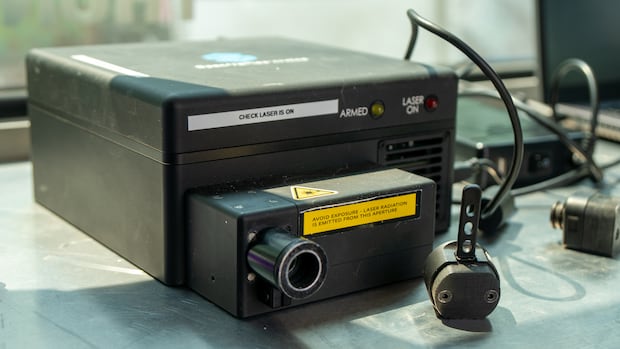
NorWest’s drug analyzer can detect harmful contaminants and unexpected ingredients in the substances people have purchased. The goal is to help people who use drugs make safer, more informed choices about what they’re consuming.
The device uses Raman laser technology to scan substances, either conducting trace scans — using a tiny sample of the substance — or bulk scans, where the substance is scanned through a clear bag.
WATCH | How Thunder Bay's drug testing machine works:Test strips that detect fentanyl, benzodiazepines and xylazine are also available for people to take home.
The mobile outreach van operates Monday through Friday from 8:30 a.m. until 4:30 p.m. The service is free and anonymous.
“It's kind of the best way that we can know and understand how the [drug] trends are changing in the city, but also knowing how we can most safely do substances if that's something that we're doing,” D’Angelo said.
People can contact NWCHC to find out where the van is at any given time. D’Angelo said it will be in the County Fair area on Dec. 30 and in downtown Port Arthur on Dec. 31.
Since the holidays can be a tough time for many, people are also encouraged to download the free LifeguardConnect app, which provides a number of resources related to addictions and drug consumption.
Anyone using drugs can set a timer on the app. If they don’t turn off the timer, emergency medical services are alerted of their location, signalling they have potentially overdosed.
“I think it's one of the best communication tools that we have for the community, the best way that we can start conversations with our loved ones,” said Nicole Fieduna, operations manager at Thunder Bay’s Homelessness and Addiction Recovery Treatment (HART) Hub, of which NWCHC is the lead partner.
She also urges people to never use substances alone and always carry naloxone, which can be used to reverse the effects of an opioid overdose.
“We know that there's many people that use substances, they use them for different reasons, and our goal is just to make sure that people are using them in the safest way possible,” D’Angelo added.
Comments (0)