
Remember me




Not unlike viewers of Netflix’s , the first thing that actors and saw on set for the epic new Mary Shelley adaptation was a life-size 19th century Royal Danish Navy ship. Except here, it wasn’t withstanding a harrowing snowstorm — it was hanging out in a parking lot. “You read it in the script, but you don’t think that in the parking lot there’s going to be an actual full-size Arctic expedition ship on gimbals,” says Isaac. “It was really nuts.” Elordi adds, “The scale of this thing was bigger than I could have imagined.”
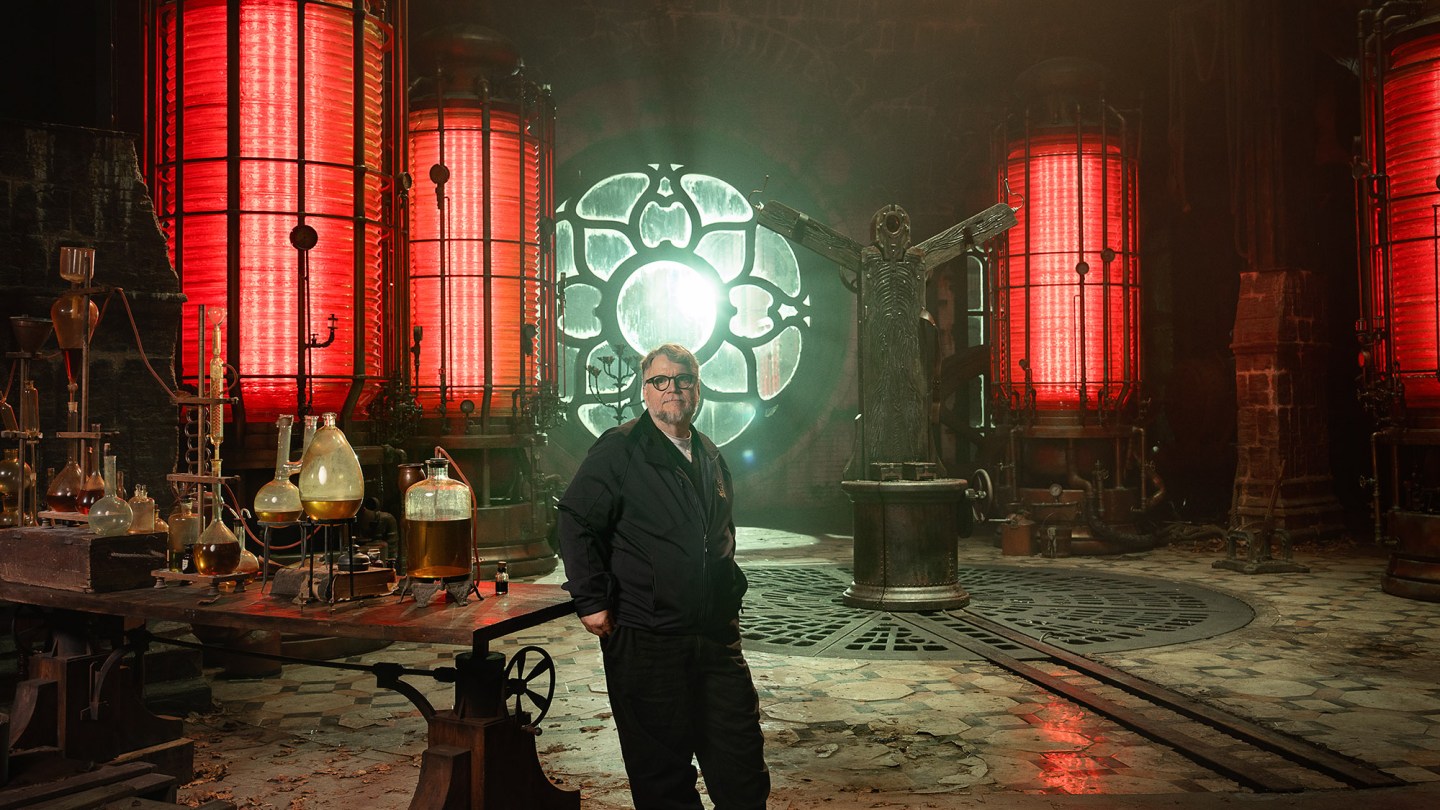
Welcome to the world of — a land of massive hand-built set pieces, long but impassioned working days, and boundless imagination. This has been true for the Oscar-winning filmmaker as long as he’s been making movies, from Pan’s Labyrinth to The Shape of Water, but it was always going to be different with Frankenstein: This is the movie he’s waited his whole life to make. He wrote the script in evocative chapters, to honor the structure of the Shelley novel that changed his life. When he saw Elordi’s Creature come to life for the first time, “The Creature that I read and imagined as a kid was now on my set — the Creature that I’ve been trying to give life to through makeup design, starting with Kronos, The Devil’s Backbone and Blade II,” he says. “It was like I was rehearsing.”
Related Stories
To realize his lush, feverish vision, del Toro enlisted an army of his most trusted collaborators, including costume designer Kate Hawley, production designer Tamara Deverell, prosthetic makeup wizard Mike Hill and composer Alexandre Desplat. Before the script was even written, these and other artisans were deep into building Frankenstein from the ground up. “I say there is no eye candy — there’s only eye protein,” says del Toro. “The departments should be as interactive as possible, and all of them are articulating not a look but storytelling through images.” Cinematographer Dan Laustsen, who has shot del Toro’s films for the past decade, says, “When he’s writing the screenplay, he’s making concept drawings that are very loose, but very specific, of special color palettes. We’re always starting on the same level.”
“The Creature that I read for the first time in Australia was exactly how he came out onscreen,” says Jacob Elordi. “I knew what to do as soon as I read it, and that is because Guillermo wrote something that is so, so good.”
Ken Woroner/Netflix
Adds Hawley: “As each department makes inroads into their own personal world, you’re aware of their journey and how that’s reflected and mirrored within your world. We’re always so conscious of each other’s work and how we’re echoing that or choosing to be in contrast with that under Guillermo.”
Take the aforementioned ship, which opens the film, trapped in ice as it’s headed to the North Pole — it’s a flash-forward to the site where the Creature is coming after his maker, a sick and aging Dr. Victor Frankenstein (Isaac), for the climactic confrontation that frames the film through to its moving conclusion. Deverell has long been fascinated by the Arctic and had always wanted to build a ship for a film. She didn’t know if she’d get the chance for Frankenstein until word at last came through. She gave it her all, including the brutal surrounding icescape, and then was able to trust her colleagues to make the most of the space — specifically, Laustsen to evoke the majesty of her creation with the camera.
“We weren’t sure if we were going to build the ship,” Deverell says. “We actually looked for a ship for a while.” As the hand-built nature of the film came into focus, they decided to construct it as a full-size set after all. In total, the crew collectively spent more than 3,000 days of labor building it, step by step.
Ken Woroner/Netflix
“One thing I know working with Guillermo and Dan is they will shoot the shit out of everything. They’ll go wide and go close and not be afraid of low ceilings, like they are in the captain’s quarters,” Deverell says. “They embrace all the bits of the set that I can offer. So when you’re just exhausted and giving it your all, at least you know that it’s going to be filmed so beautifully.”
Adds Isaac of the production setups: “They were 360 degrees; they were modular, so they could always be moved and rearranged to fit for the camera.” Deverell built 119 sets total, including 24 full studio sets. The actors — a starry ensemble that includes Charles Dance as Victor’s overbearing father, Christoph Waltz as Victor’s mercurial benefactor, and Mia Goth as both Victor’s mother and his love interest, in separate timelines — felt totally immersed during filming because of Laustsen’s single-source lighting system, with all of it beaming in from the outside (in the classic-film tradition). “He lit the sets overnight, so all the light came through the windows or doorways,” says Elordi. “That takes an immense amount of prep.”
Christoph Waltz, who plays the benefactor for Victor’s lab, fit neatly into the design palette of Frankenstein’s first act. “The visual table, as coordinated by direction, is a table with four legs: production design, makeup and hair, wardrobe, and cinematography,” del Toro says. “Those should be as interactive as possible.”
Ken Woroner/Netflix
Observing the artistry of various departments proved essential to Isaac for finding his way into the character, whose point of view defines the first section of the film, as he becomes obsessed with his looming creation. “The set is Victor’s mind. The costumes are Victor’s mind. Everything is Victor’s mind,” Isaac says. The actor developed a bond with del Toro — “We spoke only in Spanish to each other” — and wanted to “surrender” to the director’s dedicated approach to making Frankenstein. When he stepped into his first costume fitting with Hawley, everything started to click.
“It was the first real slap in the face of the intense artistry of what was happening — the walls were covered with art everywhere, all these incredible references from around the world,” he says. “Guillermo would come to every single costume fitting. Out of these conversations between the three of us, I first saw these Jimi Hendrix and punk rock references going through the ’60s, ’70s and ’80s, painting Victor as this kind of iconoclast — and that gave me a sense of who this guy was.” As Hawley explains her approach, “Victor is operatic in everything that he does. We had so many different obscure references, even down to William Blake paintings.”
The lab where Victor assembles and finally animates the Creature was one of the biggest sets that Deverell worked with; in fact, it was composed of “about eight different sets altogether.” Most everyone who worked behind the scenes on the film points to the scene of creation, complete with lightning strikes and rain and the fresh emergence of one of fiction’s most iconic creations, as among the most challenging of the months-long shoot. “It’s coming into a magic-hour shot — he’s running off to talk to his friends, saying the storm is coming, he’s running off to the rooftop, he’s … killing,” Laustsen says with a laugh. “Then the lightning strikes start to be a big part of the scene.” It required an elaborate level of “organic” coordination between departments.
Oscar Isaac concurs that there’s nothing like working on a del Toro movie. “I wanted to give over to his vision because it was so complete,” he says. This meant keeping any past versions of Victor Frankenstein out of mind: “I approached it the way that I approach Shakespeare.”
Ken Woroner/Netflix
The neat trick is that the film, by staying so stuck in Victor’s perspective, eschews the “mad scientist” trope that has tended to box in dozens of past versions of this scene. “We also often chose to use the music as a counterpoint to the image … and in the scene where Dr. Frankenstein is assembling the body parts, instead of playing the gore violence onscreen, we share his point of view,” says Desplat. “[It’s] an exhilarating moment of creation, that of an artist in a trance creating his masterpiece.”
And so the Creature is born — at which point the narrative flips, with del Toro’s epic, emotional exploration of fathers and sons beginning in earnest. “Victor and the Creature are two sides of the same soul,” del Toro says. “The narrative of Victor is isolated from the Creature, the narrative of the Creature is isolated from Victor. When Victor is alone, we multiply him on several mirrors before he creates the Creature. Then the Creature and him are reflected in mirrors — together.”
The sequences set in the brutal winter, like the dog-sledding scenes, were shot on massive outdoor sets as well as in desolate areas north of Toronto. “Shooting on a giant frozen lake, it’s such a headspace to be in — to be so alone,” Deverell adds.
Ken Woroner/Netflix
When del Toro first told prosthetic wiz Mike Hill that he was actually, really, finally going to make Frankenstein, he let him know one condition: He would not make the movie without him. “Mike is, in my opinion, one of the top three monster-makers alive today and in the top 10 monster-makers of all time,” del Toro says. “He’s sculpting character. Mike doesn’t do likeness — Mike does soul.” Del Toro and Hill also both happen to be two of the biggest “Frankenstein heads” alive, per the filmmaker.
“The main thing was trying to come up with something that hadn’t been seen before,” says Hill. They were only nine weeks out from shooting when Andrew Garfield, originally cast in the part of the Creature, dropped out because of scheduling conflicts. Their dream seemed to be slipping away. “Mike was having a meltdown,” del Toro says. “I said to him, ‘You and I have been preparing all our life for this movie. That’s how much prep you’ve had.’ ”
Adds Deverell of del Toro: “I know him intuitively — I’ve worked with him so long that I get what he is going to ask for.” In the case of Frankenstein, she knew to focus on “the repeated use of the circle and arches,” most evident in the laboratory.
Ken Woroner/Netflix
Elordi took on the part and learned from the outset that the job would require not just 10-hour days spent in the makeup chair, but a full connection with that laborious process. “Guillermo spoke about the prosthetics, and he said, ‘This is going to be a long process, but you can’t look at it like a job or something you have to get through,’ ” Elordi says. “He said, ‘It has to feel holy. It has to feel like taking the sacrament, eating the bread, drinking the wine.’ ” Fortunately, Elordi connected to the project as such when he read the screenplay. “That was the exact sort of approach I’ve been waiting to take,” he says. “I wanted someone to take the movie as seriously as I wanted to take it.”
How deeply did Elordi identify with the part? He said to del Toro at one point, “This Creature is more me than me.” He brought out a sensitivity and an otherworldliness that marked genuinely new territory for one of cinema’s most recurring presences.
It’s partly a credit to the performance, but perhaps more to the bond that took place between del Toro and Elordi. “From the moment that I met him, it felt like I’d known him for my whole life,” the actor says. Del Toro sent Elordi books, including one on the developmental stages of an infant, to help him track the Creature’s journey from newborn to some level of agency. They watched silent movies together. They confided in each other.
On Elordi’s first day of filming, “I grabbed Jacob’s hand and patted my own head with it, and I just hugged him,” del Toro says. “And every day, I would show him the work from the day before, edited and put together so he understood how great the scene was that we shot the day before.” Elordi was deeply inspired by the director’s tirelessness: “The script kept changing as we were shooting. He’d rewrite every month and add things and take things away. When he shoots a movie, it’s a completely active process. Until I’m at least 65, I’ll always have the image of Guillermo working to the bone on something — and it means I can never stop.”
Frankenstein marked Deverell and del Toro’s most epic collaboration yet. “I knew he wanted to make this for a long time, so I wasn’t surprised when he asked me,” she says.
Ken Woroner/Netflix
The character’s emergence paralleled the dark shift in the film’s aesthetic. “We worked on loads of little gestural drawings, about 30, just looking at the silhouette of the Creature coming out of the mist,” Hawley says of a key early sequence for the Creature. “Is it a bear or beast or a man? Guillermo wanted the silhouette to suggest any of those things.” Hill’s design, constructed with 42 silicone pieces attached to Elordi head-to-toe, reinforced this ambiguity: “I wanted to make it a mystery of what is actually going on in him. I didn’t want him to look like a statue, and I didn’t want him to look like a dead man.”
But emotion always fueled the evolution of the film’s look. “The first time when we see the Creature in Victor’s bedroom, when Victor opens the blinds and the sunshine is coming into the room, it’s very warm — a very strong father-and-son sequence, lit with golden sunset light,” Laustsen says. “When things start to fall apart, everything is getting very cold, steel blue.” This progression was rooted in the script stage, with distinctive chapters delineating not only the tragic changes in the Victor-Creature dynamic but also alterations in their visual realms. “This mirrors the effect of a Shelley novel in many ways,” del Toro explains.
Notes Isaac of how he approached playing Victor in the movie’s back half: “I was much more interested in a passionate artist as opposed to a mad scientist. Madness doesn’t feel like madness to the person experiencing it. It feels completely sane to the person experiencing it. So this Creature, this thing that he’s created, once he decides it’s an object and dehumanizes it —which is something that we’re seeing a lot of in this country right now — whatever cruelty he inflicts on it is justified because the idea is more important than their humanity.”
“I almost cried when I saw that ship push out of what was our parking lot and what would’ve been the Toronto Harbour and city of Toronto in the background,” says Deverell. “VFX did such a beautiful job of extending that set; the ice field around it took my breath away.”
Courtesy of Netflix
All of this leads to the final scene between Victor, bedridden and depleted, and the Creature, relatively grown up. There is pain, regret and a surprising note of forgiveness amid all the muck. It’s also the very first thing that Isaac and Elordi shot together. “We didn’t rehearse, we didn’t talk about anything,” Elordi says. “It was in the second week of filming, and it was our first time we’d met each other — just in the hallway before that, and that was it.” Adds Isaac: “It felt very familial, and that gave it a very autobiographical feeling as well. We were just present with what our emotional truth was.”
Such tenderness is not generally what one would expect of any Frankenstein adaptation. “Guillermo looks at these very dark, ugly things and he shines a light on them,” Isaac says. “He’s able to also laugh at it and be like, ‘Look how insane and silly and blind humans can be.’ ” But part of that open-heartedness also has a lot to do with how deeply this material had burrowed its way into del Toro’s bones. This is the movie he’s been working toward for decades, and to not find the bright, messy humanity of the story — the stuff he connected to when he first read Shelley’s novel all those years ago — would be to miss the point of his initial desire to make his own version.
Production designer Tamara Deverell worked with del Toro as the art director on his second feature, Mimic, nearly 30 years ago. She’s since worked on The Shape of Water, Nightmare Alley and more.
Ken Woroner/Netflix
So what did it feel like on the other side, when del Toro finally put the finishing touches on his white whale? “It’s as if you saved all your resources, all your existence, to go somewhere — say, Paris — for a moment. ‘I’m going to buy this camera for when I go to Paris, I’m going to buy this beret for when I go to Paris,’ ” del Toro says. “And then you go to Paris, and you come back and you say, ‘Oh, now where am I going next?’ It really is, existentially, a very puzzling moment.”
So it goes when you finish your life’s work. Just ask the good Dr. Frankenstein.
This story first appeared in a December stand-alone issue of The Hollywood Reporter magazine. To receive the magazine, click here to subscribe.
Comments (0)