
Remember me




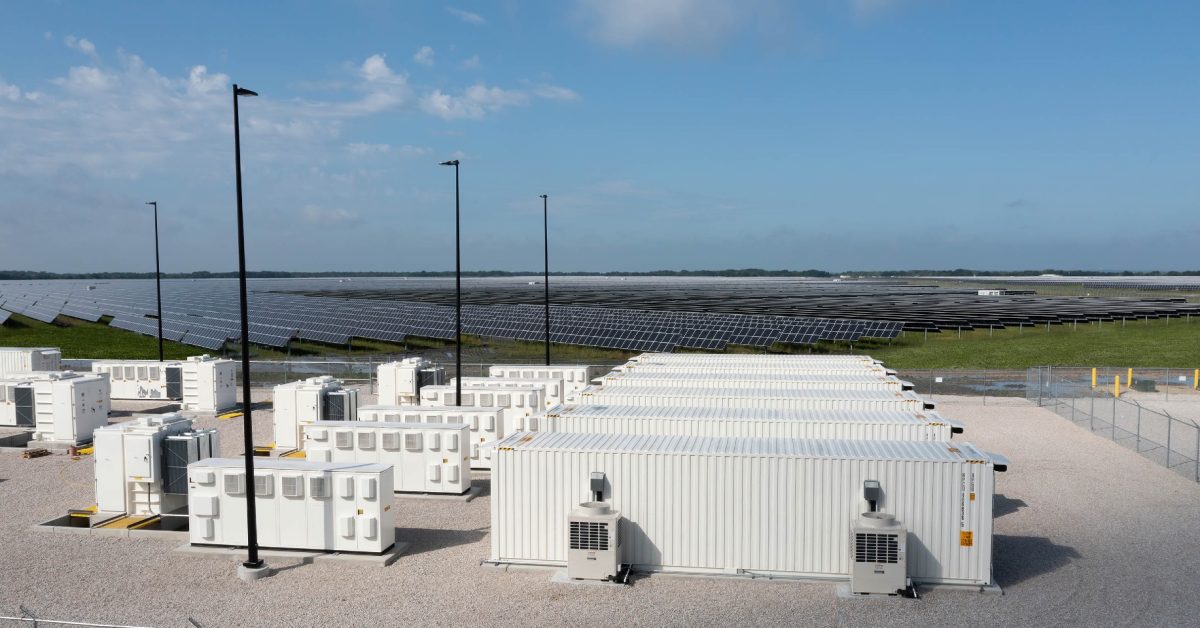




Turning cheap daytime solar into electricity you can actually use at night just got a lot cheaper. A new analysis from energy think tank Ember shows that utility-scale battery storage costs have fallen to $65 per megawatt-hour (MWh) as of October 2025 in markets outside China and the US. At that level, pairing solar with batteries to deliver power when it’s needed is now economically viable.
Battery storage costs have fallen dramatically over the past two years, and the decline continues. Following a steep decline in 2024, Ember’s analysis indicates that prices continued to fall sharply again in 2025.
The findings are based on real-world data from recent battery and solar-plus-storage auctions in Italy, Saudi Arabia, and India, as well as interviews with active developers across global markets.
According to Ember, the cost of a whole, grid-connected utility-scale battery storage system for long-duration projects (four hours or more) is now about $125 per kilowatt-hour (kWh) as of October 2025. That figure applies to projects outside China and the US. Core battery equipment delivered from China costs around $75/kWh, while installation and grid connection typically add another $50/kWh.
Advertisement - scroll for more contentThose lower upfront costs have pushed down the levelized cost of storage (LCOS) to just $65/MWh. Ember’s calculation reflects real-world assumptions around financing costs, system lifetime, efficiency, and battery degradation.
Cheaper hardware isn’t the only reason storage costs are falling. Longer battery lifetimes, higher efficiencies, and lower financing costs, helped by clearer revenue models such as auctions, have all contributed to the sharp drop in LCOS. Ember has published a live calculator alongside the report, allowing users to estimate LCOS using their own assumptions.
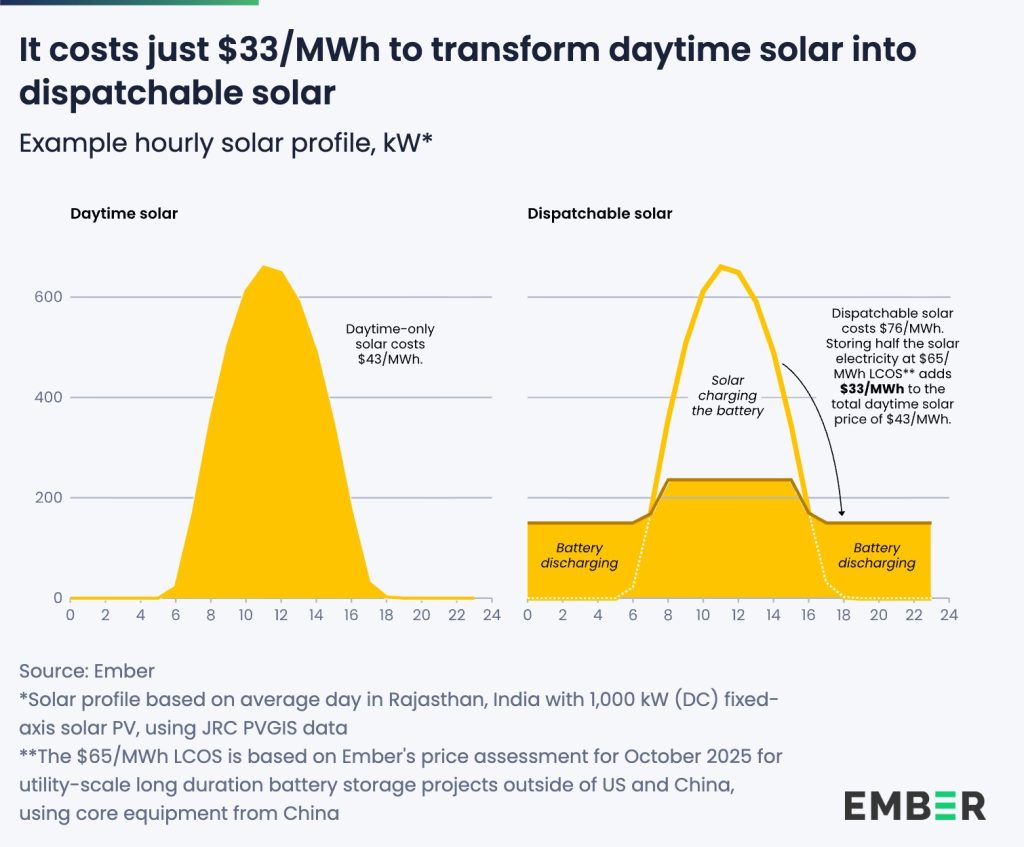
Why this matters comes down to how solar is actually used. Most solar power is generated during the day, so only a portion needs to be stored to make it dispatchable. Ember estimates that if half of daytime solar generation is shifted to nighttime, the $65/MWh storage cost adds about $33/MWh to the cost of solar electricity.
With the global average price of solar at $43/MWh in 2024, adding storage would bring the total cost to about $76/MWh, delivering power in a way that better matches real demand.
As Ember global electricity analyst Kostantsa Rangelova put it, after a 40% drop in battery equipment costs in 2024, the industry is now on track for another major fall in 2025. The economics of battery storage, she said, are “unrecognizable,” and the industry is still adjusting to this new reality.
“Solar is no longer just cheap daytime electricity; now it’s anytime dispatchable electricity. This is a game-changer for countries with fast-growing demand and strong solar resources,” Rangelova added.
Together, solar and battery storage are increasingly emerging as a scalable, secure, and affordable foundation for future power systems.
Read more: EIA: Solar + storage soar as fossil fuels stall through September 2025

If you’re looking to replace your old HVAC equipment, it’s always a good idea to get quotes from a few installers. To make sure you’re finding a trusted, reliable HVAC installer near you that offers competitive pricing on heat pumps, check out EnergySage. EnergySage is a free service that makes it easy for you to get a heat pump. They have pre-vetted heat pump installers competing for your business, ensuring you get high quality solutions. Plus, it’s free to use!
Your personalized heat pump quotes are easy to compare online and you’ll get access to unbiased Energy Advisors to help you every step of the way. Get started here. – *ad
FTC: We use income earning auto affiliate links. More.
Comments (0)