‘The Present’ in Luxembourg, Luxembourg
Kirchberg is a district located north-east of Luxembourg City centre, from which it is separated by the Alzette Valley. Urbanised from the 1960s onwards, the district was designed as the capital's business centre and quickly became home to the buildings of several European institutions (Court of Justice of the European Union, Secretariat-General of the European Parliament, European Investment Bank (EIB), etc.). Its development was intended to be exemplary, with urbanisation that gives pride of place to green spaces, high-quality architecture and the integration of public works of art.
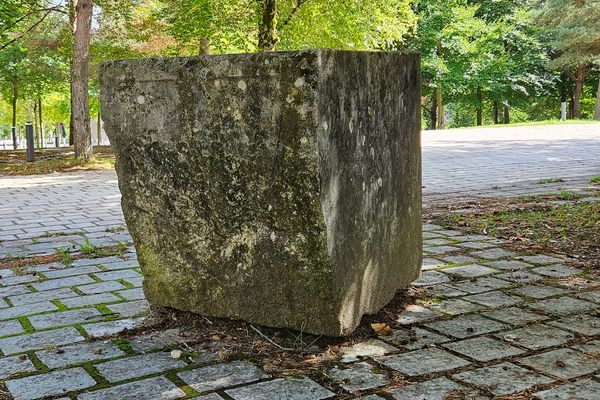
The Mudam - Musée d'Art moderne Grand-Duc Jean - fits perfectly into this dynamic: Ieoh Ming Pei's building is integrated into the ruins of a 19th-century fort - Fort Thüngen - and is surrounded by pedestrian areas. The museum is surrounded by several contemporary artworks that complement the neighbourhood's collection. Among these works is ‘The Present’ by Maria Anwander. And if it is here today, it is thanks to a tour de force by the artist.
In 2012, the Casino Luxembourg – Forum d'Art Contemporain welcomed the Austrian artist as artist-in-residence. It was on this occasion that she placed the work on the Place d'Arme on the morning of 28 June 2012. The problem was that the city had not been notified of this installation. After workers reported this strange discovery, in accordance with the law, the city became the owner of this unexpected deposit: the work was removed during the morning and stored.
Although the outcome seemed to be a fiasco, it actually worked perfectly: through this act of disobedience, the artist managed to force the city to acquire one of her works of art. Through this action, she reversed the usual mechanisms by which cities decide to acquire works of art to decorate public spaces. Contrary to what one might have expected, the city of Luxembourg appreciated this artistic tour de force: it officially accepted the gift – ‘The Present’ – shortly afterwards and the work joined the Mudam.
This method of forced acquisition appears to be unique among national art institutions. Its exhibition in Dräi Eechelen Park therefore pays tribute to the artist's audacity and returns the work to the public space (where it is destined to be installed). Exposed to the elements, it has never been restored in order to express the passage of time through the slow deterioration of the stone.

Comments (0)