
Remember me








A man wearing a nun’s wimple and veil over a grey tracksuit swayed gently to the sound of “O Come All Ye Faithful”. The wind was still, and the winter sun’s low angle lit Whitehall in profile. His face wore an expression of bliss. Above him, a flag bearing the slogan “Anglo-Saxon Freedom” hung limp. A few metres away, another man carried a large wooden cross with “Jesus Saves” carved into it. I was impressed; it can’t have been easy carrying it across London in a kind of metropolitan Calvary. I wondered which station of the cross he was at now – perhaps five, when Simon of Cyrene helped Jesus to carry it? Then I spotted the wheels at the bottom.
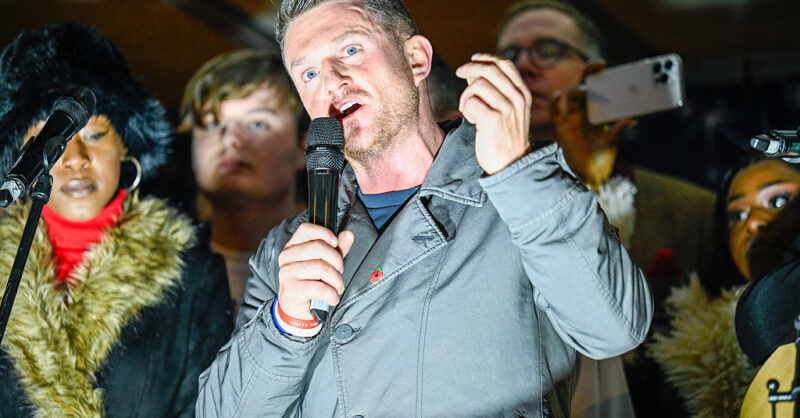
One man had brought us all here, carollers and media alike – Tommy Robinson. The event was billed as “Putting the Christ back into Christmas”, with hopes of bringing thousands of Christians together to sing carols in central London, part of Robinson’s recent turn to faith. It’s a conversion that has inspired a degree of scepticism; Robinson has form in that regard. In 2013 he announced he was leaving the English Defence League (EDL) and partnering with the counter-extremism think tank the Quilliam Foundation, founded by former Islamic extremist turned human rights activist Maajid Nawaz. For a moment it seemed Robinson had changed, but the short-lived partnership was widely criticised and branded a “high-stakes gamble”. By 2015 Robinson had turned on Quilliam, claiming the organisation paid him £8,000 to leave the EDL and credit it with his departure – an allegation the think tank denied. Even knowing all that, many Christians have welcomed Robinson – real name Stephen Yaxley-Lennon – with open arms.
Among the throng was a Baptist minister sitting on a plastic chair and engaged in a lively conversation with one of Robinson’s carollers. The minister had brought signs: “Christ was a refugee at Christmas”, said one, and “I’m a minister and I’m here to listen”, said another. I waited until they were finished, then took a seat. The minister’s name is Sally Mann, and she’s based at a Baptist church in East London. Wearing a matching red coat and woolly hat, she seemed relaxed. “Well, I heard that on face value this was about putting Christ back into Christmas,” she said. “So I’m here to say that if you’re looking for Christ in Christmas, you do need to realise that he’s not an Englishman, and in the Christian story, he was a refugee.” She warned that anything that doesn’t lead someone “into love” also doesn’t lead them “into Jesus”. “There may be some people with good intentions here, but I also believe there are some really bad political actors,” she said. But rather than being intimidated and staying at home “twiddling her thumbs”, she decided to head down to the carols herself. There was something quite vulnerable about her set-up: just two plastic chairs facing each other, the signs entreating anyone who wished to sit and chat.
By and large the response had been lovely, she said, although some people found her posters provocative. “I’m from the East End – I’m used to bullshit and bravado,” she said. She wasn’t sure if Robinson’s Christianity was genuine or not, but she wanted to meet him. It’s a sentiment I’ve heard repeatedly from Christians when discussing Robinson. In essence, to be Christian is to believe that anyone – no matter how badly behaved – can be saved. The Bible is full of unsavoury characters. Most famous of all is Paul (formerly Saul), whose conversion to Christianity on the road to Damascus has made him archetypal of the redemptive power of faith. And Paul, like Robinson, started preaching immediately – although Mann made the point that he spent a couple of years growing into his faith before he became widely known for it. “I would say if it’s genuine belief, it needs to take time,” she added.

Treat yourself or a friend this Christmas to a New Statesman subscription for just £2
Leaving Mann to her work, I headed back into the crowd. I saw an old man wearing a crucifix with rainbow-coloured beads on it. Curious, I introduced myself and asked him if the beads represented the Pride flag. “You’ve got a point there,” he said. “If it is, I’ll get rid of it.” His name is Nicholas Kafouris. He said his parents were migrants from Cyprus, forced to flee the country after Turkey invaded. I asked if he thought Jesus was a refugee. “Yeah, he was a refugee, but he didn’t come in putting his hand out,” he said (the innkeeper might disagree). “And it was one family, and they went back to Israel. They went to Egypt for, I don’t know how long – a few months maybe – then they went back to their own country.” He said his parents assimilated and “never took any benefits”. “I didn’t know any English until I went to school, spoke Greek at home. I’m grateful to the country for free education – we had the grants and everything – so I’m grateful for that.”
It’s a view shared by Jo Holding-Parsons, one of a group of “pink ladies” in the crowd. “We’re here promoting Christianity at the moment,” she said “Normally we’re outside the (asylum) hotels where the undocumented illegal immigrants are being held.” She laughed when I asked her if she thought Jesus was a refugee. One of her friends said, “Yeah, but they didn’t have documentation back in the day. I’m sure he was a refugee – that’s fine.” Holding-Parsons said her parents came to the UK from Ireland. “But they were documented, they worked, they contributed to the country.” While I spoke to the women, their children played at their feet.
Despite the event’s title, there were very few carols. Instead, online pastor after online pastor took to the stage to preach. The sermons were long, although the crowd remained attentive. They raised their hands solemnly as carollers proclaimed the power of Jesus Christ. It was all a little too American for me. I tuned back in during a sermon from “prophetic” minister Chris Wickland. “Many years ago, when I was younger, I was a practising witch,” he said. “My life was meaningless. I used to take drugs. I was suffering from suicidal tendencies.” That was until he converted to Christianity. “One day, I was minding my own business, coming home from doing a witchcraft ritual, and this voice spoke to me, clear as day, and I knew exactly who was speaking to me. It was Jesus Christ. I knew he was God, and he was the creator of everything, and he said to me, ‘Stop what you’re doing.’”
I noticed a group of well-dressed young men standing next to me. One of them, Mark Gilmore, is an evangelical Christian from Belfast. “There isn’t an evangelical leader I know who isn’t saying there’s renewed interest in the church,” he said. He chalked the resurgence of Christianity up to a crisis of meaninglessness. “I think everyone comes to the cross with mixed motivations. Nobody comes with clean hands – we’ve all got mixed motivations. But the key thing to realise is that there is an answer for everyone in this. I see this not as something incredibly problematic, but as an incredible source of hope. I think there are people here who will be challenged to love for the first time.”
After hours of sermons and a handful of carols, Robinson finally arrived on stage. Anticipation for his appearance has been building. Sporadically, a man wearing a Union Jack hat, carrying a can of San Miguel in one hand and a lit cigarette in the other, cried: “Oh, Tommy, Tommy! Tommy, Tommy, Tommy, Tommy, Robinson.”
“When I started in 2009, the church stood against us,” Robinson said. “In every city we went into, as a cry for help over what was happening in our towns and cities, the church leaders stood and opposed us. That drove me away from Christianity. In fact, I hated the church for betraying us. We – all of us – were their lost sheep.” Ahead of the event, the Church of England had condemned Robinson. “The way they’ve acted this week is the reason that churches are empty,” he said. His conversion came while in prison, after a pastor helped him study the Bible properly for the first time. “I understood that Jesus would have stood against the establishment,” he said. Looking across the small crowd, he promises that next year they will “fill Trafalgar Square”. “People are going to travel from across Europe to take part in putting Christ back in Christmas, every year, in London, in Great Britain.” He told the cheering crowd, as well as anyone watching on the livestream at home, that “something great is happening”. This is a moment he will remember forever, he said.
It was an optimistic note to end on. Robinson has been many things over the years: a football hooligan, a self-proclaimed independent journalist, and now a born-again Christian. Maybe he’ll be here again next year, or maybe he’ll reinvent himself once again, like some right-wing Madonna. Either way, something is stirring in Britain’s Christian community, and, like a human bellwether, Robinson is blowing with the wind.
[Further reading: Tommy Robinson’s day of rage]
Content from our partnersRelated

Comments (0)