
Remember me
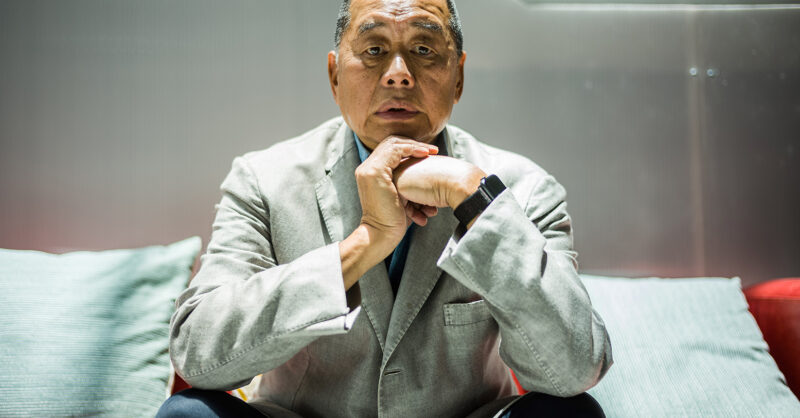



Nobody seriously expected Jimmy Lai to be cleared of the charges he faced in Hong Kong. National security trials in the territory, which can be held without a jury in front of a specially selected panel of judges, have a conviction rate of more than 95 per cent. It was still shocking, however, on 15 December, to see Hong Kong’s most famous media tycoon, who is 78 and a British citizen, pronounced guilty on 15 December of conspiring to commit sedition and foreign collusion.
Visibly thinner after five years in detention, including more than 1,800 days in solitary confinement, Lai managed a brief smile towards his wife and son in the public gallery as he was led into the glass defendant’s box. He stared straight ahead at the judges as they read out the guilty verdicts against him. He could now be sentenced to spend the rest of his life in prison.
Lai arrived in Hong Kong as a 12-year-old stowaway on a fishing boat from mainland China in 1961, when the territory was under British rule. He built his fortune on a fast-fashion clothing business, ultimately becoming one of Hong Kong’s richest men. But his media career and pro-democracy activism followed the Tiananmen Square massacre in 1989, when the Chinese military opened fire on student protesters in Beijing. He founded his first media company in 1990, and his popular tabloid Apple Daily five years later, which developed a reputation for both its uncompromising support for democracy and its sensationalist coverage of celebrity and political scandals. (Lai, a devout Catholic, has said that the name was a reference to the forbidden fruit in the Bible.)
A self-proclaimed “troublemaker” who has been called “the Rupert Murdoch of Asia”, Lai’s vertiginous rise and his subsequent arrest and conviction mirror Hong Kong’s recent trajectory from a bastion of free speech to the latest tragic emblem of the Chinese Communist Party’s obsession with centralised control and refusal to tolerate dissent.

Treat yourself or a friend this Christmas to a New Statesman subscription for just £2
Lai marched alongside the millions of pro-democracy protesters who took to the streets of Hong Kong in 2014, and again in 2019, with Apple Daily becoming one of the leading publications documenting the movement and urging Hong Kongers to stand up for their rights. Under the terms of the handover from British colonial rule in 1997, China’s government guaranteed Hong Kong a “high degree of autonomy” and the protection of individual freedoms until 2047 under a principle known as “one country, two systems”. Margaret Thatcher signed the treaty on behalf of the UK in 1984, when it was lodged at the United Nations.
Instead of honouring its treaty commitments, Beijing has steadily eroded Hong Kong’s once-vibrant democracy, silencing critical voices like Jimmy Lai and jailing activists like the young student leader Joshua Wong, who has been in prison for more than four years. A new national security law invoked protests that turned violent in 2019 as the supposed justification to bring the territory under stricter control. When the new law was passed in June 2020, Lai responded, “Hong Kong is dead.” But he refused to flee, even though as a British citizen and a wealthy man he could easily have established a comfortable life in political exile overseas. Instead, he insisted that it was his duty “as one of the leaders for the fight of freedom” to remain in Hong Kong. He was arrested at his luxurious apartment in August 2020. His newspaper, Apple Daily, was forced to close in 2021.
“It is not that everything about the spirit of resistance in Hong Kong has been killed,” said Jeffrey Wasserstrom, a professor of history at the University of California, Irvine, and author of The Milk Tea Alliance: Inside Asia’s Struggle Against Autocracy and Beijing. He pointed out that internet access in Hong Kong remains significantly freer than in mainland China and that the independent Hong Kong Free Press was still operating, albeit cautiously. “But if you go back five years to 2020 when the national security law was imposed, that was when the first arrests, and the first moves against newspapers and political parties were all happening. So, 2025 represents the completion of some elements of that cycle with the conviction of Jimmy Lai and the disbanding of the last major opposition political party.” (Hong Kong’s Democracy Party voted to disband on 14 December, on the eve of Lai’s court hearing.)
Both Donald Trump and Keir Starmer have raised Lai’s case directly with Xi Jinping, so far to no discernible effect. The British foreign secretary, Yvette Cooper, duly condemned the “politically motivated prosecution” in a statement responding to the guilty verdict earlier today (on 15 December.) She stressed that Lai had been targeting for “peacefully exercising his right to freedom of expression” and stressed that the UK had “repeatedly called for the National Security Law to be repealed and for an end to the prosecution of all individuals charged under it.”
But it is time to get real. Xi has no intention of repealing the law, which he considers an integral component of China’s national security. Nor is he likely to be cowed by the latest sternly worded statement from Whitehall, which follows a long line of similarly disapproving but effectively toothless missives. China has been in breach of its treaty with the UK over Hong Kong for five years to no discernible cost. In fact, the current government (and this has been equally true of its predecessors) seems only to be communicating ever more desperation to improve relations with Beijing in the hope of increasing trade and securing badly needed investment.
It seems unlikely that either Starmer or Trump, both of whom are expected to visit Beijing in 2026, will be inclined to blow up that relationship over the fate of Lai. Presumably the UK’s diplomatic focus will now shift to petitioning Beijing to release Lai on medical grounds, which would certainly be a valuable outcome, but is not to be confused with standing up to a country that has detained and convicted a British citizen in what amounts to a show trial for exercising the rights that were meant to be protected in a treaty with the British government.
It is not fair to say the UK has taken no action whatsoever in response to the ongoing crackdown in Hong Kong. In 2021, the government announced a new pathway to residency and citizenship for Hong Kongers holding British National (Overseas), or BNO, passports. The UK also indefinitely suspended its extradition treaty with Hong Kong and extended the existing arms embargo on mainland China to include the territory. But these measures were minimal in comparison to the US (which did not have a treaty with Beijing on the issue), which passed the Hong Kong Autonomy Act, sanctioning individual officials, revoking Hong Kong’s special trade status, and expanding export controls.
Following the recent Chinese spy drama in Westminster and the ongoing handwringing over whether to improve Beijing’s new super-embassy in London – the decision was delayed, again, earlier in December – the persecution of Jimmy Lai could be an inflection point. This could be a clarifying moment that persuades the British government to take meaningful action to show that it will no longer be pushed around; that the rights of British citizens, and treaty commitments must be respected. For fortitude they might look to the elderly British publisher enduring solitary confinement and now confronting the prospect of spending the rest of his life behind bars.
Sadly, the far more likely outcome is that the official response amounts to little more than another series of brow-furrowing statements of concern, with Xi concluding that he was right to dismiss the UK as a fading former power in a state of terminal decline.
[Further reading: Nick Fuentes, impotence incarnate]
Content from our partnersRelated

Comments (0)