
Remember me





I've always found our traditional festive feast one of the most dreary dinners of the year – dry turkey, overcooked sprouts and lumpen Christmas pudding. Not so much a celebration as a barely edible dirge.
I blame Charles Dickens who, with A Christmas Carol, helped to push the traditional stuffed boar's head, beef and goose off the festive table and replace them with that dreary American gobbler.
If only Scrooge had ignored those pesky ghosts and remained an old miser, turkey would have stayed in the butcher's window, well away from the Great British Christmas lunch.
Yes, I know, I know, there are some very fine British turkeys out there, packed with flavour and bursting with succulence. And, yes, turkey is hardly a stranger to our native table, devoured by the rich right back to the reign of Henry VIII.
But I do sometimes wish we could return to the pagan Christmas of old, an epic, no-holds-barred Bacchanalia, where things got rather wild.
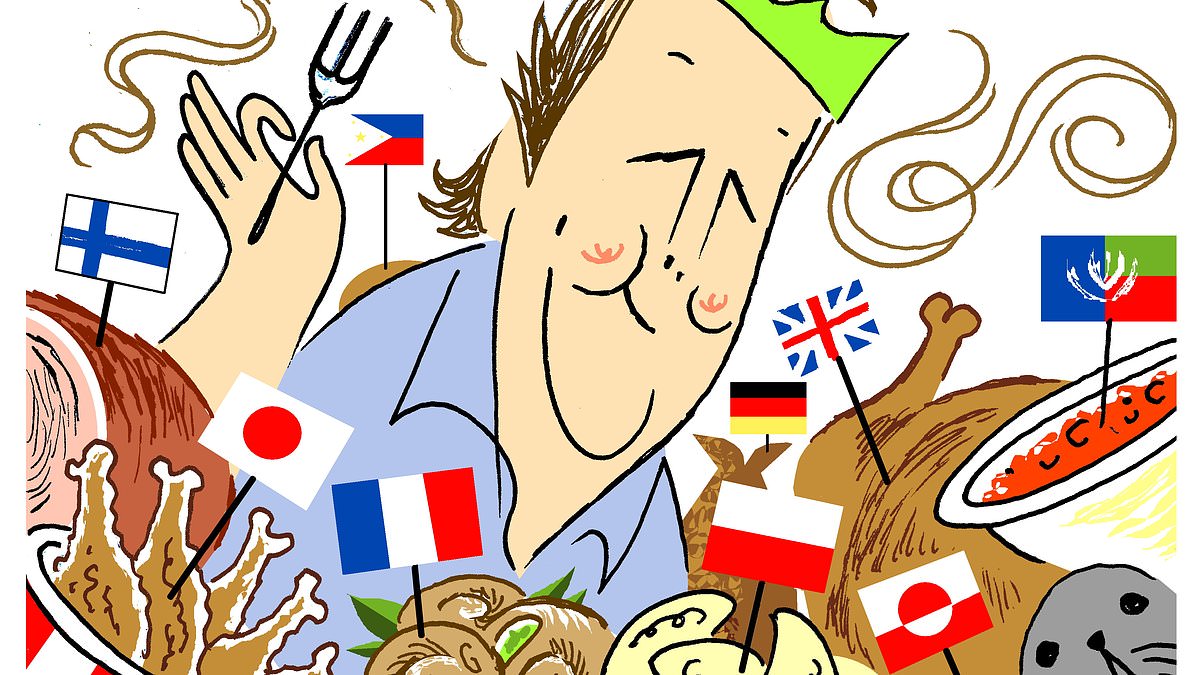
Or perhaps we could look around the world for inspiration, including some traditional alternatives that are very strange indeed...
Take what's said to be the most popular Christmas lunch of all: a festive feast so sought-after, loved and adored, that it sells out in a matter of minutes. Millions log on to secure their reservation as soon as orders open on November 1, then queue to pick them up on Christmas Day.
But this Yuletide delicacy is neither rare nor exalted. Miles removed from white truffles and golden caviar, it's not even a turkey.

Charles Dickens' A Christmas Carol helped to push the traditional stuffed boar's head, beef and goose off the festive table and replace them with that dreary American gobbler
No, in Japan, it is all about the Kentucky Fried Chicken Christmas Party Barrel, a £25 special-edition bucket packed with eight pieces of fried chicken, a gratin and some form of pudding. As the popular slogan goes, 'Kentucky is Christmas!'
The festival is very much a secular, commercial affair in Japan and it's business as usual on the 25th.
So, how did Colonel Sanders, that strangely goateed Southern gent, become so intrinsically linked with Yule? It started in 1970 with the opening of the first 'Kentucky' (as it's known in Japan) in the city of Nagoya, where manager Takeshi Okawara apparently overheard an expat bemoaning a lack of turkey on Christmas Day.
And so he came up with the Christmas Party Barrel, chicken being similar to turkey. In 1974, it went nationwide, with Colonel Sanders dressed in Father Christmas garb – and it's been Christmas at Kentucky ever since.
Some traditional dishes from other countries sound less familiar – and a little less appealing.
To make 'kiviak', a festive speciality from Greenland, a seal is disembowelled and stuffed with up to 500 small Arctic birds, before being sewn back up and sealed with fat to keep those pesky flies out.

In Japan it is all about the Kentucky Fried Chicken Christmas Party Barrel, a £25 special-edition bucket packed with eight pieces of fried chicken, a gratin and some form of pudding
The whole thing is then buried to ferment for up to 18 months. When suitably rotten, the birds are removed and eaten by biting off the head and sucking the juices out.
Another Christmas classic in these parts is 'mattak', whale skin with a bit of blubber attached, eaten raw, deep fried or pickled. Far be it from me to pass judgment on the culinary quirks of other cultures, but I think even I'd stick with turkey.
The Polish feast on Christmas Eve – when the festival is celebrated in many Catholic countries – is more up my street. Made up of 12 dishes representing the 12 Apostles and the 12 months of the year, it involves carp – a fish eaten all over central and eastern Europe – 'barszcz' (beetroot soup, known in Ukraine and Russia as borsch), pierogi dumplings and various fruit and poppy-seed puddings.
On the same day in the west of Norway, the scent of dry-cured lamb ribs, or 'Pinnekjøtt', cooked slowly over birch wood, fills the icy streets – accompanied, of course, by a bracing shot of aquavit.
The ribs are followed by 'risgrøt', a rice pudding in which an almond is hidden. The person who finds the nut traditionally wins a marzipan pig.
A similar rice pudding in Denmark is called 'risalamande'. Here, too, there is a hidden almond and a similar porcine prize. Alongside roast pork, herring plays a starring role for the Danes.

From the west of Norway, the scent of dry-cured lamb ribs, or 'Pinnekjøtt', cooked slowly over birch wood, fills the icy streets
No surprises there, but 'julesild' sees the fish pickled and spiced with cinnamon, cloves and sandalwood. It's served as a starter in the splendidly monikered 'julefrokost', or Christmas lunches, throughout December.
Over to the east in Finland, roast ham, smoked fish and pickled beetroot salad are devoured with typically Nordic gusto, alongside 'lanttulaatikko', a spiced swede bake.
You won't be surprised to hear that in France, they take Le Réveillon, or the Christmas Eve feast, very seriously.
Expect platters of oysters, langoustines, rillettes, gougeres, (baked cheese puffs), foie gras and pain d'épices (spiced bread), some form of soup, snails swimming in garlic butter, lentil salads, turkey with chestnut stuffing, roast quails, capons, ducks, coq au vin, boeuf en daube, gratin dauphinoise, a glut of cheese, all ending with a bûche de Noël, their take on the Yule Log.
Everything, basically, that makes French food delectable.
The Germans have mastered the festive feast, too, traditionally going for fish on Christmas Eve – usually carp, salmon or hake – with fried potatoes and sauerkraut. Lunch involves a roasted duck, turkey or goose, with plump bread dumplings and braised red cabbage. For pudding it's stollen, obviously.
Things get resolutely carnivorous down in Catalonia, where Christmas lunch begins with 'sopa de galets'. A broth made from beef and ham bones, plus chicken feet and pig trotters, is simmered with meatballs and galets, those giant Catalonian pasta shells.

'Sorpotel' is a lovely dish eaten at Christmas in Goa, as well as at weddings and other celebrations. This is a vindaloo-style pork-and-offal stew, tangy with vinegar and with a good chilli whack
Adifferent sort of pasta and broth, 'anolini in brodo', is eaten on Christmas Eve in the Emilia-Romagna region of Italy.
Rolling and filling the tiny meat-filled pasta parcels is all part of the fun, and that great chef Angela Hartnett – whose grandparents hailed from that part of Italy – keeps up the tradition to this day, roping in the entire family in this delectable ritual.
Some say the feast is based upon the Seven Sacraments of the Catholic Church; others argue it references the seven hills of Rome. What is absolutely agreed upon is this feast must go on for hours.
Around the world, of course, billions do not celebrate Christmas at all. But in Goa, the southern coastal state of India, the Portuguese influence is still strong. It's one of the very few places in India where pork is widely eaten.
'Sorpotel' is a rather lovely dish eaten at Christmas, as well as at weddings and other celebrations. This is a vindaloo-style pork-and-offal stew, tangy with vinegar and with a good chilli whack.
Over in the Philippines – which thanks to 300 years of Spanish rule has the largest Catholic population in Asia – the mighty 'lechon', or whole roasted pig, is the centrepiece of the Christmas Eve celebrations.

In the Philippines, the mighty 'lechon', or whole roasted pig, is the centrepiece of the Christmas Eve celebrations
The skin should be as brittle as stained glass, the meat seductively soft. Seasoned with salt, lemongrass, garlic and bay leaves, it tastes as triumphant as it looks.
In Mexico, that most magnificent of countries, they take the feasting to ever headier heights, with 'Nochebuena' on Christmas Eve. Tables are laden with 'tamales' (corn dough stuffed with sweet or savoury fillings, then steamed in corn husks or banana leaves), 'pozole' (a hearty stew made from hominy, or corn kernels, and various meats and chilies), 'moles' (a sauce that takes many forms) and churros.
In Australia which, like the rest of the Southern hemisphere, celebrates Christmas in the summer heat, the barbie is king.
And it's not just shrimp thrown on top, but crayfish and other local crustaceans, such as yabbies and lobsters like Moreton bay bugs, too. Alongside a great glazed ham, turkey, salads, gingerbread, trifle and, of course, the mighty pavlova.
The truth is that turkey is the star of the Parker Bowles's Christmas dinner for the wider family, with my mother, step-father, children, sister, brother-in-law, aunts, cousins, nieces and nephews gathered round the table.
It's held the week before Christmas, before everyone disappears in different directions around the country.
But for my own Christmas Day at home, the gobbler is out of the question. I adore goose, but the kids tend to moan. So beef it is, a great four-rib roasting joint cooked very rare, with gravy, roast potatoes, sprouts with bacon, and pigs in blankets. Obviously. Because Christmas simply isn't Christmas without an excess of chipolatas wrapped in bacon.
Yet the truth is I still yearn for the old Twelve Days of Christmas, a time of much carousing, mischief and merry-making, all fuelled by industrial amounts of booze. Plus ca change, I hear you cry.
But when the Victorians put the emphasis back on family – aided, once more by Dickens, and the high-church Oxford Movement of the 1830s and 1840s – we lost dishes such as the Christmas Pie.
For this, pheasants, hares, rabbits, capons and pigeons were deboned, chopped and mixed with their livers and hearts, along with two sheep's kidneys, forcemeat balls, pickled mushrooms, salt, pepper, spice and vinegar.
The mixture was stuffed into a 'crust of good bake' shaped like a bird, and the whole thing filled with stock. This mighty mélange was then baked and finished with a pheasant's head and feathers. Now that's what I call a proper Christmas feast.
Comments (0)