
Remember me



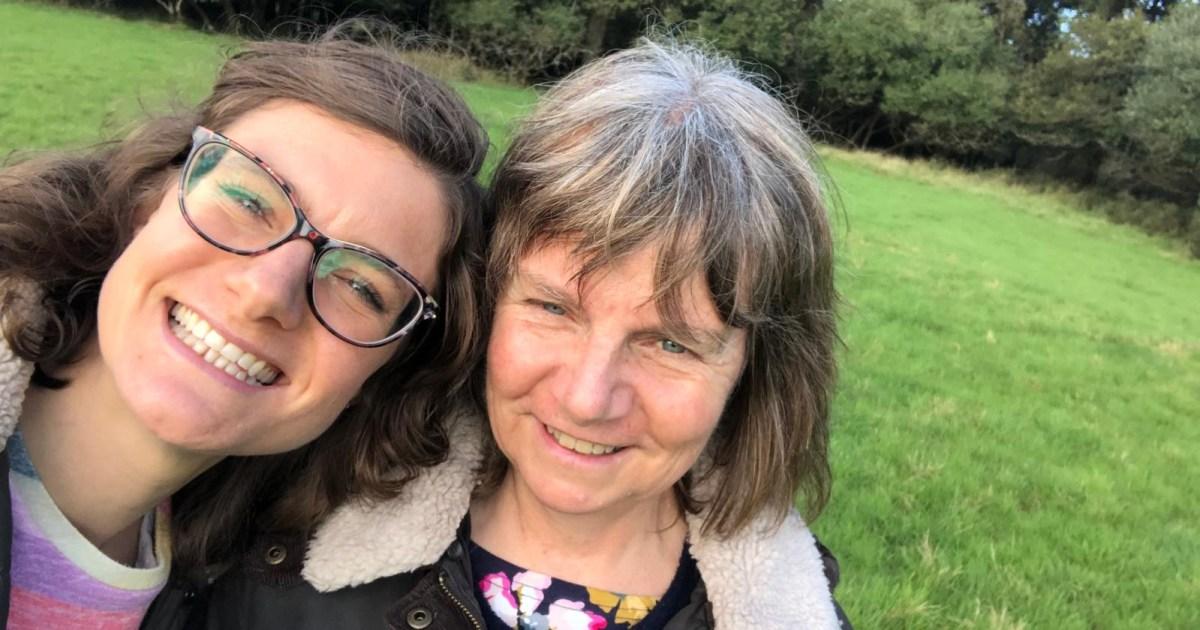






 Rosie was very close to her mum, Dawnie, but had no idea how much she had been struggling (Picture: Supplied)
It wasn’t until after Dawnie Brooks had to move into a care home that her daughter Rosie uncovered the heartbreaking extent of her struggle to conceal her memory loss.
As she and her brother Jake were clearing out their mum’s house, they discovered hoards of paperwork, cluttering surfaces and stuffed into random crannies.
Among them were documents that detailed just how much Dawnie, 59, had tried to hide what was happening to her. Such as when she had taken sick leave in February 2018 after her three days a week as a support worker for a brain injury charity had become too much.
Looking through the piles of paperwork, Rosie managed to piece together just how much Dawnie’s employers had tried to support her through errors that her family had no clue about.
‘It was heartbreaking to read about these struggles. I also found out that she’d had a couple of minor car accidents and had to go into the police station to pay fines for damage done to other people’s vehicles,’ Rosie, from Gloucester tells Metro.
‘She’d kept it hidden from us, as she was clearly ashamed – especially as she had been a motorbike instructor when she was younger.’
When Rosie asked Dawnie why she wasn’t driving somewhere, she would say the distance was too far or she was too busy. In reality she now realises, her mum probably couldn’t remember the route.
‘She’d been trying to hide her symptoms while desperately trying to understand what was wrong with her.’
 Rosie realised that her mum had been trying to hide her symptoms (Picture: Supplied)
The two had always been close. But Rosie, now 39, didn’t realise how bad things were until she returned to Dawnie’s Worcestershire home in 2018 after six months away with the RAF.
They shared a horse, Mr Bud, who lived nearby and it was at the yard where Rosie first saw that something was seriously wrong.
‘Mum kept saying, “He’s really naughty. He won’t let me put his bridle on.’” But she was standing there holding it out like he’d magically put his head inside it. And she tried to use a brush to try and clean his hooves instead of a hoof pick,’ she recalls.
At 57, Dawnie had visited Mr Bud twice a day for 18 years – but she could no longer fathom the basics of horse care.
‘She would forget to fill his water bucket or keep his vaccinations up to date, which she had never done before. These were huge warning signs, but she just blamed being busy at work,’ Rosie remembers.
‘Around the same time, I took her for afternoon tea. She picked up a scone, looked confused, and asked, “What’s that? What do I do with it?” Then she ate it like a cupcake – no jam, no butter. And she had been a trained chef.
 Rosie and her brother Jake did all they could to help support their mum (Picture: Supplied)
‘Another occasion, she’d left a pan of pasta on the gas cooker hob before heading up to have a shower, almost causing a house fire. Luckily she realised what had happened before it burnt completely dry.’
It was chilling for Rosie, whose paternal grandfather had suffered from Alzheimer’s. As her mother grew increasingly forgetful and repetitive, she knew in her heart Dawnie was struggling with the early symptoms of dementia.
However, when she and Jake took her to the GP their concerns were dismissed. Instead, the doctor blamed stress, depression, and menopause for their mum’s memory loss. Over the next 15 months, further opportunities for diagnosis were missed.
How to sign up to our 2026 Metro Lifeline challengeThis year Metro.co.uk is proudly supporting Alzheimer's Society for our 2026 Lifeline campaign.
On Saturday 13 June 2026, we’re inviting our readers to take on an unforgettable challenge: an epic hike through the stunning Cotswolds countryside — all to help support people living with dementia.
Choose your distance: 25km, 50km or 100km.
With registration starting at just £15, and fundraising targets of £150 (25km), £225 (50km) or £330 (100km), you can push yourself as far as you want — while helping fund vital support and research.
Whether you sign up solo or take on the challenge with friends, you’ll be part of Team Lifeline, with plenty of guidance, encouragement and support along the way. Every mile you walk and every pound you raise will help make a real difference for people facing the daily realities of dementia.
For our 'everything you need to know' guide, click here - or if you're already raring to sign up, click here.
Dawnie went back and forth to the GP on multiple occasions over the previous two years, as she knew something was wrong. Even when she suffered an eye bleed in 2018 and was given a brain scan, the dementia was not picked up.
It was only a year later when reviewing the scans, her consultant psychiatrist spotted shrinkage in the parietal lobe – a clear sign of dementia.
‘There were so many missed chances. She kept getting told she was too young. But we both knew something was really wrong. It was devastating watching her personality slip away,’ Rosie says.

As time went by, Dawnie was no longer able to care for her horse and then she had to surrender her driving licence. Each changing moment filled Rosie with dread. ‘I didn’t know where to start. I was scared for her, scared for us, and I just thought – how are we going to cope?’ she explains.
‘Early support is so important. You’re trying to figure out how to pay the mortgage while also navigating this terrifying new reality. I was 31, Mum was single, and I knew my life was about to change dramatically. Dementia only goes one way. It was overwhelming.’
It wasn’t until March 2019, that Dawnie was finally diagnosed with young-onset Alzheimer’s Disease, a condition shared by more than 70,800 people in the UK, according to the Alzheimer’s Society.
‘I was with her at the doctors’ for the diagnosis. It was a weird mix of emotions. Relief, because we finally had an answer. But fear too. I didn’t know how fast things would decline.’
Her mum said little after the appointment. Rosie believes she was trying to protect her daughter. They went out for coffee and cake, then to visit Dawnie’s father, then in his late eighties.
 The family made the most of their time together (Picture: Supplied)
‘She immediately wanted to tell him, but she couldn’t remember the name of the condition. She asked me to explain. He was crestfallen. It was so sad.’
From then on, Rosie and her brother Jake stepped in fully, making the most of their time together. But Dawnie’s decline was swift. Just as they’d adjust to a new normal, she would deteriorate again.
Rosie helped her mother visit Mr Bud and even got her into the saddle for a while, until it became unsafe. They ticked off bucket-list experiences, including a helicopter ride from Staverton Airport, where Dawnie saw the Malverns, her home and Mr Bud’s field from the sky.
 Rosie and Jake helped Dawnie tick off her bucket list, which included a trip in a helicopter (Picture: Supplied)
‘She loved it. She had a really childlike spirit, so we took her to Cadbury World, Warwick Castle and the safari park. She even did a sea lion meet-and-greet. People were so kind and patient with her.’
As Dawnie’s health declined and the hospital and social care appointments piled up, life became stressful and overwhelming for Rosie and her family. ‘Every time we got used to a change, something else would shift. It was hard when she forgot how to use the toilet.’
Eventually, Rosie had to care for her mum full time, with the support of Jake at weekends, as they couldn’t leave her for more than an hour at a time as she would become too distressed.
‘She wasn’t safe at home,’ she remembers. ‘I keep wondering, if she’d started treatment earlier, could we have slowed it down? Given her a better quality of life?’
 Dawnie and her beloved horse, Mr Bud (Picture: Supplied)
Eventually, Dawnie made the decision herself to move into a care home. ‘She didn’t want Jake and me to give up our lives. She still had that emotional intelligence of “I’m your mum. I don’t want you looking after me.”’
In March 2022, Dawnie moved to Beechwood Care Home in Upton-upon-Severn, where she received ‘incredible care’, Rosie says. But because it was still impacted by Covid, they could only make limited visits, talking to her through a cracked-open window.
‘It was awful. The care staff were amazing, but we couldn’t even hug her,’ Rosie remembers.

Despite everything, Dawnie could still experience joy. On a trip to the Severn Valley Railway, Jake announced he and his wife were expecting a baby and his mum lit up.
‘We thought she’d forget straight away, but she didn’t. She couldn’t remember who was having the baby, but she remembered there was going to be a granny. When we got back to the care home, she told everyone,’ recalls Josie.
Jake’s son was born in December 2022 and Dawnie was overjoyed to meet him.
As the family did everything they could to keep her comfortable, providing reiki therapy, foot spas and essential oils, Dawnie found calm in the unexpected, listening to heavy metal in her room, tapping her foot to Ozzy Osbourne and Black Sabbath.
Rosie also found support from the Alzheimer’s Society to be a lifeline. ‘Their guidelines were invaluable. One support worker, Gordon, visited her after diagnosis and took her to local support groups. He was so kind, so patient.’ And through their befriending service, Dawnie was paired with a woman who helped her visit Mr Bud.
 Rosie is grateful for the memories she has of her mum (Picture: Supplied)
But by late summer 2022, Dawnie was experiencing hallucinations, paranoia and extreme emotional distress, caused by delirium. The following year she lost her ability to speak and by 2024 Dawnie, who had always loved food, became unable to eat. It was a brutal and emotionally gruelling time for the family.
Dawnie passed away at age 63 in April 2024.
‘Losing her was surreal and horrific. I was glad she wasn’t suffering anymore, but I still miss her so much,’ says Rosie, who inspired by the care her mum received, and her own work with community health carers, is now training to become a mental health nurse.
‘I want to do something meaningful. People helped us in our darkest moments, and now I want to do the same for others,’ she explains.
Rosie’s grateful for the memories, and for the fact that until the end, Dawnie never forgot who they were.
 I begged doctors to remove my arm - I have the 'suicide disease'
My son was joy personified - but he died at just 6
I'm proof 'Ozempic penis' exists — weight loss jabs gave me a huge boost in bed
I begged doctors to remove my arm - I have the 'suicide disease'
My son was joy personified - but he died at just 6
I'm proof 'Ozempic penis' exists — weight loss jabs gave me a huge boost in bed
‘So many people say the worst moment is when your loved one doesn’t know you anymore. But Mum always knew us,’ she says.
‘You could see it in the way she looked at us, held our hands. We were lucky. Not everyone gets that.’
A spokesperson for Herefordshire and Worcestershire Health and Care NHS Trust told Metro: ‘We understand that waiting for a diagnosis can be an anxious and uncertain time for patients and their loved ones. We strive to provide timely assessments, post-diagnostic support, and specialist advice tailored to each person’s needs, helping patients and families feel supported while in our care.
‘While we’re unable to comment on individual cases, we would encourage anyone who has concerns about their care to reach out to the team involved or contact our Patient Advice and Liaison Service (PALS). This ensures concerns are heard and responded to appropriately.‘
Alzheimer's and dementia: the factsThe most common forms of dementia (symptoms of a decline in brain function) are Alzheimer’s disease followed by vascular dementia.
Alzheimer’s is caused when plaques and tangles form in the brain making it increasingly hard for it to function properly. Early symptoms include forgetting recent events, struggling to remember words, becoming disorientated in familiar places and finding it difficult to concentrate.
Common early symptoms of vascular dementia include problems making decisions or following a series of steps, such as cooking a meal; slower speed of thought and trouble sleeping. The condition can also cause significant mood changes and depression and make people behave completely out of character.
Dementia is the UK’s biggest killer – and one in three babies born today will develop dementia in their lifetime. The risk of developing both Alzheimer’s and vascular dementia roughly doubles every five years from the age of 65. Women and men are affected equally. Diabetes, obesity, heart problems and high blood pressure all increase the risk.
However, you can significantly reduce your chances of developing the diseases by leading a healthy lifestyle – not smoking or drinking to excess, eating a balanced diet and getting regular exercise. Keeping mentally and socially active is also beneficial.
The third most common form of dementia – accounting for an estimated 20 per cent of cases – is Lewy body. With this condition, tiny clumps of protein appear in the brain’s nerve cells, causing a range of issues including mood swings, problems processing thoughts, hallucinations, difficulty balancing and walking slowly. Although DLB (dementia with Lewy body) can affect people under 65, it is much more common as we age, affecting men and women equally.
There is currently no cure for any of the forms of dementia. But getting an early diagnosis is very important in allowing you and your loved ones to access all the medical and social support available. If you are worried that you have any of the symptoms, your GP will be able to refer you to a specialist who can carry out a range of tests.
If you are worried that yours or someone else’s symptoms may be dementia, download the Alzheimer’s Society symptoms checklist, on alzheimers.org.uk; for more information or support on anything you’ve read here, call our support line on 0333 150 3456 or visit our website.
Arrow MORE: Every 3 minutes someone in the UK develops dementia – here’s how you can help them
Arrow MORE: My boyfriend coerced me into a joint mortgage and ruined my life
Arrow MORE: I grew up watching dad abuse mum – I’m a victim too
Comment now Comments Add Metro as a Preferred Source on Google Add as preferred source The SliceYour free newsletter guide to the best London has on offer, from drinks deals to restaurant reviews.
Comments (0)