
Remember me








Among the diverse community of bacteria, fungi, and other microbes that call the human gut home, scientists have identified a bacterial species that can single-handedly and significantly reduce weight gain.
In a new study led by microbiologists from the University of Utah, the gut bacteria species Turicibacter was singled out for reducing weight gain and improving metabolic health in mice fed a high-fat diet.
"I didn't think one microbe would have such a dramatic effect – I thought it would be a mix of three or four," says June Round, a microbiologist from the University of Utah.
Supplements of the molecules produced by Turicibacter could eventually help to reduce the health effects of obesity in humans.
Related: Tiny Molecule Made by Gut Bacteria Could Cut Type 2 Diabetes Risk
Obesity can lead to various metabolic diseases like type 2 diabetes, which affects millions of people worldwide. The gut microbiome exerts profound effects on metabolic health and obesity – yet it's a two-way street, as this microbiome is continuously shaped by one's diet.
Previous studies have linked low microbiome diversity to obesity. Similarly, that diversity declines in animals that are fed a high-fat diet.
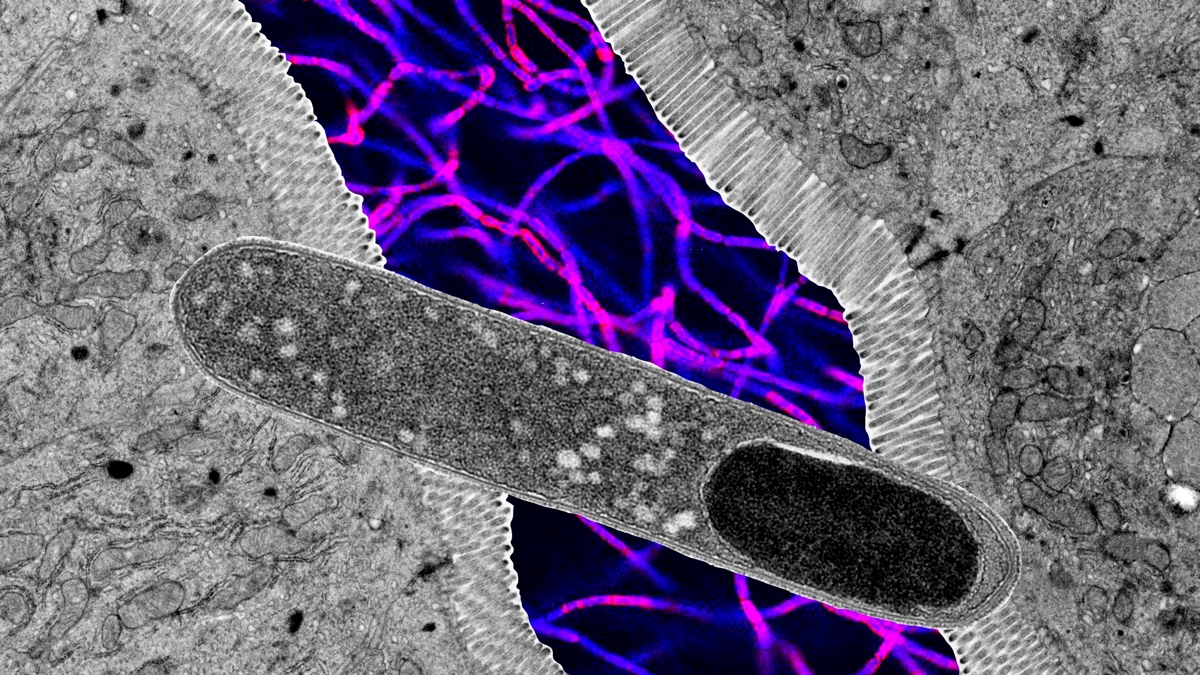
 A collage of microscopic images, not to scale, shows the rod-shaped Turicibacter in the foreground, set against a cross-section of intestine, with a fluorescent microscopy image of other bacteria in the background. (Klag et al., Cell Metab., 2025)
Enter Turicibacter, one part of a metabolically protective community of microbes that includes at least 80 bacterial species, present in the microbiome milieu at a relative abundance of around 0.1 percent.
Turicibacter produces a suite of fatty acids that keep other, more detrimental fat molecules in check. These detrimental fatty molecules are called ceramides: they increase as a result of a high-fat diet and are associated with metabolic diseases like type 2 diabetes and heart disease.
Yet it appears that the fatty acids produced by Turicibacter confer numerous metabolic advantages by affecting how fat is absorbed in the small intestine.
So, could Turicibacter allow one to gorge themselves on chocolate cake and remain relatively lean? Alas, no, because Turicibacter populations fluctuate with diet – too much fat in its environment stifles the growth of this beneficial bacterium.
 Turicibacter supplementation brings about multiple favorable metabolic changes even when mice are fed a high-fat diet. (Klag et al., Cell Metab., 2025)
In one experiment, Turicibacter growth was halted by the presence of palmitate, a major saturated fat component that's common in high-fat diets. Interestingly, this fat component did not kill the Turicibacter bacteria, which resumed their growth cycle once removed from the palmitate-laced environment.
Since Turicibacter protects against the detriments of high-fat diets but is also depleted by them, Turicibacter levels must be topped off through regular supplementation.
Indeed, when mice were given an oral Turicibacter supplement five days a week, they displayed less weight gain, lower resting glucose levels, reduced body fat, and other favorable changes in lipid profiles, even while still fed a diet high in fat.
These findings are medically exciting, but further study is warranted to see if they apply to humans. It's a complex, ever-evolving avenue for future therapies because gut microbe research remains an 'iceberg', of which only a small portion has been revealed.

The new work adds to a growing body of research into the connection between metabolic health and the gut microbiome. In one earlier study, gut microbes from obese mice were transferred into lean mice with no gut microbiome of their own – and those formerly lean mice gained weight.
In another, perhaps counterintuitive study, mice that had all their gut bacteria wiped out were protected from gaining as much weight while on a fatty diet, compared to those with normal microbiomes. That suggests that certain microbial mixes are linked to weight gain and increases in body fat.
Turicibacter is likely to be just one of many allies. Developing an arsenal of other beneficial microbes and 'weaponizing' their lipids in the fight against metabolic diseases could open new treatment options.
"With further investigation of individual microbes, we will be able to make microbes into medicine and find bacteria that are safe to create a consortium of different bugs that people with different diseases might be lacking," says Kendra Klag, microbiologist from the University of Utah, and first author of the new study.
And, unlike the current craze over Ozempic and its kin, bacterial therapy could be specially customized in accordance with each person's unique needs while squashing side effects, as these bacteria and lipids are already present in human guts.
This research is published in Cell Metabolism.
Comments (0)