
Remember me





Hi all,
Welcome to the Sunday edition.
Inside:
What building two dozen apps over the holidays taught me about the shrinking distance between “Chief Question Officer” and no officer at all.
Labor pains, capital gains: US GDP is up, employment not so much. What is going on?
The data center, a microgrid: AI labs outran the grid, then hit the turbine factories. Now they’re buying the infrastructure companies themselves.
Plus: Utah’s bet on AI prescriptions, taming complexity, robots performing surgeries, and new spheres of influence…
In the latest member briefing, I share my expectations for 2026. It’s the year AI stops feeling like a tool and starts feeling like a workforce. Plus Q&A.
The year ahead
2026 is the year when AI will feel less like a set of tools and more like a workforce, where the advantage moves to those who can orchestrate it into reliable outcomes.
Over the break, I spun up multiple agents in parallel — one building a fact-checker, another an EV slide deck maker and a third a solar forecast model. All ran simultaneously in the background while I did other work. I described the problems, LLMs create detailed product specs and the agents made the apps. In my first meeting back, I demoed two dozen working tools to the team. This follows my rule of 5x – if I do something more than five times, I build an app for it. A year ago, each of those apps would have cost a developer weeks to build.
My friend Erik Brynjolfsson calls the human in this arrangement the “Chief Question Officer.” We ask, machines do, we evaluate. Erik’s framing is elegant, but I don’t think it’s true to the moment; we’ve moved even further. I used to check every output against a strict spec; now I mostly trust the agent to catch and fix its own mistakes – and it usually does. Before Opus 4.5, I had to rescue the model from dead ends. Now it asks good clarifying questions, corrects itself and rarely stalls.
This velocity changes behaviors. For instance, I used to frame briefs carefully; now I leave them a bit looser because the agent fills the gaps. I remain the Chief, yet the role feels like a pilot toggling autopilot ever higher. If progress continues, will I always occupy the cockpit? Would stepping aside, ceding the questions as well as the answers, actually increase what gets built?
Erik warns of the “Turing Trap,” the temptation for firms to use AI to mimic and replace humans. He frames this as a societal choice between augmentation and replacement. I agree we shouldn’t drift into replacement. But my holiday build sprint made it clear that convenience pulls hard. The pressure isn’t just from companies; it’s from us, users making choices. When each small handoff to the agent feels free, can we really resist going all the way to full automation?
Here’s this weekend’s essay on the work after work, the value of human judgement and authenticity:
🔮 The work after work
Nine years ago, I told an audience that the future of human work is artisanal cheese. I got a laugh. GPT-4 didn’t exist yet, the trend line was invisible to most, and “knowledge work” still felt impregnable.
See also:
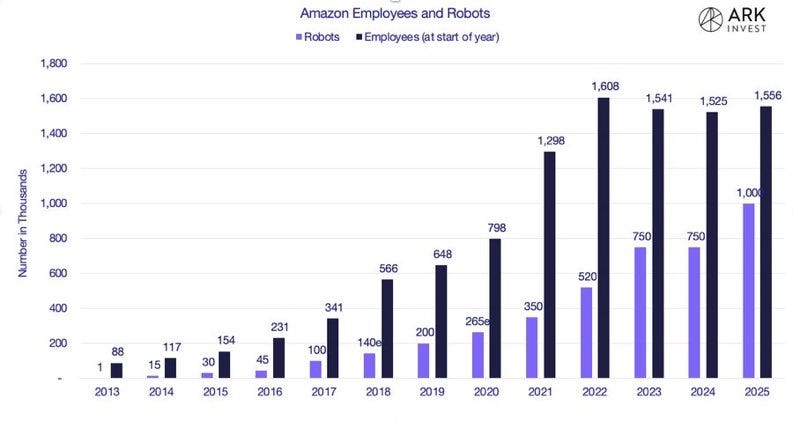
The US economy has decoupled growth from hiring (see EV#545). While the Atlanta Fed projects a massive 5.4% GDP surge for Q4 2025, the labor market has effectively stalled, adding only 584,000 jobs all year. This is the worst non-recession performance since 2003. This divergence is driven by acceleration in productivity and back-to-back quarterly declines in unit labor costs. Is AI the cause?
Comments (0)