
Remember me

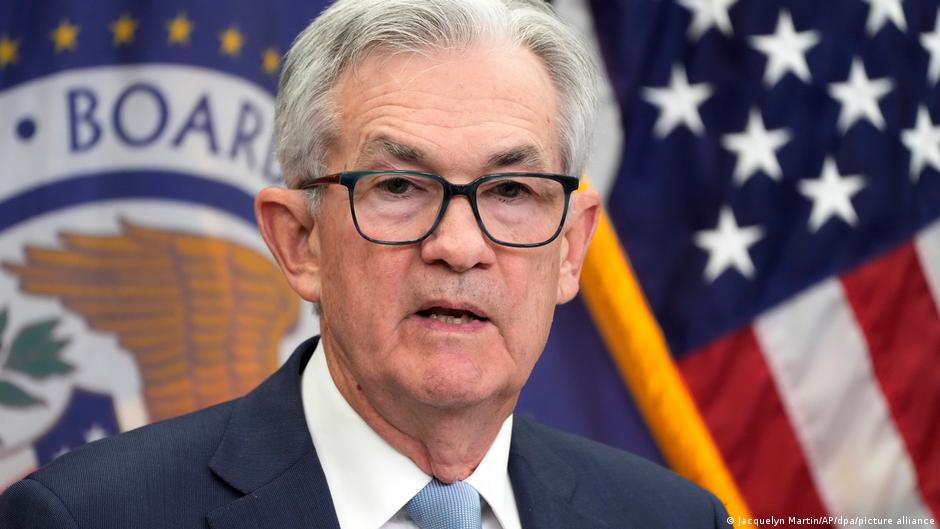



Federal prosecutors in the United States have launched a criminal investigation into Federal Reserve Chairman Jerome Powell's testimony to Congress on the $2.5 billion (€2.14 billion) renovation of the US central bank's headquarters in Washington, DC.
Powell confirmed the probe Sunday in a statement posted on the social media platform X, hitting back at what he said was pressure from the Trump administration on interest rate policy.
During US President Donald Trump's first term and since he returned to the White House one year ago, the pair have clashed repeatedly over interest rate decisions made by Powell
The Fed chair has maintained that the central bank must set policy independently — guided by economic data rather than political pressure.
What triggered the row between Trump and Powell?Trump has grown increasingly vocal in his criticism of the Fed's decisions — notably in March, when the US central bank held interest rates steady. The president wrote on his Truth Social platform that the Fed would be "MUCH better off CUTTING RATES."
In April's so-called Liberation Day announcement, Trump said lower rates would help the US economy deal with his sweeping new import tariffs on goods from major trading partners.
After calling Powell "stupid" and a "numbskull," Trump went further in July after the Fed still failed to cut rates, saying the policy was "hurting people."
That month, Trump even visited the Fed’s headquarters — the first such trip by a sitting president in decades — which was widely seen as expressing his dissatisfaction with Powell.
Trump also moved against other senior Fed figures, including Governor Lisa Cook, whom he sought to remove over unrelated allegations. The subsequent litigation is awaiting a hearing in the US Supreme Court.
By midyear, US media outlets reported that Treasury Secretary Scott Bessent had emerged as a front-runner to replace Powell when his term ends in May. He has since downplayed his candidacy.
Other reports suggested that the Trump administration was sounding out a wider list of possible successors.
More recently, US media outlets have focused on four candidates: longtime Trump loyalist Kevin Hassett, former Fed Governor Kevin Warsh, current Fed Governor Christopher Waller and BlackRock executive Rick Rieder.
By the end of 2025, Trump said he would announce Powell's successor in January.
The growing speculation underscored how much pressure the chairman was facing well before the criminal investigation became public over the weekend.
Why is Powell under investigation?The probe stems from Powell's appearance before the US Senate Banking Committee in June, when he downplayed cost overruns related to the Fed office renovation and unnecessary luxury features, including rooftop terraces and gardens, premium marble flooring and private art collections.
Senate Banking Committee Chair Tim Scott had raised concerns prompted by a New York Post article that likened the project to the French Palace of Versailles — the former royal residence near Paris commissioned by King Louis XIV.
Powell pushed back at what he said were "inaccurate" and "misleading" claims and denied luxury add-ons, saying the project, which is self-funded by the Fed rather than via taxpayers, focused on modernization and long-term cost savings.
A month later, Republican Congresswoman Anna Paulina Luna announced that she was referring Powell to the Department of Justice (DOJ), accusing him of perjury and making false statements.
As the DOJ rarely comments on active investigations, a spokesperson for the agency declined to react to Powell's statement on Sunday, but said: "The Attorney General has instructed her US Attorneys to prioritize investigating any abuse of taxpayer dollars."
In his video statement, Powell labeled the investigation as "unprecedented action," which he said is really linked to the Trump administration's pressure over interest‑rate policy.
"This new threat is not about my testimony last June or about the renovation of the Federal Reserve buildings. ... Those are pretexts. ... This is about whether the Fed will be able to continue to set interest rates based on evidence and economic conditions — or whether, instead, monetary policy will be directed by political pressure or intimidation," the Fed chair said.
"Public service sometimes requires standing firm in the face of threats," Powell said, adding that he would continue to do the job "with integrity and a commitment to serving the American people."
The probe caused a selloff in US stocks and the dollar on Monday, while Gold jumped to a record $4,600.33 per ounce.
Trump has denied any knowledge of or involvement in the DOJ probe, but repeated his belief that Powell is "certainly not very good at the Fed and he's not very good at building buildings."
In an interview with NBC News on Sunday night, Trump said: "What should pressure him [Powell] is the fact that rates are far too high — that's the only pressure he's got."
What does the Fed do? Why is its independence critical?As the central bank of the world's largest economy, the Fed's core mission is to set interest rates, keep inflation close to its 2% goal, support maximum employment and keep the financial system stable.
It also supervises banks, acts as a lender of last resort during financial crises and helps keep credit flowing through the US economy, which has for decades also been the world's most attractive investment market.
As the US dollar is the world's so-called reserve currency in which much of world trade is conducted, the Fed’s interest‑rate decisions have ripple effects globally, influencing borrowing costs, capital flows and economic growth far beyond the United States.
The Fed is not funded by the US government; instead, it earns income from loans to corporate banks and its investments in US government bonds, currencies and other securities.
The Fed's independence is widely seen as critical to avoid political pressure, which is often based on short-term goals because of the four-year US presidential election cycle.
The bank's decisions to cut or raise interest rates are vital to prevent high inflation and steady the US economy during downturns.
Though these moves may be unpopular among voters, proponents of Fed independence say handing interest rate control to elected politicians would risk destabilizing the economy.
In reaction to the Powell probe, Capital Economics disputed whether central bank independence has helped keep inflation low historically and warned that high levels of public debt would make it harder to control price rises via interest rate hikes.
But the London-based research house warned that "any shift away from monetary policy autonomy would send a worrying signal of a weaker commitment to maintaining low inflation."
Many economists and corporate leaders believe that Trump's unprecedented tariffs have already hurt investor confidence in US sovereign debt and the economy's long-term future.
Edited by: Uwe Hessler
Comments (0)