
Remember me








Welcome to Polished with Elise Wilson, where Daily Mail's qualified makeup artist and hair stylist answers your questions, shares advice, and trials the up-and-coming beauty and skincare trends so you don't have to.
As a beauty editor, I'm usually the last person to be surprised by a new 'miracle' ingredient.
But heading into 2026, there's one that keeps resurfacing across dermatology papers, in-clinic conversations, K-beauty formulations and the private group chats of beauty obsessives (AKA my friends).
Known as PDRN - short for polydeoxyribonucleotide - it first gained attention as an injectable treatment derived from wild salmon DNA and has since become something of a holy grail for improving skin quality.
It's been used in Korea for years, long before TikTok discovered it, and it works not by filling or freezing the skin, but by repairing it.
When PDRN is injected into the skin, it triggers the body's natural healing response, stimulating collagen production, improving elasticity and helping skin regenerate at a cellular level.
'Rejuran is amazing because it is actually wild salmon DNA, so the fragments are stronger and it is just a far superior product,' cosmetic nurse injector Eleanore Quadri-Taylor told me after introducing it to her UK clinic in 2025.
'I've done a lot of research around polynucleotides, and we now offer it to our clients for the face and neck,' she added, explaining that there are now formulas specifically designed for the under-eye area as well as acne-prone skin.
The downside is cost though (sigh), with injectable PDRN treatments typically starting at around $1,000 for the eye area alone and can well-exceed $1,500 for the full face.

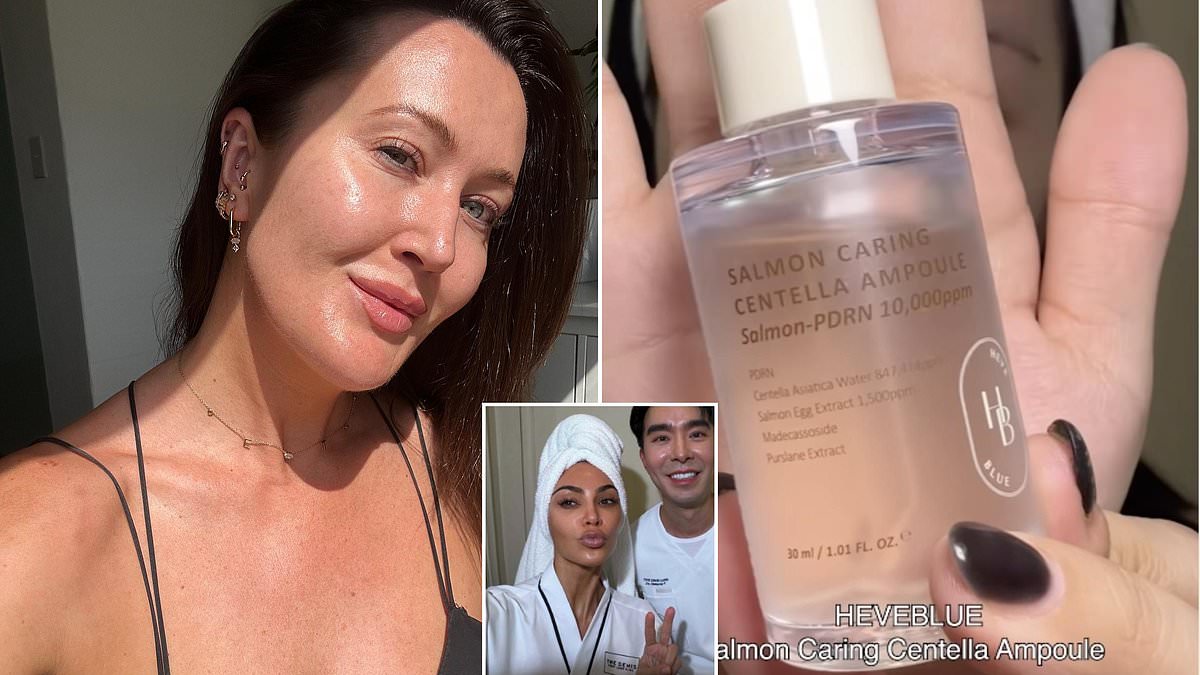
As a beauty editor, I'm rarely surprised by a 'miracle' ingredient, but heading into 2026, PDRN is everywhere. Short for polydeoxyribonucleotide, it first gained attention as a wild salmon DNA injectable and is now considered a gold-standard skin-repair ingredient. Pictured: Beauty expert Elise Wilson


When injected into the skin, PDRN triggers the body's natural healing response – and yes, I've tried it. But now topical versions are taking over, promising similarly glass-like results without the needles and hefty price tag. Pictured: Elise during and just after her 'expensive and painful' PDRN treatment
Oh, and I should also warn that patients also require an initial course of three sessions, followed by ongoing maintenance treatments each year.
However, with A-listers like Jennifer Aniston and Kim Kardashian praising the treatment as their 'holy grail', they also note results that build progressively rather than peak and fade.
That said, there's now a way to sidestep the hefty price tag and the discomfort of needles thanks to an influx of increasingly potent at-home products featuring this much-talked-about skin booster.
The major caveat with topical PDRN, however, is its molecular size.
PDRN molecules are large, which means they don't easily penetrate intact skin. That's why professional treatments rely on injectables or skin needling to deliver it where it actually matters.
At home, brands work around this in two main ways: by using lower concentrations for surface-level hydration and repair, or by refining and fragmenting the molecules so they absorb more effectively.
This works particularly well when paired with microneedling or reedle-style treatments which are those tiny spicules that pre-treat the skin - but more on that here for the newbies.
After testing what feels like every PDRN product released over the past year, I started ranking them by disclosed strength from the gentlest to the most potent.

A-listers Jennifer Aniston and Kim Kardashian (pictured) have praised the treatment, but no-needle versions are now offering a more accessible alternative

At the entry level is the Anua PDRN Hyaluronic Acid Capsule 100 Serum ($34) - With just 100 parts per million (PPM) of PDRN (that's 0.01 per cent), it's technically a PDRN product, but in practice it behaves more like a beautifully formulated hyaluronic acid serum
I did this because, like lots of skincare, not all formulas are created equal and some provide different price points and entry levels depending on what your skin (and budget) needs.
At the entry level is the Anua PDRN Hyaluronic Acid Capsule 100 Serum ($34).
With just 100 parts per million (PPM) of PDRN (that's 0.01 per cent), it's technically a PDRN product, but in practice it behaves more like a beautifully formulated hyaluronic acid serum.
That's not a criticism. It's hydrating, comforting and supports the skin barrier, but if you're chasing reparative, clinic-adjacent results, this is more support act than headline act.

A step up is the viral Dr Reju-All Advanced PDRN Rejuvenating Cream ($57.95), formulated at 1,200 PPM
A step up is the viral Dr Reju-All Advanced PDRN Rejuvenating Cream ($57.95), formulated at 1,200 PPM.
The brand markets this as the 'optimal' concentration and suggests higher strengths could be irritating, though current research doesn't actually show PDRN to be inflammatory or sensitising.
Personally, I'm not afraid of higher strengths, but I do genuinely love this gel-cream. I use it nightly around my eyes, where its soothing, hydrating texture works beautifully on delicate skin.
Things become more serious at 5,000 PPM, where Genabelle's PDRN Vita Toning Ampoule ($45) and Rejuran's own Turnover Ampoule ($63) sit.


Things become more serious at 5,000 PPM, where Genabelle's PDRN Vita Toning Ampoule ($45) and Rejuran's own Turnover Ampoule ($63) sit
Rejuran, of course, is the original pioneer of salmon DNA injectables, and its topical formula uses a patented C-PDRN technology designed to improve absorption.
The texture alone is worth noting – thick, viscous and deeply hydrating – and it's one of the few products that genuinely makes skin feel cocooned and repaired overnight.
At around 10,000 PPM, Medicube's PDRN Pink Peptide Serum ($43) enters the picture.
There are two versions - rose-derived and salmon-derived - and both deliver serious hydration with a glow-boosting finish.

At around 10,000 PPM is Medicube's cult PDRN Pink Peptide Serum ($43). There are two versions – rose-derived and salmon-derived, but a word of warning: the salmon version is fragranced, so sensitive skin types may want to proceed with caution

Also sitting at the 10,000 PPM mark is the Heveblue Salmon Caring Centella Ampoule ($48). The texture reminds me of Rejuran's ampoule – rich, cushiony and ultra-hydrating – with the added calming benefits of centella to support barrier repair
The formula also includes peptides, niacinamide and soothing plant extracts, making it a multitasker for uneven tone and stressed skin.
A word of warning, though: the salmon version is fragranced, so sensitive skin types may want to proceed with caution.
Also sitting at the 10,000 PPM mark is the Heveblue Salmon Caring Centella Ampoule ($48), which has quickly become one of my favourites.
The texture reminds me of Rejuran's ampoule – rich, cushiony and ultra-hydrating – with the added calming benefits of centella to support barrier repair.
Reaching new heights is Swanicoco's PDRN Hydrating Repair Ampoule ($82), which clocks in at 20,000 PPM, while Genabelle's PDRN 3% Hyper Boost Ampoule ($65) reaches a staggering 30,000 PPM.


Reaching new heights is Swanicoco's PDRN Hydrating Repair Ampoule ($82), which clocks in at 20,000 PPM, while Genabelle's PDRN 3% Hyper Boost Ampoule ($64.80) reaches a staggering 30,000 PPM

PDRM products are ideally after dermarolling or microneedling rather than casually slotted between cleanser and sunscreen. By creating micro-channels in the skin, needling triggers collagen and elastin production while allowing reparative ingredients like this to penetrate more effectively. Pictured: Bowie Microneedling Starter Set ($89)

To be clear, no topical product will ever replace professional Rejuran injections (unfortunately), but as part of a considered routine at-home PDRN can absolutely improve hydration, texture and overall skin resilience. Pictured: Dr. Pen M8S Microneedling Pen ($307)
These are the closest you'll get to 'clinical strength' without needles, and they're best used strategically – ideally after dermarolling or microneedling – rather than casually slotted between cleanser and sunscreen.
By creating micro-channels in the skin, needling triggers collagen and elastin production while allowing reparative ingredients like this to penetrate more effectively.
To be clear, no topical product will ever replace professional Rejuran injections (unfortunately), but as part of a considered routine at-home PDRN can absolutely improve hydration, texture and overall skin resilience.
If 2025 was the year of slugging, skin cycling and over-exfoliation regret, 2026 is shaping up to be about repair, regeneration and playing the long game.
And while the idea of salmon DNA might still sound a little wild, trust me, your skin doesn't care about the backstory - only the results.
The PDRN breakdownAs demand continues to shift towards subtle, skin-boosting injectables over obvious enhancements, polynucleotides are poised to dominate in 2026.
Polynucleotides (PDRN) are one of the fastest growing aesthetic treatments of the past half-decade - with an increase of 1,566% Google searchesPDRN is an acronym for PolyDeoxyRiboNucleotide, which is a DNA fragment typically derived from fish like salmon or troutWhen injected, PDRN stimulates fibroblasts, cells responsible for producing collagen and repairing damaged skinIn skincare it's gaining popularity for its restorative and soothing effects, even when used in topical form PDRN cannot replace polynucleotide injectable treatments - While used topically it can support hydration and skin repair, experts agree it can't penetrate or perform at the same level as injectable polynucleotidesDisclaimer:
The views and opinions expressed in this article are solely my own and do not reflect those of any brands or companies mentioned. This content is not sponsored or endorsed.
Comments (0)