
Remember me








More than 20 soldiers from the same regiment have been caught using cocaine in one of the biggest drug binges in recent Army history, the Daily Mail can reveal.
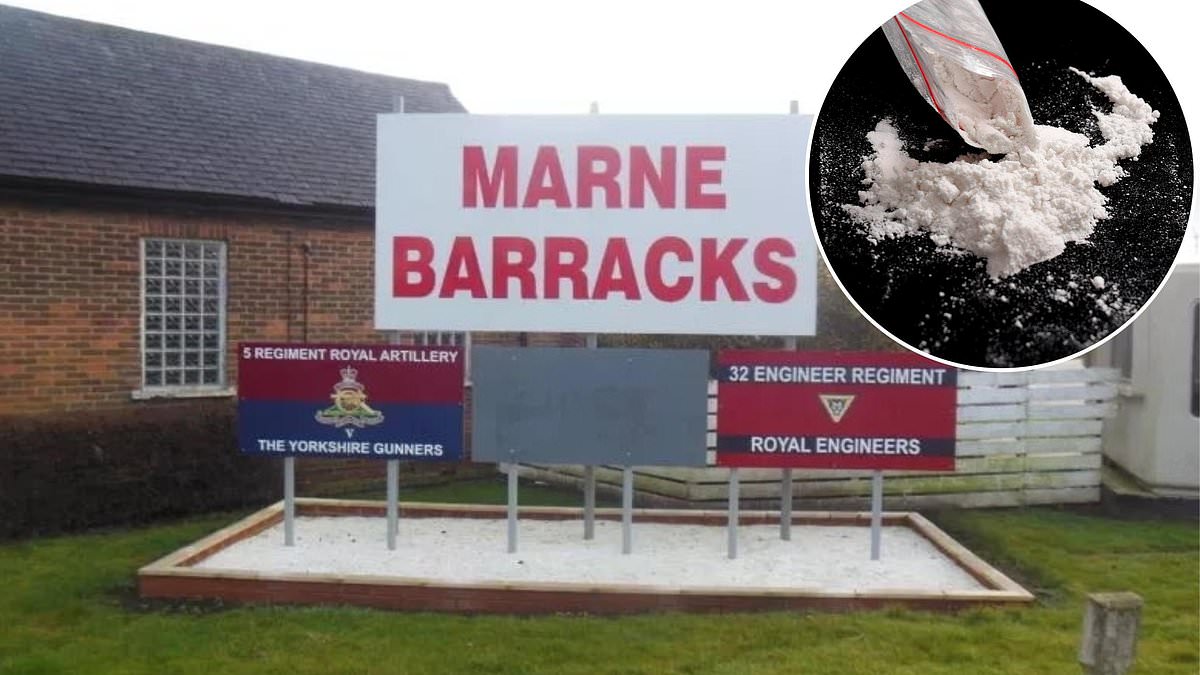
Troops from 32 Engineer Regiment failed a Compulsory Drug Test (CDT) sanctioned by their Commanding Officer amid reports of dealers operating in their barracks.
Yet in a reversal of previous Army directives to get tough on drug users, some of the soldiers will be educated in the dangers of substance abuse, rather than receiving their marching orders.
Last night, embarrassed defence officials confirmed the tests conducted at Marne Barracks, Catterick Garrison in North Yorkshire.
The 32 Engineer Regiment provides close engineering support to 7 Light Mechanised Brigade's combat team and is aligned with the NATO Very High Readiness Joint Task Force.
The Task Force is likely to contribute to any British contingent deploying to Ukraine in the aftermath of a ceasefire agreement with Russia.
Formed in 1948, the regiment's skills include reconnaissance, construction and bridge launching - where temporary crossings are deployed for troops and vehicles to cross obstacles such as rivers or ravines.
Its soldiers, historically known as 'Sappers', also drive 33-tonne Terrier armoured combat tractors with a top speed of 40mph.

Troops from 32 Engineer Regiment failed a Compulsory Drug Test (CDT) sanctioned by their Commanding Officer amid reports of dealers operating in their barracks

Cocaine is one of the narcotics most frequently used by drug-taking soldiers

Former senior officer Colonel Hamish de Bretton-Gordon said: 'We probably have to look at this through a 2026 lens. More than 20 troops is a disaster and we cannot afford to lose them'
Previous deployments have included Iraq and the Balkans.
On Wednesday, a Royal Engineers source said: 'There was a Boxing Night before Christmas and a lot of the lads went wild. They're young, stupid and junior. No seniors were involved.
'The officers have got to stamp out the drug culture. It so easy to get cocaine at major bases in the UK it is ridiculous.'
It is understood most of the 23 soldiers will be booted out but others will be given a second chance.
Officially, the Army policy is that troops caught taking drugs should expect to be discharged. But that is not always the case.
The Army is having to take a realistic approach to managing drug abuse within units considering troops' exposure to illegal substances prior to enlistment and when they socialise.
Commanding Officers have the discretion to retain soldiers when there are mitigating circumstances such as age, inexperience and when it is their first offence.
Read More Twenty Scots soldiers are kicked out the Army after they were caught taking drugs
On Wednesday, former senior officer Colonel Hamish de Bretton-Gordon conceded the need for realism over idealism.
He told the Daily Mail: 'We probably have to look at this through a 2026 lens. More than 20 troops is a disaster and we cannot afford to lose them.
'Maybe two strikes and you're out is realistic, considering how drug use is embedded in society. We really need to keep highly trained soldiers, especially considering the threat posed by Russia.'
Following a lull in operational tempo when troops returned from Afghanistan, the Army held a stricter line on sacking drug users.
That trend peaked in 2019 when 660 soldiers, the equivalent of a battalion, were discharged after testing positive for illegal substances, mostly cocaine.
That figure was up from 630 firings in 2018 and 580 in 2017.
Drug taking and drug testing subsequently went down during the Covid lockdowns.
Today, the Army is thought to be sacking around 500 soldiers annually for failing CDTs.
On Wednesday, an Army spokesperson said: 'Substance abuse is unacceptable in the Army. We robustly enforce a zero-tolerance policy to drug use by all those who serve and provide an education programme to inform all personnel of the dangers and consequences.
'A number of soldiers from 32 Engineer Regiment recently failed a Compulsory Drugs Test. As the matter is the subject of an ongoing internal investigation it would be inappropriate to comment further.'