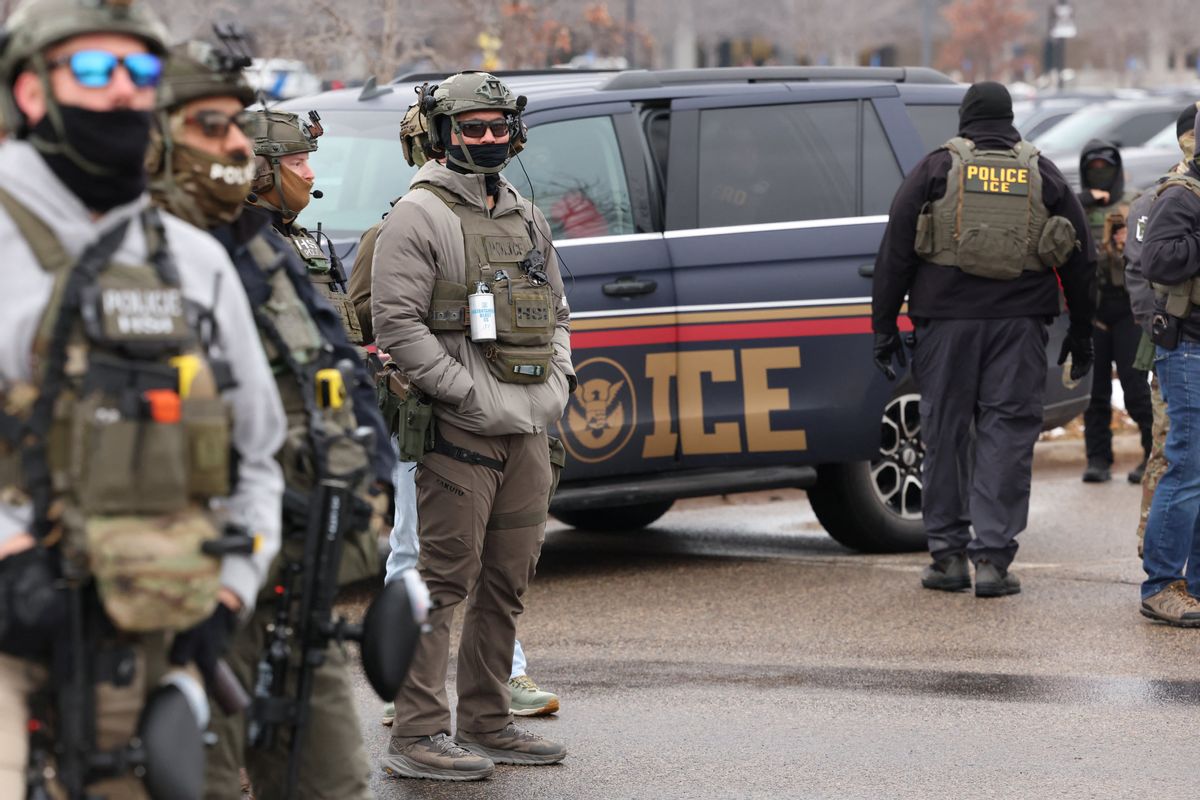
As U.S. President Donald Trump launched sweeping immigration enforcement operations across major cities in 2025 and 2026, legal experts analyzed how much authority federal immigration officers, particularly Immigration and Customs Enforcement agents, could have over U.S. citizens.
The question was a hot topic in January 2026, when Trump deployed around 2,000 ICE agents in the Minneapolis area to crackdown on alleged illegal immigration. On Jan. 7, an ICE agent fatally shot Renee Nicole Good, a U.S. citizen. (White House officials have said Good tried to run over the agent who shot her, while media analyses challenged the veracity of that account.)
Snopes previously addressed this issue in June 2025, after then-New York City Comptroller Brad Lander was arrested by ICE agents at a courthouse while he was volunteering with a group that accompanies immigrants to and from their court hearings.
Lenni Benson, professor of immigration and human rights law at New York School of Law, told Snopes over email that ICE's targeting of immigrants attending their court hearings is "an attempt by the [Department of Homeland Security] to rapidly detain a high number of people, including those who have complied with all requests and have sought asylum."
Our readers questioned whether ICE, which focuses on immigration-related crimes, had the authority to arrest people without a warrant and whether ICE has the power to arrest U.S. citizens like Lander. Below, we break down the laws governing ICE agents, the warrants they use and their authority when it comes to U.S. citizens.
We spoke to a number of immigration lawyers and reached out to ICE and the Department of Homeland Security.
When can ICE arrest someone without a warrant?
According to 8 U.S. Code 1357, "Powers of immigration officers and employees," subsection "Powers without warrant," summarized below, immigration agents do not need warrants for the following actions:
To interrogate any alien or person believed to be alien about their right to be or remain in the United States.
To arrest an alien who, in the agent's presence, is apparently entering the United States in violation of laws or regulations, particularly if the agent has reason to believe the alien can escape before a warrant can be obtained.
To board and search for aliens on any vessel in the territorial waters of the United States within "reasonable distance" from any external boundary of the United States, as well as "any railway car, aircraft, conveyance, or vehicle, and within a distance of twenty-five miles from any such external boundary to have access to private lands, but not dwellings." This access is for the purpose of patrolling the border.
To arrest people for "felonies which have been committed and which are cognizable under any law of the United States regulating the admission, exclusion, expulsion, or removal of aliens, if he has reason to believe that the person so arrested is guilty of such felony and if there is likelihood of the person escaping before a warrant can be obtained for his arrest."
To make arrests: "A) for any offense against the United States, if the offense is committed in the officer's or employee's presence, or B) for any felony cognizable under the laws of the United States, if the officer or employee has reasonable grounds to believe that the person to be arrested has committed or is committing such a felony."
Per the code, immigration officers can arrest anyone without a warrant if officers are "performing duties relating to the enforcement of the immigration laws at the time of the arrest and if there is a likelihood of the person escaping before a warrant can be obtained for his arrest."
When is a warrant required for ICE to arrest someone?
Aside from the exceptions outlined above under "Powers without warrant," ICE is required to present one of two warrants while making an arrest or conducting a search: either a judicial warrant to enter private property, or an administrative warrant from the agency authorizing an arrest or seizure.
For example, while Lander asked to see a judicial warrant for the immigrant ICE was attempting to detain at his court hearing, ICE is not required to present a judicial warrant in a public place like a courtroom. According to the National Immigration Law Center, a judicial warrant can be issued only by a court, must be signed by a state or federal judge, and authorizes "a law enforcement officer to make an arrest, a seizure, or a search of some private area, such as your home."
An administrative warrant (also referred to as an "immigration warrant" or "ICE warrant") can be signed by ICE itself. According the NILC, an administrative warrant is "issued by a federal agency and may be signed by an 'immigration judge' or an 'immigration officer' (such as an ICE agent). Unlike a judicial warrant, an immigration warrant does not authorize a search or entry into your home or other private areas."
We spoke to a range of immigration experts who noted that while ICE can obtain judicial warrants against immigrants as well as U.S. citizens, they hardly ever do so due to the requirement of persuading a federal judge to issue said warrant. Administrative warrants carry less legal weight, as in practice they allow an agency like ICE to give itself permission to carry out an arrest. Further, ICE cannot use administrative warrants to arrest U.S. citizens.
Benson told Snopes that while an administrative warrant should generally not be enforceable against anyone (immigrants and citizens included), it has often been accepted in many cases:
In general, no administrative warrant is enforceable against ANYONE. But administrative warrants are frequently accepted in a variety of settings, e.g., employer enforcement where an agency is looking for wage and hours records or compliance with verification of authorization to work. Individuals who are shown a warrant should read it carefully and can tell the officer they will not comply unless the warrant is issued by a member of the federal judiciary. State judges do not have the power to grant federal officers the right to arrest.
Sarah Owings, an immigration attorney in Atlanta, told Snopes by phone that ICE has no administrative warrant powers over U.S. citizens. "A judicial warrant could be obtained to arrest a U.S. citizen, but they are not going to do that," she said.
One reason is because of how complex the process of obtaining such a warrant can be. In a phone conversation, Nathan Yaffe, an immigration lawyer in New York, told Snopes that while an administrative warrant could simply be signed by an ICE official, the process for getting a judicial warrant can take longer: "You have to convince the judge that there is probable cause [their] search will reveal a crime or unlawful activity."
However, Yaffe added, the focus on the type of warrant needed to arrest individuals is a distraction from ICE's general practices.
"It's unfortunate that many elected officials and people in the media are fixating on the judicial warrant aspect, because it has never been the case that ICE gets judicial warrants prior to making arrests. It is extraordinarily rare," he said.
He continued:
[The demand for a warrant] is founded on an inaccurate premise that ICE is operating "lawfully" to get a judicial warrant. It wrongly creates exceptionalism around this moment and feeds into the idea there is a procedural justice fix. People should be attacking ICE practices across the board and not just under Trump in that case. There is a good argument [ICE] needs an administrative warrant to make the arrest but even that practice is not a meaningful layer of protection because ICE is basically giving itself permission.
Does ICE have the authority to arrest US citizens?
ICE generally does not have the authority to arrest U.S. citizens without a warrant except in certain circumstances. Yaffe said all three of the following criteria would have to be met to justify the arrest of a citizen:
ICE has to be actively in the middle of performing duties related to immigration enforcement.
The person they are arresting has to have been committing an "offense against the United States." That would be a subset of federal crimes.
There has to have been "a likelihood of the person escaping before a warrant could be obtained."
As stated in 8 U.S. Code 1357, in section 5 of "Powers without warrant," agents can arrest anyone "for any offense against the United States, if the offense is committed in the officer's or employee's presence" or "for any felony" and if the agent believes the citizen will escape before a warrant can be obtained for his arrest.
In Lander's case, DHS sent us a statement from Assistant Secretary Tricia McLaughlin in which she accused Lander of assaulting law enforcement and impeding a federal officer. However, available footage of the arrest did not provide evidence of Lander assaulting an officer.
Despite the above restrictions, ICE reportedly detained and deported numerous U.S. citizens in 2025, including children born in the United States.
Sources
"8 U.S. Code § 1324 - Bringing in and Harboring Certain Aliens." LII / Legal Information Institute, Cornell. https://www.law.cornell.edu/uscode/text/8/1324. Accessed 19 June 2025.
"8 USC 1357: Powers of Immigration Officers and Employees." U.S. Code. https://uscode.house.gov/view.xhtml?req=(title:8%20section:1357%20edition:prelim). Accessed 19 June 2025.
Benson, Leni. Professor of Law, New York Law School. Email, 18 June 2025.
Danner, Chas. "U.S. Citizens Keep Getting Caught Up in Trump's Immigration Crackdown." Intelligencer, 3 May 2025, https://nymag.com/intelligencer/article/tracking-us-citizens-children-detained-deported-ice-trump-updates.html. Accessed 19 June 2025.
Doherty, Erin. "NYC Mayoral Candidate Brad Lander Released after Arrest by ICE." CNBC, 17 June 2025, https://www.cnbc.com/2025/06/17/brad-lander-ice-mayoral-comptroller.html. Accessed 19 June 2025.
Ferré-Sadurní, Luis. "Brad Lander, NYC Mayoral Candidate, Arrested by ICE Agents at Immigration Courthouse." The New York Times, 17 June 2025. NYTimes.com, https://www.nytimes.com/2025/06/17/nyregion/brad-lander-immigration-ice.html. Accessed 19 June 2025.
Ferré-Sadurní, Luis. "Brad Lander Tried to Escort Immigrants Facing Arrest. He's Not Alone." The New York Times, 19 June 2025. NYTimes.com, https://www.nytimes.com/2025/06/19/nyregion/ice-immigrants-volunteer-escorts-courthouse.html. Accessed 19 June 2025.
Hutton, Rachel, and Alex Chhith. "What ICE Agents Can and Can't Do — and What Legal Rights the Public Has during Encounters." The Minnesota Star Tribune, 9 Jan. 2026, https://www.startribune.com/what-ice-agents-can-and-cant-do-and-what-legal-rights-the-public-has-during-encounters/601560316. Accessed 13 Jan. 2026.
"NYC Mayoral Candidate Brad Lander Arrested at Immigration Court." AP News, 17 June 2025, https://apnews.com/article/brad-lander-nyc-immigration-court-arrest-6ed341297efab31a08a14421674d8ed8. Accessed 19 June 2025.
"NYC Mayoral Candidate Brad Lander Arrested by ICE: Raw Video." YouTube, Fox 5 New York, 17 June 2025, https://www.youtube.com/watch?v=J_cT0GQln1w. Accessed 19 June 2025.
"NYC Comptroller Brad Lander's Wife Speaks out about His Arrest." YouTube, CBS New York, 17 June 2025, https://www.youtube.com/watch?v=DyuehLS5ID8. Accessed 19 June 2025.
"NYCLU on Arrest of City Comptroller." NYCLU, https://www.nyclu.org/press-release/nyclu-on-arrest-of-city-comptroller. Accessed 19 June 2025.
Owings , Sarah. Immigration Attorney. Telephone, 18 June 2025.
Warrants and Subpoenas 101. National Immigration Law Center, Sept. 2020, https://www.nilc.org/wp-content/uploads/2020/10/Warrants-and-Subpoenas-101.pdf. Accessed 19 June 2025.
Yaffe, Nathan. Immigration Lawyer. Telephone, 18 June 2025.





Comments (0)