
Remember me



US Treasury Secretary Scott Bessent said the new sanctions against Iranian officials – made at Trump’s direction – would continue the administration’s pressure campaign since March aimed at accelerating Iran’s economic collapse.

Donald Trump and Iran’s National Security Council chief Ali Larijani traded threats in December.Credit: AP
He reiterated Trump’s support for protesters risking their lives on the streets of Tehran and other Iranian cities. The US president said earlier this week that “help is on its way”, which many interpreted as a promise to intervene militarily.
In New York, the UN Security Council held an emergency meeting to discuss the situation in Iran, at the request of the US, which was attended by US ambassador to the UN Mike Waltz and Iranian officials.
“President Trump is a man of action, not endless talk like we see at the United Nations,” Waltz said. “He has made it clear that all options are on the table to stop the slaughter. And no one should know that better than the leadership of the Iranian regime.”
Canada’s Foreign Minister Anita Anand on Thursday said a Canadian citizen had died “at the hands of the Iranian authorities” amid the protests, though she did not provide further details.
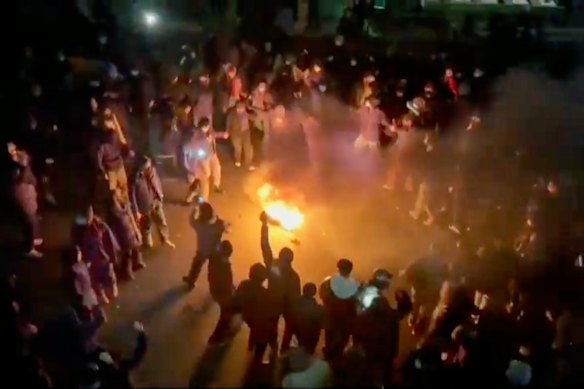
Protesters take to the streets in Tehran on January 9.Credit: AP
Australia’s Foreign Minister Penny Wong joined other nations in calling on Iran to “cease your brutal crackdown” and warned Australians in Iran that “the security situation could deteriorate rapidly without notice. This could see flights cancelled, airspace closed and other disruptions.”
As Australia and Iran no longer have reciprocal embassies in the capitals, Wong said Australia had extremely limited ability to help any citizens who remained in Iran.
There was widespread expectation of US strikes on Thursday when, in the early hours, Iran closed its airspace to all but a few select international flights to Tehran, and the US withdrew some personnel from military bases in the region.
But Trump softened his position at the same time, saying the US had received information from trusted sources that the killing had stopped and that executions of political prisoners would not occur.
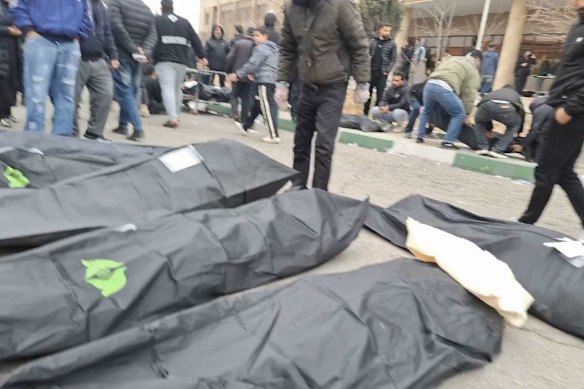
Photos posted by Vahid Online on January 14 claim to show body bags at Kahrizak Forensic Medicine Centre in Tehran.
Iranian state media also cited officials saying 26-year-old protester Erfan Soltani, who was arrested last week, had not been sentenced to death and would not be executed.
Trump did not rule out military action, but he said he would see whether the promises to stop killing protesters eventuated.
The US president has taken particular objection to the brutality of the regime against protesters. Human Rights Activists in Iran, a US-based organisation, says the death toll now exceeds 2600.
Loading
Some reports from Iran indicated protests were shrinking, although verifying information is difficult amid an internet and mobile phone blackout, and a ban on foreign journalists.
The Associated Press reported witnesses in Tehran said recent mornings showed no new signs of bonfires lit the night before or debris in the streets. The sound of gunfire had also faded after several nights of intense shooting.
The Wall Street Journal quoted two protesters in Tehran who said the streets were calmer, with fewer protesters and police roadblocks.
Those encouraging Trump to strike Iran remained confident he would eventually do so. Lindsey Graham, an interventionist Republican senator, said Trump’s resolve was not in doubt.
“The question is, when we do an operation like this, should it be bigger or smaller?” he said. “I’m in the camp of bigger. Time will tell. I’m hopeful and optimistic that the regime days are numbered.”
Eurasia Group president and political scientist Ian Bremmer, speaking at an event hosted by Foreign Policy magazine, said it was clear the intervention by the Gulf states was the most significant factor in convincing Trump to hold off.
“The Turks were also very sceptical and opposed, and they sent those messages to Trump,” he said.
Bremmer also said the US had determined Iran had brutally suppressed much of the demonstrations, and the US military was not convinced the timing was optimal to manage a large Iranian retaliation.
Loading
“The US doesn’t yet have an aircraft carrier in the region,” he said. “It was going to take probably another week before that was the case. They were hearing internally from the military: ‘we can do this, but this is not the best time for us’.”
Bessent appeared to offer an olive branch to Iranian leaders in his video message, telling them there was “still time” if they chose to “join us”.
“US Treasury knows that like rats on a sinking ship, you are frantically wiring funds stolen from Iranian families to banks and financial institutions around the world. Rest assured, we will track them and you,” he said.
“But there’s still time if you choose to join us. Stop the violence and stand with the people of Iran.”
With AP, Reuters
Get a note directly from our foreign correspondents on what’s making headlines around the world. Sign up for our weekly What in the World newsletter.