
Remember me


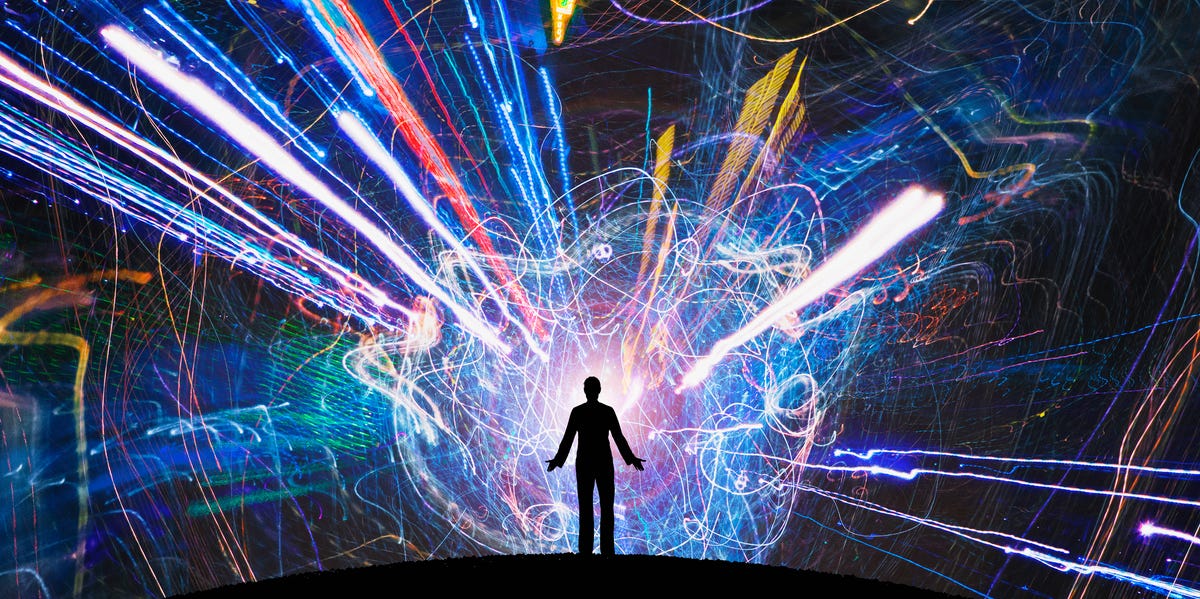





The spectrum of alien appearances across popular culture is vast, limited only by human imagination. From the sharp, angular features of Captain Spock to the dinosaur-like neck and big, expressive eyes on E.T. the Extra-Terrestrial, these beings embody logic, deep wisdom, and emotional connection.
This is no coincidence. Humanity’s deepest wish is that if we encounter another intelligent life form, it will be conscious, capable of understanding, and maybe even befriend us.
But could such beings really exist?
“Certainly,” Christof Koch, PhD, a neuroscientist and prominent figure in the field of consciousness studies, said in 2024. “Any complex system, whether evolved on Earth or elsewhere, could be conscious.” What that consciousness might look like is another matter entirely. Could aliens exhibit empathy, self-awareness, love, hate, or fear?
Update to the promo embed I want you guys to put into stories ... I came up with a format that looks better. Here are screenshots of what it looks like in MediaOS in the text editor, what it looks like on the front end when it's live, and the accompanying code:
🔮 Check Out Our New Video Series, Pop Mech Explains: Precognition
You’ve probably had that eerie feeling before—knowing what’s about to happen before it actually does. Flashes of deja vu. A text from someone you were just thinking about. A dream predicting the future. Coincidence? Or something deeper? Across four chapters, we investigate the science and speculation behind those “gut feelings.”
Go Down the Rabbit Hole With Us
To answer these questions, consider panpsychism, an ancient cosmic theory that suggests consciousness could be a ubiquitous feature of the universe, akin to gravity or charge. This idea, dating back to ancient Greek philosophers like Thales and Plato, has seen a resurgence in the 21st century as mainstream scientific approaches struggle to fully explain consciousness.
“Instead of starting with physical processes and trying to get consciousness out of that, we start with consciousness and try to get physics out of it,” said Koch, who’s currently serving as a meritorious investigator at the Allen Institute, a bioscience nonprofit based in Seattle, Washington.
That means panpsychism might help us solve the “hard problem of consciousness”—how the brain, a gooey mass of neurons, produces subjective experiences and an inner world of colors, sounds, tastes, and fantasies. But first, we need to rethink our assumptions about the world that have been in place for the past 400 years, before the scientific revolution, when theories like panpsychism were more mainstream.
The perfect exercise? Considering alien consciousness.
Theoretical physicist and cosmologist Paul Davies, PhD, suggests that alien consciousness could be radically different from human consciousness, operating on principles fundamentally foreign to us, making communication a significant challenge.
Or, extraterrestrials might rely on artificial intelligence rather than organic brains, argues Susan Schneider, PhD, a philosopher and cognitive scientist.
“Maybe they have gaseous forms,” suggested Philip Goff, PhD, a professor of philosophy at Durham University, who says we can only speculate about how aliens and their consciousness may manifest. Despite these challenges, mathematics could be our common language, he says. There’s also the speculative possibility of something like telepathy—which panpsychism doesn’t rule out. Consciousness, Goff argues, goes beyond what physical sciences can explain. “It is in the realm of metaphysics,” he said.
Interestingly enough, other experts agree. Psi phenomena—paranormal events such as telepathy, precognition, or psychokinesis that point to the existence of abilities beyond the scope of current scientific understanding—could play a key role in understanding alien consciousness, explains Dean Radin, PhD, chief scientist at the Institute of Noetic Sciences. “Adequate models of psi phenomena will probably require philosophies that look a lot like panpsychism,” he said.
Still, some experts are outright skeptical of panpsychism. Seth Shostak, PhD, a senior astronomer at the SETI Institute, argues consciousness evolved simply because it aids survival. “That’s all nature really cares about,” he said.
Shostak also believes intelligence—particularly the kind that leads to communication—needs a structured system to thrive in. “Intelligence requires some sort of machinery, like a brain, which needs to be organized,” he said. Given the universe’s vastness and age, intelligent life capable of communication, or what we perceive as conscious life, might be rare.
“You’ll only hear from those who can build a radio transmitter,” Shostak said. Those are the truly intelligent ones.
As for the other potential intelligences out there... maybe we just don’t have the means to listen in—yet.
More consciousness stories Did Consciousness Develop Before Life Itself?
 Could Lucid Dreaming Unlock Precognition?
 Consciousness May Not Be Uniquely Human













Stav Dimitropoulos is a Gold and Community Anthem Award–winning journalist, and writes about consciousness, science, and culture for Popular Mechanics, Nature, and the BBC. Her work often explores mind-stretching angles where science meets philosophy. Her debut nonfiction book, Slow, Lazy, Gluttons (Greystone Books, 2026) asks: What if the traits society shames — laziness, darkness, nostalgia, and more — are actually survival superpowers?
Comments (0)