
Remember me
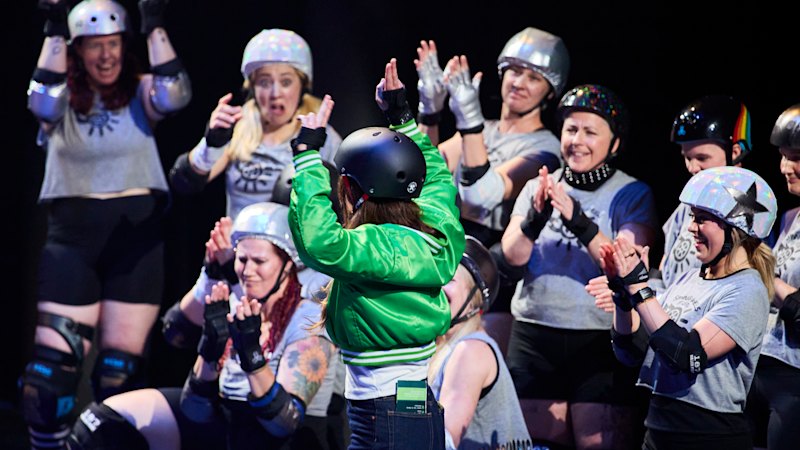
The acoustics also sabotaged the actors. What were intended as intimate exchanges between Mama and Billie sounded like announcements at Central Station, and, anyway, the acting, despite the gifted McMahon’s best efforts, was forced, sterile and (Mason-Hyde, apart) charmless.
Which brings us back to the skaters. These were real roller derby skaters having their moment in the sun. They deserved to be extras in a better show.
MUSIC
OPERA FOR THE DEAD
Neilson Nutshell
February 15
Reviewed by CASSIE TONGUE
★★★½
The Neilson Nutshell has been transformed into a liminal space for Opera for the Dead: it’s the space where grief collides with the outside world, so you can expect to be a little disoriented.
There are no banks of audience seats; we’re on our feet for this 50-minute performance, although there are a few scattered chairs, should you need them. It’s easy to be drawn into yourself and melt into the dark. At first, all we can see, illuminated by small points of light, are hanging bowls filled with mandarins: offerings for the dead. And then the multisensory feast begins.
Lightly jostled, the sound of their movement in the bowls is amplified until it fills the room. Later, bells are quietly slipped in with them by solemn performers acting as Wu Chang – those who escort spirits to the afterlife. Yu-Tien Lin begins to sing, and it’s beautiful and otherworldly.
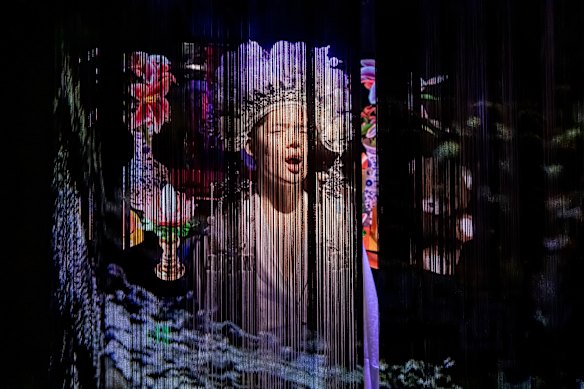
There is so much happening it is hard to decide where to concentrate your attention.Credit: Jacquie Manning
Created by Mindy Meng Wang and Monica Lim, Opera for the Dead: could swallow you up. Its ambient and electronic soundscape is loosely built around the loss of the father; the score is soaring, layered and clever, featuring guzheng (played by Wang), cello (Nils Hobiger) and percussion (Alexander Meagher).
The soundscape includes elements of traditional mourning (there’s a wailing chorus that plays with the tension between performance of grief and deep sorrow); and twists on traditional prayers and poems for the deceased, which are then complicated with digital, experimental elements, including pulsing lights (Jenny Hector), projections and video (Nick Roux), and thrumming beats (Lim).
We are encouraged to move around the space as each number unfolds – there are small platform stages that move positions throughout the piece to emphasise progression through time and emotion.
But on the night I attended, the audience seemed reluctant to do much exploring, and it’s easy to understand why. As the piece progressed and the numbers became more musically and visually complex, each stage – no matter where it was – offered actions or projections that favoured front-on views.
This had the effect of keeping people awkwardly in place, those caught on the edges of the best sight lines straining for a clear view. It’s hard to embrace the discovery that occurs from watching a piece from unexpected angles when you’re pretty sure you’re missing something, and video storytelling is easy to miss if you’re not standing in the right place at the right time.
But if you’re happy to lose yourself in the experience – and not worry about capturing everything that happens – there’s plenty to love. The thrilling relationship between lighting and sound cues created ripples across the performance stage as lights chased changes in sounds and sounds grew louder, more urgent, under more intense lights; Lin’s voice could settle in your gut, no matter where you were. The show, crafted as an offering for lost loved ones, allows us to find moments to connect with our own ghosts. For 50 minutes, we are with them again.
THEATRE
ENGORGED
Concert Hall, Sydney Opera House, January 16
Reviewed by KATE PRENDERGAST
★★★★
Appearing with flowing pony-tailed mic and black raiments – a couture of deconstructed dressage – “the only horseman of the apocalypse to ride side-saddle” Reuben Kaye has summoned an orchestra to match his par excellence of excess for Sydney Festival.
Having reached the cultural summit of the Opera House with his mordant wit; his high-strength cocktail of brazen political jibes and double-entendre smut; and his larger-than-cis-life drag persona, the Melbourne-born Cruella De Vine of comedy flashes a rare vulnerable side for his one-night show.
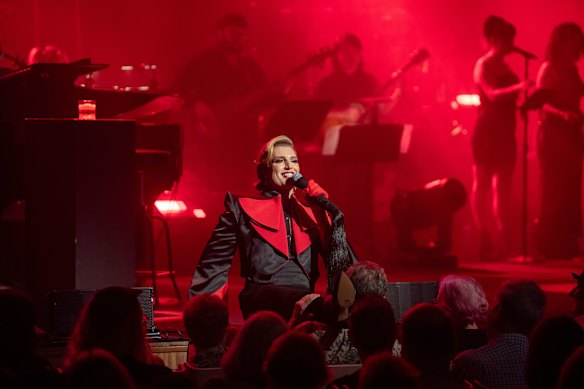
Reuben Kaye delivered a cabaret of furious defiance.Credit: Wendell Teodoro
Because fearless as he is, Kaye knows all too well that the sponsored celebration of queer identity can turn on a dime. That terrifying volatility, where unbothered acceptance can turn to violent hate overnight, is a lesson he’s carried with him since he was a young boy playing dress-ups.
Stuffed as this show may be with sly vulgarities and titillating overshares, enGORGEd forces us to confront this truth, too. Because while the marginalised deserve a “safe space”, the mollycoddled majority does not. It’s an apt message for a well-to-do crowd wearing more flannel than sequins.
With a string and horn section, two drum kits, three back-up singers, and his long-time collaborator conducting behind a grand piano, Kaye lends his powerhouse voice and storytelling elan to this cabaret of furious defiance. Protest songs include Nat King Cole’s When I Fall in Love and Asaf Avidan’s A Part of This, with several original numbers at the top.
Between songs, Kaye prowls the stage and regales us with his exploits, misadventures and hot takes. We hear confession of his sins when touring with Jesus Christ Superstar last year, hijinks including the delivery of a fart machine to the stage door of Crown Casino. He later recalls that joke he told on live TV about Jesus getting nailed, and the death threats that followed.
Kaye’s demimonde diva is a bitter and beautiful creation, showing the point of collapse between the vengeful pride of a would-be victim with self-parodic vanity. Great, glittering tension oozes from the ambiguity of whether the incandescent rage behind his adamantine smile is mock, or real, or both. It’s present in his spontaneous audience interactions, too: when a lady put her wine glass on stage, he crowed at the audacity, pounced, and confiscated the contents in his throat.
enGORGEd’s structure isn’t seamless, with a few jarring transitions. This is most acutely felt when Kaye jumps into a roof-raising satire of the religious rich, right after a poignant ballad by the piano that he wrote in response to his school bullies. It’s an abrupt hoisting of the showbiz mask after a window of tenderness.
He does land the end, though. After eight years singing it for himself, Kaye closes the night with Will You Love Me Tomorrow, reminding us that for the first time last year, the US refused to recognise World AIDS Day. I hadn’t expected to choke up.
Earlier, Kaye himself choked, suffering a small hiccup of indigestion. Without pause, he quipped, teeth gleaming behind that Cheshire cat grin, “a good man never stays down”.
OPERA
Turandot
Opera Australia
Joan Sutherland Theatre, Opera House, January 15
Until March 27
Reviewed by PETER McCALLUM
★★★★½
In Opera Australia’s new production of Puccini’s last (and incomplete) opera, Turandot, director Ann Yee and designers Elizabeth Gadsby (set), David Fleischer (costumes) and Andrew Thomas Huang (video) have placed a magnificent trio of principals, Rebecca Nash (Turandot), Young Woo Kim (Calaf) and Maria Teresa Leva (Liu), in a dark dystopia of the mind.
Everyone wears the same drab blue and grey (except Turandot who first appears in pristine white). The walls and fabric have creeping dark patches at the edges like mould suffocating the soul, while a projected video-game avatar lurks on the back wall, blinking creepily.
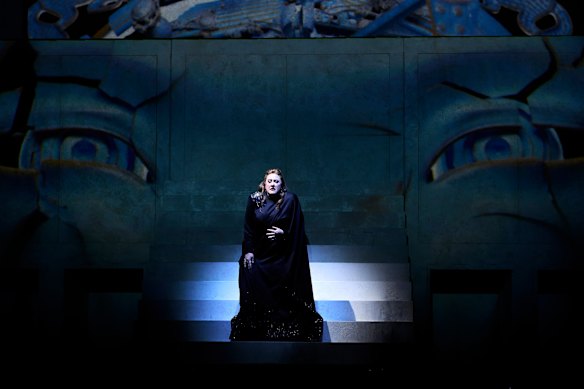
Rebecca Nash as Turandot. Credit: Keith Saunders
Side-stepping the original’s racist stereotypes, Ping, Pong and Pang (Luke Gabbedy, John Longmuir, Michael Petruccelli) become P1, P2 and P3, cynical techno-geeks whose retro-technology inure them from reality.
Central to Yee’s conception is to make the ancestor who spurs Turandot’s hostility towards men, Lou-Ling, into an embodied character – a dancer (Hoyori Maruo), whose writhing convulsive movements return at salient moments.
Although the silent dance before the music began had moments of awkwardness, it placed the persona firmly in the listener’s mind as a driver of action. When Lou-Ling unites with the gentle Liu, “so good, so sweet”, at the end, the message is clear: it is the suffering of both that creates healing from intergenerational trauma.
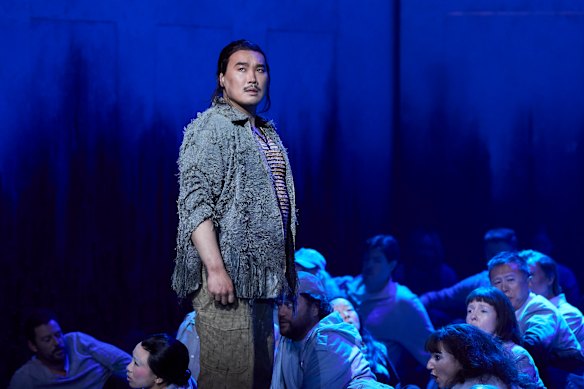
Young Woo Kim as Calaf. Credit: Keith Saunders
In this context, the problematic final scene (completed by the composer Adami from Puccini’s sketches) was meaningful where it is often ineffective (though one wonders if Puccini himself would have shortened it to create more verismo impact after the emotional climax of Liu’s death).
Conductor Henrik Nanasi maintained dramatic momentum incisively up to that poignant moment, so the score moved forward with the decisiveness of the story, while leaving ample flexibility for the singers to expand expressive moments.
As Calaf, Kim sang with gorgeous, richly tanned velvety colours and stentorian strength that he seemed able to push to the limits without cracking the beautifully burnished finish. He leavened the soaring lines of Nessun Dorma with phrases of quieter nuance to give classic shape to this most famous of moments and, more broadly, created a rounded character, which avoided pushing Calaf’s forceful dominance too far into wearying and overbearing self-centredness.
Nash was every bit his equal as Turandot, matching his tone in the riddle scene with vivid dramatic colours and riveting, almost frightening, intensity, which she transformed to a softer glow in the final scene.
Leva captured both simplicity and depth as Liu singing with light charm in Act 1 and allowing more full-blooded passion into the sound in Act 3. Her most memorable note was the high B flat in her first aria, which emerged like a quiet truth in a mist of melancholy.
Richard Anderson was a poignant Timur giving well-shaped lines unvarnished eloquence. As the three Ps, Gabbedy, Longmuir and Petruccelli provided sarcastic comic counterpoint, sustaining Puccini’s slightly overlong scene in Act II strongly, with well-articulated vocal lines and witty deflection, as though responsible for the running of the machinery of a surveillance state.
In fading respectable skivvy and slacks Gregory Brown sang the Emperor’s role with frail clarity like one keen to return to his retirement village, while Shane Lowrencev made the Speaker’s role into a mindless vehicle of autocratic edicts. Placed on a revolving stage with static symbolic movements, the Opera Australia Chorus sang with vivid openness, subtlety and power to bind together these fragments of the excesses of human passion.
DANCE
EXXY
Sydney Opera House, Drama Theatre
January 15
Until January 18
Reviewed by KATIE LAWRENCE
★★★★★
Think of something in the world that makes you question the future of humanity. I’ll wait.
(Actually, I won’t — we’d be here all night.)
Whatever came to mind, Dan Daw’s Exxy is the antidote.
Exxy is a dance-theatre love letter to the best of us: to survival, to tenderness, and to a tiny boy with cerebral palsy and his ballsy Nan, belting out The Power of Love into the red dust of the outback. It is hilarious, ferocious, devastating – and somehow also an incredible night out.
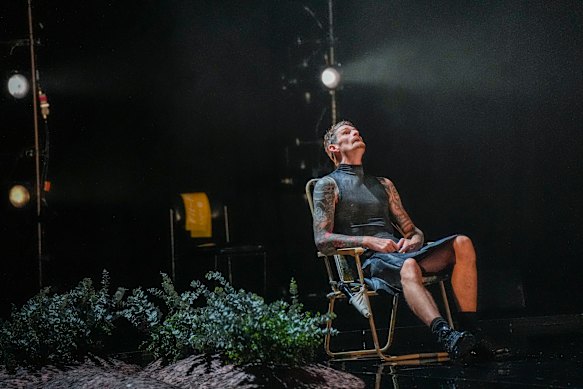
Dan Daw is resplendent in a tank top and kilt. Credit: Neil Bennett
The action unfolds against corrugated iron, framed by deck chairs and the vast Australian landscape. The cast of four (Daw, Tiiu Mortley, Joseph Brown and Sofia Valdiri) are stunning. Monologues and movement land like gut-punches, then pull you in for a hug.
From the jump, Exxy commits hard to inclusion. Participation isn’t just welcome; it’s actively directed via flashing overhead captions. Don’t panic. I have never enjoyed being gently bossed around by a show more, including the singalong (no spoilers, but it goes off).
The costumes and sets (by Kat Heath) are Mad Max survival chic: industrial greys, bodies braced for impact. It’s battle gear with a forehead kiss. Daw is resplendent in a tank top and kilt, tattoos on full display. His solos are breathtaking in their intelligence and clarity; the definition of a dancer working with his body.
Guy Connelly’s soundtrack ranges from lilting melodies to techno thuds, matching the movement. The stage is carpeted in saltbush and light. Daw’s metaphor is clear: saltbush doesn’t just survive; it bursts through concrete.
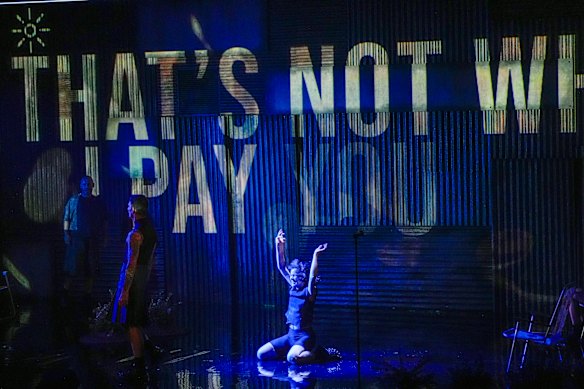
Exxy is packed with camp, gleeful absurdity. Credit: Neil Bennett
Exxy doesn’t sugarcoat. It tells stories of sexual rejection and casual cruelty: doors slammed in faces; turning up for a hookup only to be asked to leave after undressing; encounters with people who need someone else kneeling in order to feel tall.
Don’t be misled into thinking Exxy is solemn. It is packed with camp, gleeful absurdity – performers on all fours, drooling onto the stage; a “who’s better at cerebral palsy” battle that ends in applause; a group marathon where the destination is unclear but the vibe is unadulterated “I got you.” Exxy is 90 minutes in a room full of people who vocally have your back.
Like saltbush, Exxy doesn’t ask for permission to take up space. It insists on participation, demands tenderness – and turns the theatre into an intimate, raucous, glorious celebration of being alive.
DANCE
Save the Last Dance for Me
Palm Grove, Sydney Town Hall, & Leichhardt Town Hall
January 15
Until January 23
Reviewed by CHANTAL NGUYEN
★★★★½
In Save the Last Dance for Me, a white dance floor is marked out with masking tape in a diamond pattern. A slow, electro-swing beat begins (Aurora Bauzà and Pere Jou’s soundscape), and two men pace onto the dance floor (Gianmaria Borzillo and Giovanfrancesco Giannini).
They both have neat, toned physiques; upright posture; slick fashionable clothes; and impassive facial expressions. Stylistically, they are clearly European contemporary dance artists.
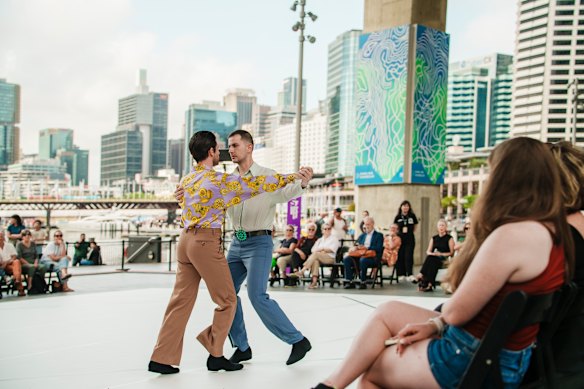
Gianmaria Borzillo and Giovanfrancesco Giannini. Credit: Stephen Wilson Barker
But the dance itself has more earthy roots. It is the polka chinata, a folk dance from Bologna, Italy when early-1900s social norms prohibited men from dancing with unmarried women. So the men danced with each other, exerting to attract female attention with the polka chinata’s rapid complexity.
Borzillo and Giannini slowly grasp each other in a ballroom embrace, their bodies gently lifting like two lungs inhaling. A pause like a wave cresting, then they begin gliding down each arm of the diamond, their feet moving in a swift, syncopated pattering step.
The travelling step becomes hypnotic in its speed and liquid intricacy. One false move and the dance would meet the kind of tangled end you see in cycling race pile-ups.
Loading
But Borzillo and Giannini never misstep, their bodies moving with such smooth, disciplined synchrony that it is like watching one entity rather than two (interestingly, the two male bodies are far more visually uniform than ballroom dancing’s usual male-female pairing). There are dizzying spins and a remarkable scooching turn, where Borzillo and Giannini grasp each other’s biceps, crouch down, and begin to whirl.
When the choreographer, Venice Golden Lion-winner Alessandro Sciarroni, first learnt about the polka chinata, you could count on one hand the number of couples who still knew how to dance it. He sent Borzillo and Giannini to Bologna to learn the dying artform. That effort led to this extraordinary piece, a rediscovery of a folk dance form, beatified and resurrected in a modern, fine arts setting.
A smile breaks through Borzillo’s face, his neat shirt now drenched with sweat. As they break through a wall of exhaustion, the audience begins clapping along, uplifted by the combination of tradition and modernity. Passers-by linger, entranced. The finale is a joyous crescendo of movement, with grins all round.
With Canadian import Kris Nelson directing this year’s Sydney Festival, the dance offerings have been exceptionally strong. At just 30 minutes, Save the Last Dance for Me is a clear winner.