
Remember me

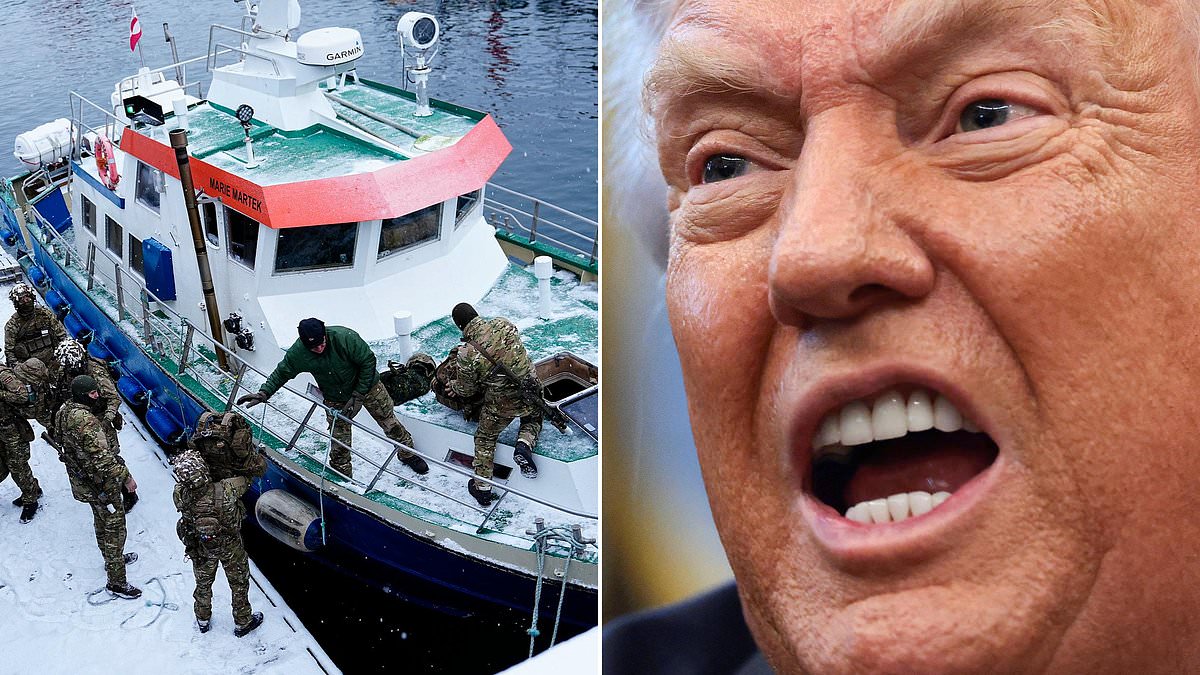




Could Donald Trump have just influenced the outcome of the next general election? His idiotic threat to launch a trade war against Britain and its European allies, unless he is allowed to get his avaricious hands on Greenland, may have achieved precisely that.
Sir Keir Starmer is clearly one major casualty since he has sucked up to Trump in the most embarrassing way, despite it being obvious that he disagrees with the US President about almost everything.
Trump proposes to punish Britain, as much as the EU, with vindictive new tariffs directed at the country that is supposed to be America's closest ally.
It is probably Washington's most shockingly anti-British act since the 1956 Suez Crisis, when the US joined with the Soviet Union to vote against us in the UN Security Council.
The prospect of Trump seizing Greenland is too much even for Starmer. For the first time he has summoned the courage to raise a tremulous voice of criticism against his domineering American master. It is unlikely to make much difference.
Our feeble Prime Minister could sink still lower in public esteem as it becomes clear that all that cringe-making sycophancy has got him absolutely nowhere.
But he is probably doomed anyway. Trump may simply hasten his inevitable demise.
There is another political leader whose fate could be more decisively shaped by what Trump has done. I mean Nigel Farage.

Both Trump and Farage think the same about a lot of issues, meaning it will not be easy for Farage to disown Trump if he wanted to
He needs to put as much distance as possible between himself and the increasingly outrageous occupant of the White House. But will it be too little, too late?
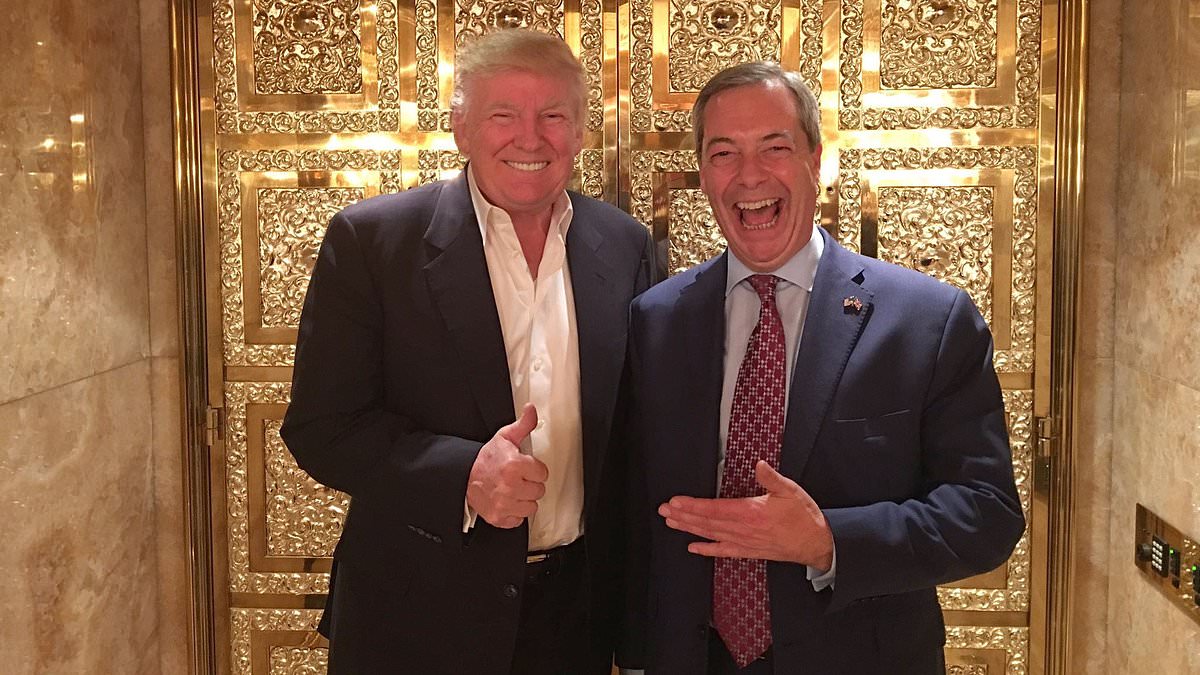
The leader of Reform UK admires and likes Trump. He counts himself a friend who stuck with the bouffant-haired maverick when Democrat Party lawyers and judges were trying to bring him down after the end of his first term.
From Farage's point of view, the relationship is about far more than being close to the most powerful man in the world. The two men think the same way about so much. Unlike many people, Farage sees virtues in Trump's character.
So it is not going to be easy for him to disown Trump, even if he wants to. Granted, the reverse may not be true.
At a press conference last week, a journalist asked Reform's leader whether it was true that the President had 'totally lost faith' in him, as has been suggested in parts of the media.
Farage seemed somewhat put out by the question. He replied that he had seen his old mate last October and again in November.
Trump had 'always been enormously supportive' of him. They did not, of course, 'see eye to eye about everything'.
Reform's leader is well aware of what happened to the Conservatives in Canada in last year's federal elections.
Pierre Poilievre's party, which had been far ahead in the polls, slumped to a narrow defeat after many voters judged that he had become too close to Trump.
The President had virtually threatened to annex Canada, supposedly a close US ally. He has so far not been so aggressive towards this country.
But I doubt that patriotic Reform voters will welcome the latest anti-British announcement from Farage's bombastic American friend.
Supporters of Reform are surely at least partly defined by their love for their country and a feeling that they don't want to be bossed about – far less threatened – by overbearing foreign powers. It is why most of them voted for Brexit.
Many of them are probably instinctively pro-American but that allegiance would crumble if the US President, notwithstanding his praise for the Royal Family, were seen to be increasingly antagonistic towards Britain.
In short, Nigel Farage has a problem. He can't erase the pro-Trump sentiments he has uttered in the past, and any attempts to disavow his friend in the future may not carry conviction.
He has other difficulties, which Labour and the Tories are already exploiting, arising from his former enthusiasm for Vladimir Putin. This is often much exaggerated, but there is enough truth in the accusation for it to damage Reform's leader.

Putin is the leader that Farage admires most and Trump has gone even further in praising the Russian leader
Farage has repeatedly claimed to have forecast a war between Russia and Ukraine in 2014.
Whether he made such a precise prediction has been disputed, but he did accuse the European Union of poking 'the Russian bear with a stick', and of having 'blood on its hands' for allegedly encouraging anti-Russian rebels in Ukraine.
A year later he said in an interview that he admired Putin more than any other world leader, though he added that he did not 'approve of him politically'. Still, it was an incautious thing to say. Trump has, of course, gone much further in praising the Russian autocrat.
Nor should we forget Nathan Gill, an MEP in Farage's UKIP, who later became Reform UK's leader in Wales. Last September he was jailed for ten and a half years for accepting up to £40,000 in bribes to push pro-Putin propaganda.
Let's just say that Nigel Farage is vulnerable to the charge of having been overly sympathetic to Russia in the past, while there is no doubt that he has warmly supported an American President who cheerfully damages British interests.
I'm sure he understands the dangers of his position, which is why Reform quickly condemned Trump's plan to apply tariffs. Head of policy Zia Yusuf said yesterday that the party was 'gravely concerned about it'.
He added that 'bigger tariffs on this country will make it even harder for British manufacturers, even harder for British workers'.
Will voters be persuaded that a Britain run by Nigel Farage would stand up to Vladimir Putin and avoid being the lapdog of an unreliable American President?
He may have a get-out clause inasmuch as Trump will have gone by the time of the next British general election. But what if his successor is just as bad?
Farage rightly says that Britain must spend more on defence. But I don't believe he has yet persuaded the electorate that a Reform government would conduct a robust and independent foreign policy. He carries a lot of baggage.
An increasingly astute Kemi Badenoch may be more readily believed. In an interview with yesterday's Sunday Telegraph, she said that Britain would not be a 'poodle' to Donald Trump under the Tories.
Unless we spend more in building up our defences, we will be seen as weak on the international stage.
The Conservative leader added: 'Reform presents itself as insurgent and anti-establishment, yet it displays no serious interest in national security at all.'
By way of an example, she pointed out that in his self-serving speech last week justifying his defection to Reform, Robert Jenrick failed to mention foreign affairs.
Needless to say, the next election won't be won or lost on geopolitics alone.
Yet in an increasingly unstable world, and with the United States appearing almost as much of an enemy as an ally, these are issues that matter more than they have since the darkest days of the Cold War.
Nigel Farage has a mountain to climb if he is going to convince voters that a Reform government would stand up for Britain against Russia and China, and not be pushed around by the United States. He had better start climbing now.