
Remember me







The new hit Netflix movie The Rip, starring Matt Damon and Ben Affleck as cops investigating a pile of cash at a “stash house” in Miami, feels like a perfect fit for director Joe Carnahan, whose previous work includes movies about cops (like 2002’s Narc, which he wrote and directed) and movies about cops in Miami (like 2020’s Bad Boys For Life, which he co-wrote). As The Rip demonstrates, it’s a tricky milieu to navigate without starting to feel insular at best and jingoistic at worst, but Carnahan’s last police movie pulls it off nicely. Unfortunately, few people have actually seen Copshop.
In fact, back in 2021, Copshop posted what remains the second-worst opening ever for a movie debuting in 3,000 or more theaters, which feels like quite a rejection. (This is a movie that was widely available in a time of low competition, and audiences still took a hard pass). The presence of Gerard Butler in a bullet-riddled thriller may have drawn some additional viewers at home (which is probably where this movie was always going to do better regardless), but Copshop doesn’t seem to be anywhere near as well-known as other Butler thrillers of the same era like Greenland, which just got a sequel. No such franchising will likely follow Carnahan’s film.
 Image: Briarcliff Entertainment
That’s fine, because despite its flash, Copshop throws back further than most cop thrillers. Though it takes place in the present day, the movie immediately announces itself as a Western. Its opening shot pans across the Nevada desert and finds Valerie Young (Alexis Louder) as she practices drawing, twirling, and holstering her new six-shooter. The actual plot is like something from the post-Tarantino boom that gave Carnahan his start. Criminal fixer Teddy Murretto (Frank Grillo) gets himself thrown in jail to evade some bad guys, only to have hitman Bob Viddick (Gerard Butler) pull the exact same trick to follow him, placing Valerie and her colleagues in the crossfire. The movie gets even cartoonier when another hitman, played by scene-stealing Toby Huss, arrives on the scene.
The majority of Copshop unfolds at a police station in Gun Creek, Nevada, with a classic siege dilemma. As dangerous and murderous forces close in, Valerie must decide who, if anyone, from those jail cells she can trust to help her survive. It’s not a spoiler to say that, after a certain point, she’s not receiving much help from the right side of the law.
By throwing back to a dynamic that would be perfectly at home in a movie set 130 years earlier, Carnahan and his co-writers Kurt McLeod and Mark Williams gracefully sidestep both the insularity and the glorification of movie policework. While The Rip seems enamored by the lingo, interdepartmental rivalries, and rugged weariness of being a (movie) cop, Copshop offers a more workaday portrait of the job, even when the action is eventually heightened with machine-gun fire and loquacious criminals. Valerie is surrounded by a variety of policemen; laziness, competence, corruption, and administrative frustration all bump up against each other before all hell breaks loose.
 Image: Briarcliff Entertainment
Valerie herself, in what should have been a star-marking performance for Louder, is obviously a smart, resourceful cop. Thankfully, the story doesn’t puff up her thin-blue-line righteousness. You want her to survive because she’s scrappy and likable, not because of her moral authority. Louder makes a terrific modern cowboy, plainspoken and laconic without becoming either overly quippy or ostentatiously furious. The screenplay obliges with a series of small-scale but tense challenges: barricading herself in the jailing area by hastily changing the passcode; finding some stray bullets when she’s out of ammo; and that old standby, performing an emergency tracheotomy
The focus on Valerie also sets Copshop apart from some of Carnahan’s other, more traditionally macho crime flicks —- and there’s some indication that an earlier version of the movie might not have been so well-balanced. Around the time of the movie’s release, Grillo (who has worked with Carnahan on multiple projects) complained on Instagram that his performance had been cut down, and the version of Copshop that was hitting theaters wasn’t Carnahan’s final cut. Carnahan’s own release-week post was more magnanimous, but notably left out Butler’s name from a long list of thank-yous, causing speculation that he was the difficult party on-set. (Grillo and Butler were both also producers on the project.) Maybe Butler and Grillo were dueling for screentime in parallel with their characters’ rivalry, which is ultimately pushed to the side by Valerie.
 Image: Briarcliff Entertainment
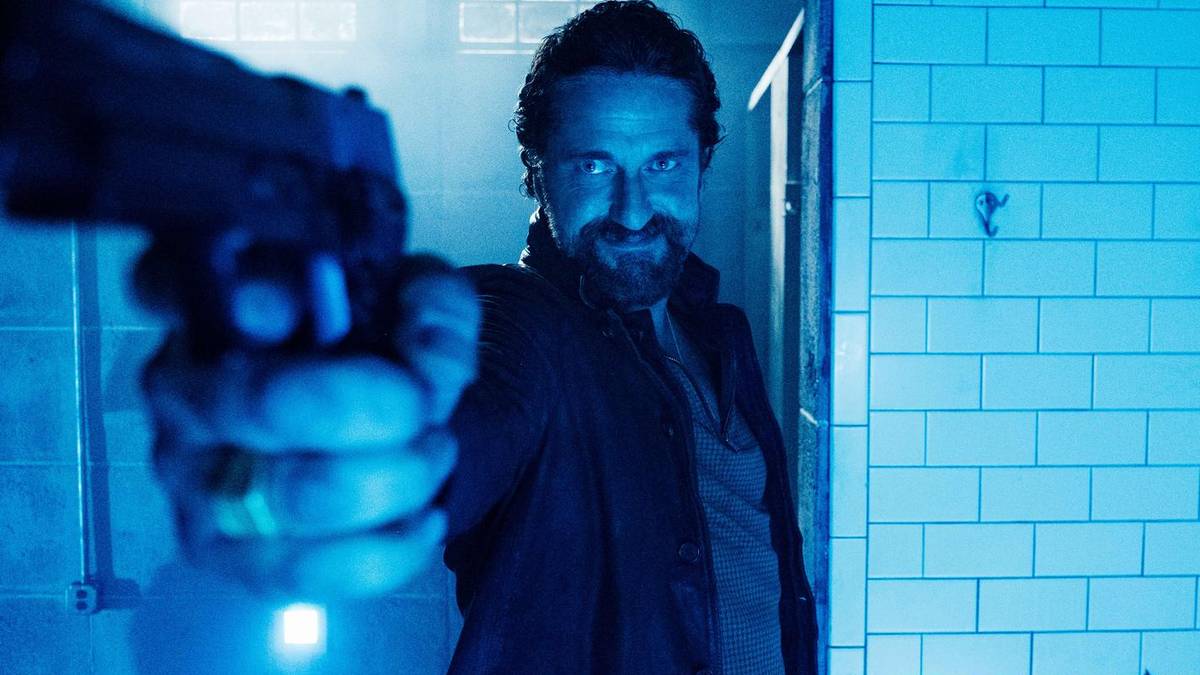
It’s possible Carnahan’s cut was even better, but watching the Copshop that exists may not inspire wistful thoughts of a Grillo-heavier version. Regardless of the how or why, it’s easily one of Carnahan’s best features. Whether or not Butler was agreeable during filming, Carnahan makes great use of him as a killer who is relentless and cold-hearted, but pragmatic in his way. Grillo makes an appropriately slippery yet not unsympathetic outlaw. The shoot-outs may have more overblown firepower than the typical 1950s Western, but they don’t lose their tension. The bullets seem just as deadly as they would in the late 19th century.
All in all, Copshop forms a neat flipside to Carnahan’s other cut-above film, 2012’s The Grey, which took a pulpy survival premise (guys plane-crashed into the wilderness where they’re stalked by wolves) and turned it into a surprisingly existential drama. Copshop has a more playful tone, but it summons a similar determination as Valerie faces stacked odds. The movie taps into an American sensibility that predates more militarized police and, as such, feels more relatable. After all, who hasn’t felt besieged by malevolent forces during a day on the job?
Copshop is currently on Prime Video and is coming to Netflix in February.