Credits
Nathan Gardels is the editor-in-chief of Noema Magazine. He is also the co-founder of and a senior adviser to the Berggruen Institute.
When the United States summarily defected from the world order it had built since the end of World War II, effectively joining the revisionist powers of China and Russia, it was clear we were headed back to the kind of Great Power spheres of influence that characterized the 19th century. What was less clear was how all those left out of this equation would fare going forward.
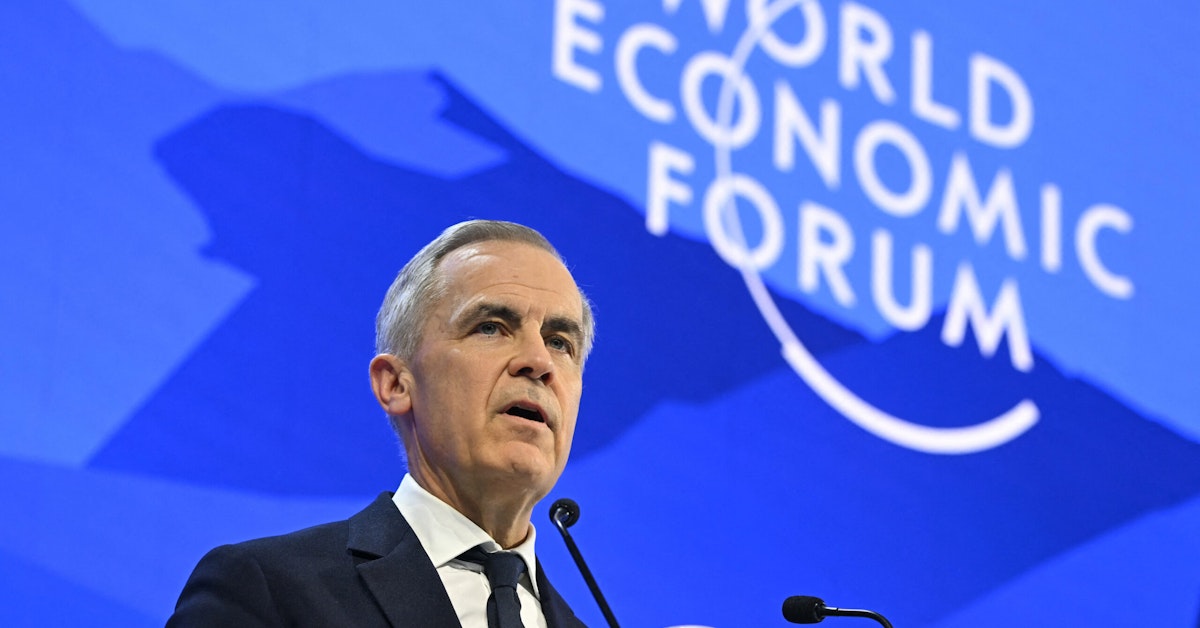
In the most powerful speech delivered at the World Economic Forum in Davos, Switzerland, this week, Canadian Prime Minister Mark Carney laid out a forward-looking vision for those who must operate in the breach.
To begin with, he acknowledged that, for all its faults and hypocrisies, the liberal rules-based order did benefit the security and prosperity of smaller powers enough to foster their allegiance. But that is all over. We should not fool ourselves that we are in a moment of “transition” that may someday revert to an approximation of the old normality, he chided. Rather, we are facing a total “rupture” with the past that compels the less powerful to construct an alternative collective approach.
“Middle powers must act together because if we’re not at the table, we’re on the menu,” he bluntly told the government and business elites assembled in the Alps.
“The great powers can afford, for now, to go it alone. They have the market size, the military capacity and the leverage to dictate terms. Middle powers do not. But when we only negotiate bilaterally with a hegemon, we negotiate from weakness. We accept what’s offered. We compete with each other to be the most accommodating.
“This is not sovereignty. It’s the performance of sovereignty while accepting subordination.
“In a world of great power rivalry, the countries in between have a choice: compete with each other for favor or to combine to create a third path with impact.
“We shouldn’t allow the rise of hard power to blind us to the fact that the power of legitimacy, integrity and rules will remain strong — if we choose to wield them together.”
He went on to spell out what he means:
“First, it means naming reality. Stop invoking ‘rules-based international order’ as though it still functions as advertised. Call it what it is: a system of intensifying great power rivalry where the most powerful pursue their interests using economic integration as a weapon of coercion.
It means acting consistently, applying the same standards to allies and rivals. When middle powers criticize economic intimidation from one direction but stay silent when it comes from another,” it accommodates the narrative of powerlessness.
Further, he continued, “It means building what we claim to believe in. Rather than waiting for the old order to be restored, it means creating institutions and agreements that function as described.
“And it means reducing the leverage that enables coercion. Building a strong domestic economy should always be every government’s immediate priority. And diversification internationally is not just economic prudence — it is the material foundation for honest foreign policy. Countries earn the right to principled stands by reducing their vulnerability to retaliation.”
Carney’s vision tracks with the thinking of Anne-Marie Slaughter, a former director of policy planning at the U.S. State Department, in a recent Futurology podcast. In our discussion, she recognized that an era of Great Powers was once again ascendant, but that we face a different world than in the 19th century. Ruling in their domain is only part of the story.
Mapping the world today, she argued, must include a whole array of different actors and networks — cities, states, provinces, multinational companies, civil society NGOs, middle powers and regional arrangements from the Association of Southeast Asian Nations (ASEAN) to the African Union which, all together, face common global challenges from climate change to pandemics as well as economic and security threats from the predations of the great powers.
This is not a map of powerlessness, but of distributed power where the actors are “multi-partnered and multi-aligned,” even forming pivotal “hubs” organized around trade, finance, climate mitigation, technology or other competencies that provide “global” public goods. It is a world both more politically and functionally horizontal than the hierarchical system now fading into history, and thus more flexible and fluid.
Following the principle of subsidiarity in global governance, Jonathan Blake and Nils Gilman describe a similar image of a possible world order in their book “Children of a Modest Star: Planetary Thinking for an Age of Crises.”
Carney’s intervention in Davos was a breath of hope for those still seeking to live in a principled, yet pragmatic world where might alone does not confer right.
Still, one great question looms for these Middle Powers, regional organizations, multi-partner arrangements or horizontally distributed networks and hubs: Can geographically non-contiguous diversity across so many realms, with no center of gravity, cohere enough as a unified force to serve as an effective counterweight to the Great Powers?
The geopolitical story of the coming decades will be about how this asymmetry works itself out, or not.