“Wherever you are, whatever sand you can throw on the gears of genocide, do it now,” Palestinian poet rasha abdulhadi tweeted, in October 2023. Over the last few years, cultural workers have taken up various tactics, engaged in grassroots organizing, and created initiatives and coalitions such as No Arms in the Arts, Artists Against Artwashing, and more to join in the struggle for a free Palestine in the cultural sector.
One such initiative is CanLit Responds, “a group of authors and cultural workers organizing towards a literary world free of arms funding. Guided by the calls of Palestinian liberation movements worldwide, we are working to defang, delegitimize, and defund institutions who invest in, and profit from, Israel’s genocide.”
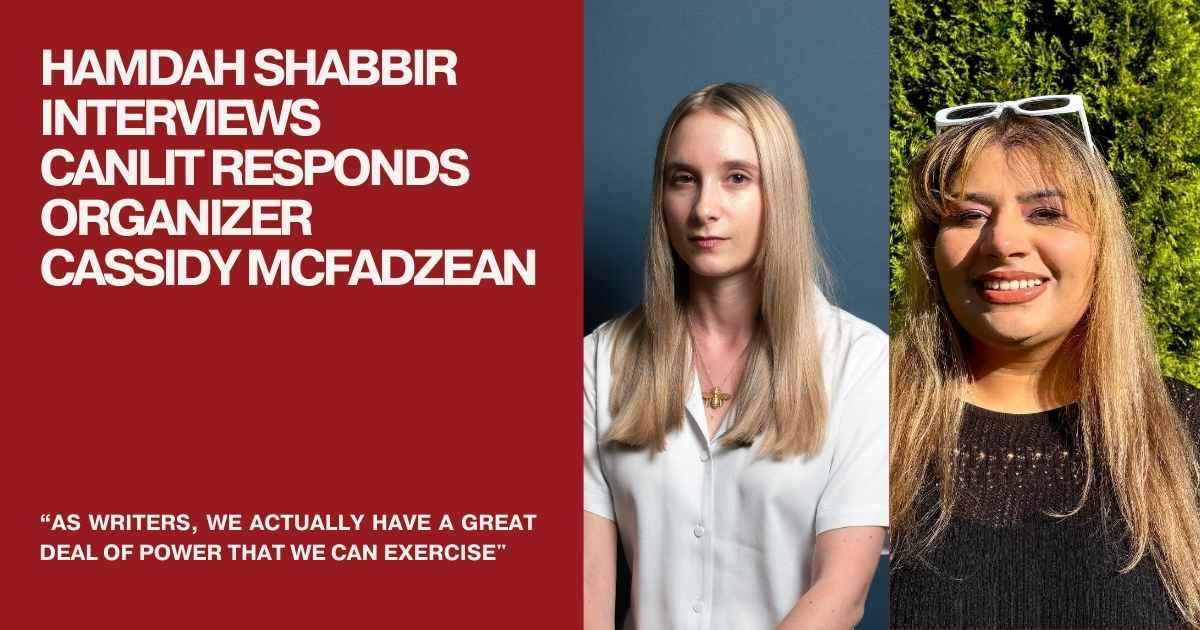
Our current issue, Room 48.3 Rest/Unrest, is guided by the parallel tensions of ongoing unrest—which propels us to create from our deep discomfort with a world shaped by profound injustice—and the need for rest, which gives our words and art the space to breathe and develop. In this vein, Room collective member Hamdah Shabbir speaks to Cassidy McFadzean, a poet and fiction writer who has been organizing with CanLit Responds since September 2024.
In a capitalist world that prioritizes “the grind” even amidst political unrest, what are your thoughts on boycotts that disrupt our “business as usual” worldview? Do you believe it is an effective way to protest?
Cassidy McFadzean: One of CanLit Responds’ early taglines was “No Business as Usual in CanLit” and for two years, authors have been boycotting the Giller Prize, refusing to participate in their events or to submit their books for consideration. In February 2025, the Giller Prize ended its partnership with Scotiabank as a direct result of the No Arms in the Arts campaign waged by hundreds of boycotting authors and book workers. This campaign was sparked by the 2023 Giller gala disruption, when protesters interrupted the live broadcast of the Prize ceremony with signs reading “Scotiabank funds genocide,” immediately and effectively drawing widespread attention to Scotiabank’s investment in Elbit Systems and the Giller Prize’s complicity in genocide.
Simply put, this campaign owes its origins to a disruption of CanLit’s status quo.
This campaign has been successful because of its long-term sustained and strategic pressure on the Giller Prize, from our first open letter asking the Giller Prize to drop charges laid against protesters, to our initial boycott of Giller-eligible authors in 2024, and our virtual and in-person programming in 2025. We didn’t cave to false concessions from the Giller when they dropped Scotiabank from their name; we recognized this as a move to appease writers – a move which we didn’t fall for. In fact, we expanded our boycott to include all authors and book workers. We will continue boycotting until the Giller drops ties to the Azrieli Foundation and Indigo Books, sponsors that continue to finance the genocide of Palestinians and the silencing of political speech within Canada.
This campaign has also helped shift writers’ preconceived ideas about the necessity of prize culture in the literary ecosystem, and the expectation that we need to compete and grind for scraps. The kinds of things we really value—particular readerships, community, and living in line with the ethics of our writing—can come through collective action itself and we don’t have to sacrifice our ideals to find them.
During ongoing global injustice, feelings of helplessness may arise and can distract us from our individual call to action. What do you suggest to those who are unsure of how they can show solidarity?
C.M: This feeling of helplessness arising from the horrific images of Israel’s bombing and murder of Palestinians is why I became involved in CanLit Responds in the first place. Believing that we’re helpless can easily lead to hopelessness and defeat, but tuning out is precisely what the Zionist death machine wants of us. Many Palestinians don’t have the luxury of feeling hopeless, and as writers we actually have a great deal of power that we can exercise in our communities. I think of Palestinian poet Rasha Abdulhadi’s statement on October 11, 2023: “Wherever you are, whatever sand you can throw on the gears of genocide, do it now. If it’s a handful, throw it. If it’s a fingernail full, scrape it out and throw.”
One immediate action that writers and book workers can take is signing onto our Giller boycott which commits you to boycotting the prize and its programming for as long as the foundation retains Indigo Books and the Azrieli Foundation as sponsors. Individuals can also participate in Just Peace’s letter writing campaign asking the CRA to investigate Indigo Books, whose CEO Heather Reisman’s HESEG foundation funds “Lone Soldiers” or non-Israelis who enlist in the IDF, which seems to violate the CRA’s rules for charitable organizations.
Lastly, if you have a friend with a book eligible for the 2026 Giller Prize, you can speak to them about withdrawing from the prize and share your own reasons for joining the boycott.
Organizing a coalition must require a lot of community effort. How did you become involved? What were the challenges that came with coordinating between multiple arts communities?
C.M: I got involved with CanLit Responds in September 2024. By that point, the group had been working with the broader No Arms in the Arts campaign, which includes other organizations like Toronto’s branch of Writers Against the War on Gaza, Film Workers for Palestine, and Artists Against Artwashing. The campaign’s initial strategy was to leverage our relationships to our own arts institutions, such as the Giller Prize and Hot Docs, in order to pressure the key arts sponsor, Scotiabank, to divest from the Israeli arms manufacturer Elbit Systems.
I recall my friend and fellow organizer Noor Naga’s powerful words at the press conference that launched the No Arms in the Arts campaign: “We refuse to let our work distract for even a second from the filthy business of war. To use language that will be familiar to a bank: it’s not worth it. We won’t be bought. There isn’t a book or a film or painting here that is worth the slaughter of a single civilian there.”
Collaborating allows us to hit targets such as Scotiabank from multiple angles, but it can present challenges of space, resources, and in navigating different groups with different relationships to their own institutions. At the same time, collaborating helps us imagine arts and literary spaces that don’t rely on the profits of occupation, and prizes that don’t ask us to participate in art-washing. The No Arms in the Arts Festival offered ten days of counter-programming to Hot Docs including actions, film screenings, and talks, and that is one example of the possibilities of spaces that we can create in the arts when we aren’t beholden to the structures of corporate sponsorship.
Artists Against Artwashing (AAA) staged an action at a Toronto Arts Council fundraiser in protest of TAC sponsor, the Azrieli Foundation, which was founded by former IDF soldier David J. Azrieli. Azrieli is known to have participated in the Nakba as a member of the 7th Brigade of the Haganah, and the Azrieli Foundation has current and former ties to illegal settlements in the West Bank. In Toronto, the Azrieli Foundation currently funds various theatre, photography, and literary groups. AAA’s action demonstrates one way we can meaningfully organize against it.
Some writers stated they were discreetly discouraged from sharing their stances on Palestine by threat of censorship or blacklisting. As an author, how did you navigate this?
C.M: These threats of censorship and being blacklisted are exactly why it’s important for writers to withdraw our books and labour as part of a collective action. If one writer were to withdraw their work, it unfortunately wouldn’t make much of a difference to the Giller Foundation, but dozens of writers withdrawing collectively grabbed the attention of the media and led to Scotiabank divesting their stake in Elbit Systems from 500 million to 124 million, and the Giller Prize to end its partnership with Scotiabank. Collective action puts the entire CanLit industry into question. A prize becomes meaningless when hundreds of us withdraw our books from consideration.
It’s also worth noting that the Giller Foundation is responsible for much of this censorship and harassment. 2023 Giller winner Sarah Bernstein said that she was told any questions about Gaza would be edited out of her Giller Book Club appearance. Madeleine Thien and Omar El Akkad were also the target of Giller executive director Elana Rabinovitch’s unprofessional social media posts, as she erroneously accusing them of leaking private emails. We have to stand against this kind of targeted harassment which is unacceptable from any organization, let alone one that claims to support all Canadian authors.
In November 2024, we staged a Boycott Giller counter-gala on the sidewalk outside the Park Hyatt hotel, right across the street from the 2024 Giller Prize gala itself. Poets and writers gathered in community and solidarity to read the work of Palestinian authors. I often think of poet and organizer Jody Chan’s powerful closing speech: “We have to be willing, at the very least, to take risks for each other, to relinquish the false accolades, the fancy galas, all of them the oppressor’s incentives to keep us from actively building solidarity with each other.”
What do CanLit Responds / No Arms in the Arts (NAITA) hope to achieve in their goals for future organizing?
C.M: No Arms in the Arts will continue pressuring Scotiabank to divest completely from Elbit Systems. We’re also reaffirming our boycott of the Giller Prize until the Giller cuts ties to the Azrieli Foundation and Indigo Books. However, given the Giller Foundation’s censorship of shortlisted authors like Sarah Bernstein, pressuring of the police to arrest protesters, and harassment campaigns against dissenting authors, it will be difficult for the Giller to repair the trust it has broken.
We also held more virtual and in-person NAITA counter-programming in 2025. Some of those included talks on the economic and practical realities of anti-Zionist publishing, treaty obligations and Palestine solidarity, and prize culture, festivals, and funding. These held spaces for authors to re-envision what the future of our literary ecosystem looks like.
Click to learn more about Canlit Responds and the Giller boycott.
Read this piece and more in our current issue, Room 48.3 Rest/Unrest.