
Remember me


The widow of Rob Burrows has revealed the late rugby star urged her to find love again after his death - but more than a year on she insists it is 'not on my agenda'.
Former rugby star Rob, who was left paralysed and unable to communicate after he was diagnosed with motor neurone disease (MND), tragically died aged 41 in June 2024.
He and Lindsey, now 42, had been married for nearly 18 years when he passed away at Pinderfields Hospital in Wakefield, Yorkshire, with the young widow recalling how she had repeatedly watched the video of their wedding day in his final hours as a way of remembering the happiness they had shared.
She has previously said of their relationship, which began as childhood sweethearts when they were both aged 15: 'There was never going to be anyone else I was going to marry. I knew it from the start.
'He treated me like a princess. It was love at first sight. It can be a cliché, but it was true for me'.
Now in a heartfelt interview with The Telegraph, Lindsey disclosed that not a day has gone by since his death that she does not think or talk about the late sports star, who won an impressive eight Super League titles with Leeds.
Remaining positive to the end, Rob had recorded messages for the children and Lindsey on specialist equipment in his final months. In one he had urged his wife not to spend the rest of her days alone and had encouraged her to find love again.
But for Lindsey - who is now a single parent to their three children Macy, 14, Maya, 10 and Jackson, seven - thoughts of throwing herself back into the dating game are far away.

Lindsey Burrows, pictured with her late husband Rob Burrows, has revealed the late rugby star urged her to find love again after his death - but she insists it is 'not on my agenda'.

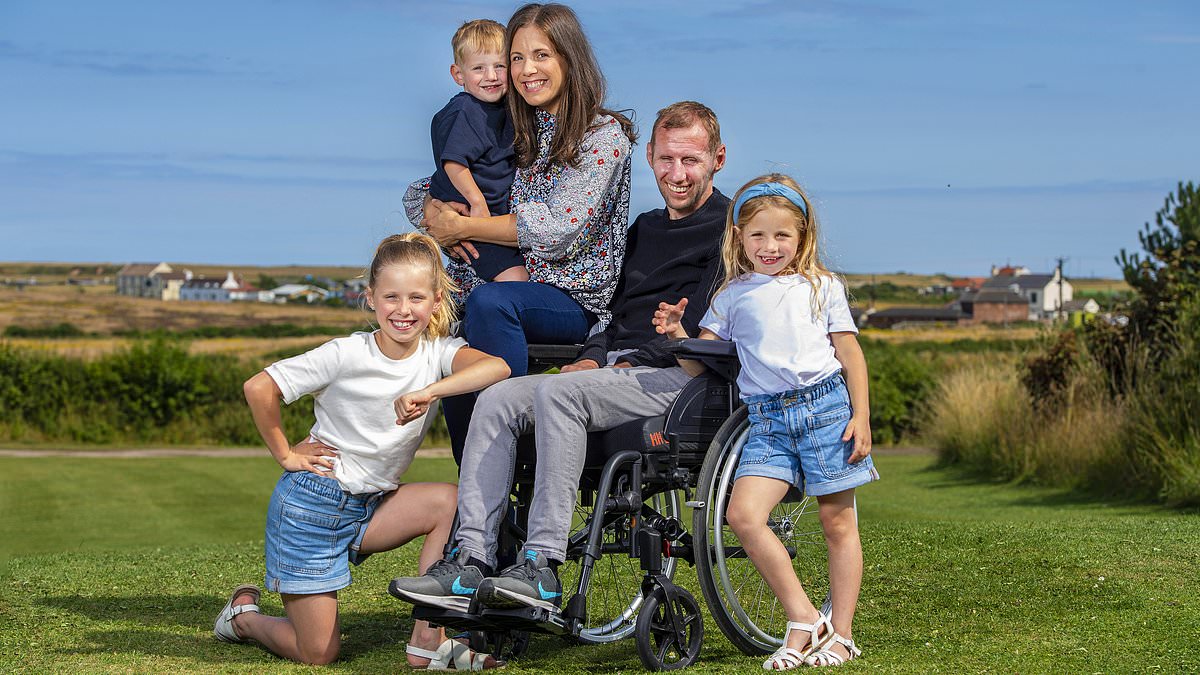
Lindsey and Rob with their children Macy, Maya, and Jackson, pictured in their younger years
She said: 'People do say to me, "I hope you move on," but it's not about that.
'My priority is the children, first and foremost. I don't know what the future holds but [finding love again] is not on my agenda.'
In her memoir, Take Care, published last year, Lindsey recalled how her late husband upheld a positive outlook throughout his battle with the disease.
Lindsey said it was the power of their love that got them through tough times, and recalled how Rob would use his eyes and equipment to message her 'I love you, darling,' or, Have a great day,' or 'I can't wait to see you,' if she was at work.
Rob was first diagnosed with MND in December 2019, just two years after retiring from a 17-season league career.
As his disease progressed, it was Lindsey who cared for him - feeding, bathing and even carrying him in her arms up the stairs to bed.
She has spoken previously about the hardest part of his journey was the impact on their children.
'The emotional part for me was that MND robbed Rob of being the dad he wanted to be to our three children,' she told The Times.

In her memoir, Take Care, published last year, Lindsey recalled how her late husband upheld a positive outlook throughout his battle with the disease. Pictured: The family in 2022
'He couldn't read them a bedtime story or kick a ball about with Jackson as he got older, so that was hard for me emotionally. But it never changed my love for Rob.'
Lindsey also revealed in her memoir how her family was determined to make important memories with Rob in the lead up to his death.
The couple's three children painted their father's fingers with rainbow-coloured ink to add his fingerprints into their memory book.
There was another time when Lindsey recalled carrying Rob - 'an avid film fan' - from his downstairs room to their home cinema room so he could watch a movie for the first, and as it turned out, last time with his children.
They chose Charlie and the Chocolate Factory, with the children sitting around his reclining chair on bean bags, eating popcorn.
Just days later he went into hospital for the last time.
Macy and Maya had spent the previous months rehearsing for a musical show that fell on the day of Rob's death, but he insisted they still went.
When they returned to the hospital they showed their father a recording of the performance, which 'really lifted' Rob and put a 'big smile' on his face,' Lindsey said.

Rob was first diagnosed with MND in December 2019, just two years after retiring from a 17-season league career. Pictured: Rob with his family in 2021

Rob and Lindsey, pictured with their children, were childhood sweethearts from the age of 15

Leeds Rhinos captain Kevin Sinfield picked up his former teammate in his arms and carried Rob Burrows over the finish line of the Leeds Marathon in 2023
Hours later the sports star passed away.
Among the tributes that came flooding in was an emotional message from the Prince and Princess of Wales.
In a post on X at the time, William wrote: 'A legend of Rugby League, Rob Burrow had a huge heart. He taught us, 'in a world full of adversity, we must dare to dream'.
'Catherine and I send our love to Lindsey, Jackson, Maya and Macy.'
The Prince had presented Rob with his CBE just months earlier, alongside his friend and Leeds Rhinos captain Kevin Sinfield, at Headingly Stadium, in recognition of their outstanding contributions to the fight against motor neurone disease.
Both famously made headlines after emotional scenes at the Leeds Marathon in 2024, when, after being pushed around the 26-mile course in a wheelchair, Kevin picked up his former teammate in his arms and carried him over the finish line to huge cheers from the watching crowds.
Sinfield was photographed as he gave his former teammate a kiss of affection to mark the moment they crossed the line.
Rob said at the time: 'The Marathon was one of the most important and special events I've done and meant so many things to so many people.

At the time of receiving his CBE, Rob had asked Prince William if he would open The Rob Burrow Centre for Motor Neurone Disease once it was completed - and the royal duly fulfilled his promise at the ribbon-cutting ceremony last November
'But for me, it was about friendship and crossing the finish line with my mate Kev will live with me forever and it created a platform to raise funds and awareness for MND charities'.
Their fundraising efforts, which raised £16million - rising to £20m after Rob's death, paid for the construction of the Rob Burrow Centre for MND in Leeds, at Seacroft Hospital.
It is the first purpose-built centre dedicated entirely to MND care, research, education and holistic support in the UK, and stands as a trailblazer for other centres around the country.
At the time of receiving his CBE, Rob had asked Prince William if he would open the centre once it was completed - and the royal duly fulfilled his promise at the ribbon-cutting ceremony last November.
William again showed his 'kindness and compassion' when he agreed to provide the foreword to Lindsey's memoir, which details her experience of caring for her late husband during his five-year battle with motor neurone disease.
In an audio recording, the royal said: 'Despite the advanced nature of Rob's condition, I was struck by the incredible strength, positivity and incredible resilience of Lindsey.
'Rob told me she is far tougher than any of the men he has played with or against over the years.
'I know I am not alone in feeling great admiration for how she has kept going in the face of adversity.
'This book tells Lindsey's story of perseverance and love. By sharing her story, she is shining a light on those who are dealing with incredibly difficult situations, putting other's needs before their own and making great personal sacrifices every day.'
He added that he hoped the book would provide 'comfort and optimism' to others facing challenges - 'and that it inspires us all to look out for one another.'
What is motor neurone disease?Motor neurone disease is a rare condition that mainly affects people in their 60s and 70s, but it can affect adults of all ages.
It's caused by a problem with cells in the brain and nerves called motor neurones. These cells gradually stop working over time. It's not known why this happens.
Having a close relative with motor neurone disease, or a related condition called frontotemporal dementia, can sometimes mean you're more likely to get it. But it doesn't run in families in most cases.
Early symptoms can include weakness in your ankle or leg, like finding it hard to walk upstairs; slurred speech, finding it hard to swallow, a weak grip, and gradual weight loss.
If you have these symptoms, you should see a GP. They will consider other possible conditions and can refer you to a specialist called a neurologist if necessary.
If a close relative has motor neurone disease or frontotemporal dementia and you're worried you may be at risk of it, they may refer you to a genetic counsellor to talk about your risk and any tests you can have.
Source: NHS UK