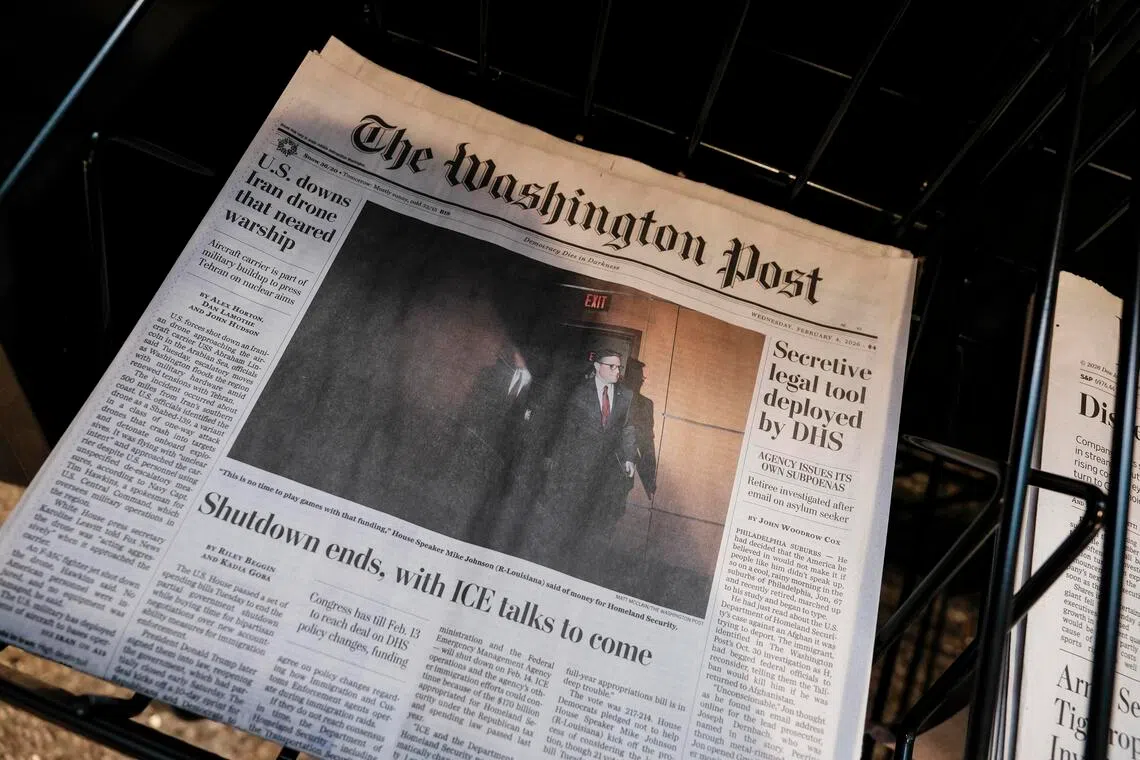
WASHINGTON - The Washington Post, owned by Amazon’s billionaire founder Jeff Bezos, announced major job cuts
on Feb 4, saying that “painful” restructuring was needed at the storied newspaper.
The Post, which gained legendary status when its reporting helped bring down former US president Richard Nixon in the Watergate scandal, will see “substantial” reductions in its newsroom, executive editor Matt Murray said.
The shrinking of the Post comes as major traditional media outlets in the United States face intense pressure from US President Donald Trump, who routinely denigrates journalists as “fake news” and has launched multiple lawsuits over coverage of his presidency.
Mr Bezos, one of the world’s richest people, has become close to Mr Trump in the Republican’s second term. His Amazon behemoth controversially paid Mr Trump’s wife, First Lady Melania Trump, a reported US$40 million for a documentary this year, along with another US$35 million for marketing.
Mr Murray said the shifts at the Post reflect the radically changing economy for news media.
This “will help to secure our future...and provide us stability moving forward,” he said in a note to employees.
He cited changes to the news ecosystem, from individuals who “generate impact at low cost” to AI-generated content, as well as financial challenges that have already produced rounds of cost-cutting and buyouts at the Post.
“The company’s structure is too rooted in a different era, when we were a dominant, local print product,” he said. “And even as we produce much excellent work, we too often wrote from one perspective, for one slice of the audience.”
On Facebook, Mr Marty Baron, the Post’s executive editor until 2021, said: “This ranks among the darkest days in the history of one of the world’s greatest news organisations.”
The Post did not disclose the number of job cuts, but the New York Times reported that approximately 300 of its 800 journalists were laid off.
Most of the paper’s journalists overseas were let go, includings its entire Middle East roster and its Kyiv-based Ukraine correspondent.
Sports, graphics and local news departments were sharply scaled back and the paper’s daily podcast, Post Reports, was suspended, local media reported.
Mr Murray said the Post would now focus on politics, national security, technology, investigations, and business, among other topics.
But a reporter who covered Amazon – currently valued at US$2.6 trillion – was let go.
“These layoffs are not inevitable. A newsroom cannot be hollowed out without consequences for its credibility, its reach and its future,” the labour union representing many Post journalists said in a statement.
It called for supporters of the paper, acquired by Mr Bezos in 2013, to rally outside its Washington headquarters at noon on Feb 5.
The White House’s communications director, Stephen Cheung, issued a typically scornful message.
“Just a reminder that printing fake news is not a profitable business model,” he posted on X.
Mr Baron, the Post’s former executive editor, said that Post owner Mr Bezos had resisted “brutal pressure” from Mr Trump in the past, but it was battered by “ill-conceived decisions that came from the very top”.
Mr Bezos reined in a liberal-leaning editorial page and blocked an endorsement of Democratic presidential candidate Kamala Harris days before the 2024 election – breaking the so-called firewall of editorial independence, and seen as bowing the knee to Mr Trump.
In response, loyal readers “fled the Post. In truth, they were driven away”, Mr Baron said.
The Wall Street Journal reported last month that 250,000 digital subscribers left the Post after it refrained from endorsing Ms Harris
and the paper lost around US$100 million in 2024 as advertising and subscription revenues fell.
In May 2024, Post publisher Will Lewis told staff the paper had lost US$77 million over the preceding year and had lost half of its audience since 2020.
In stark contrast, The New York Times announced on Feb 4 that it gained more than one million digital subscribers in 2025, bringing its total to nearly 13 million and confirming its dominant position in the US media market. AFP