
Remember me
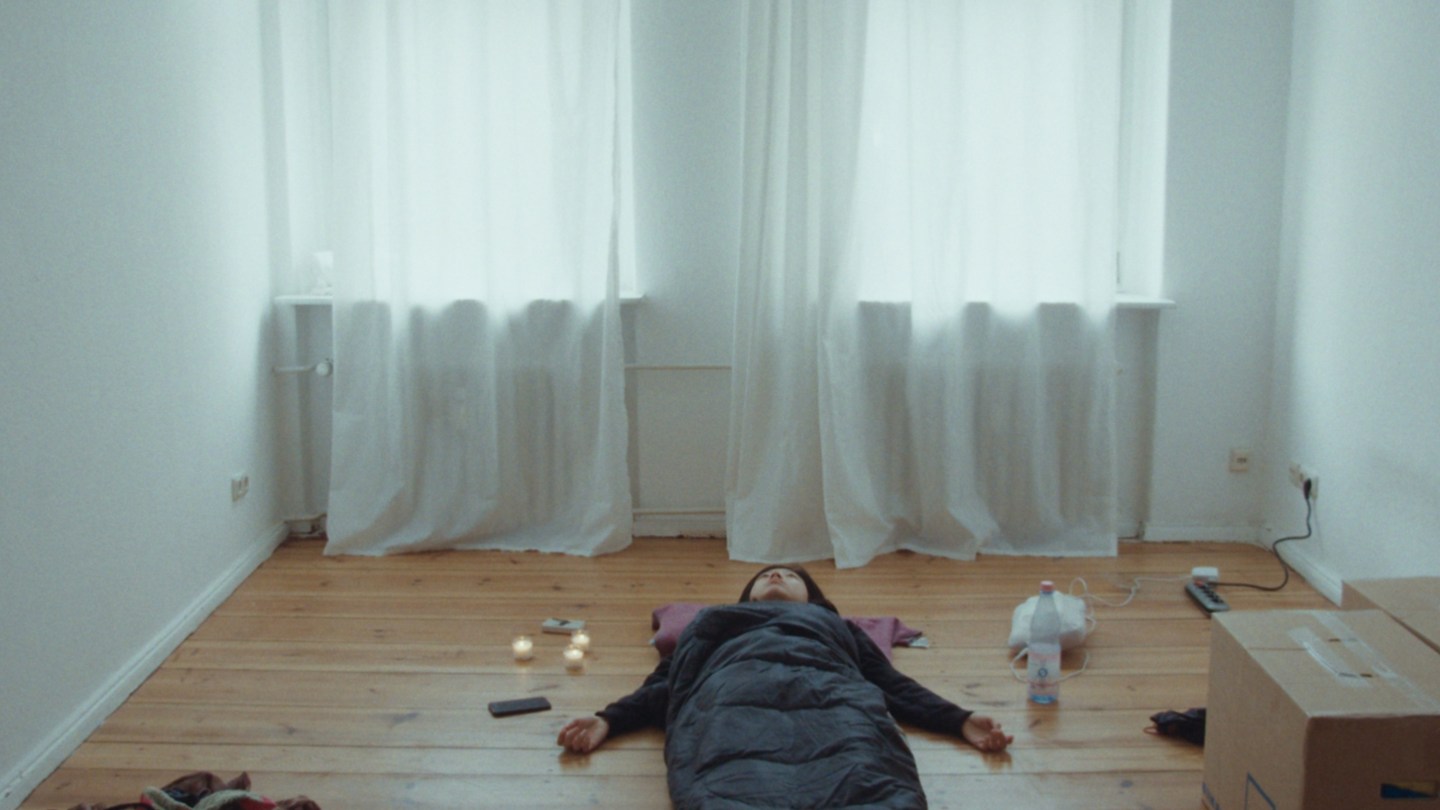
Two Mountains Weighing Down My Chest – the title of her feature directorial debut describes how Viv Li, a self-described Chinese artist wannabe, has been feeling ever since she got stuck in after the COVID pandemic and ventured into the German capital’s alternative culture scene.
“A Chinese misfit ricochets between Berlin’s alternative frenzy and Beijing’s family order, transforming cultural whiplash into an offbeat search for identity and a playful quest for belonging,” reads a logline for the genre-bending movie that world premieres in the Berlin International Film Festival‘s Panorama Dokumente section on Feb. 13.
Related Stories
Raised to follow traditional, “standard” family life, Li finds Berlin to seem to be bursting with excitement. But her family in China just can’t stop wondering why she is such an oddball. “Drifting between new environments and traditional expectations, Li is constantly adapting to shifting opinions about herself, the world, and, of course, China, only to feel more lost than ever,” highlights a synopsis of the film.
In Two Mountains Weighing Down My Chest, we follow Li as she searches for herself, her identity, and a sense of belonging and acceptance in a globalized world. The result is a deep dive into the question: how do you deal with your own culture after you have learnt another?
Li’s journey is a kaleidoscope of, at times surreal, encounters. Nude swimming, anyone!? The exclusive trailer below will give you a better sense for the mix of the serious, the hilarious, and the offbeat in Two Mountains Weighing Down My Chest.
“As I slowly put on the ‘hat’ of a Berliner, I realized that all these years of learning to be the other, of being accepted, has weighed heavily on my mind, quietly mirroring the reality of my upbringing and where I am coming from,” Li, who has made the shorts I Don’t Feel at Home Anywhere Anymore, Accross the Waters, and You Jian Chui Yan (A Soil A Culture A River A People), says in a director’s statement. “But when I was finally home in Beijing, it became difficult to take off all the ‘hats’ and to see my own face again.”
Li wrote the screenplay and directed, and she handled cinematography, together with Janis Mazuch. The editor is Christoph Bargfrede, with sound design courtesy of Marcel Walvisch. Two Mountains Weighing Down My Chest is produced by Corso Films in co-production with 100% Film and ZDF – Das Kleine Fernsehspiel. The producers are Daniela Dietrich, Erik Winker, Martin Roelly, and Ümit Uludağ. The co-producers are Olivia Sophie Van Leeuwen, and Ruby Deelen, Mediawan Rights is handling world sales.
So, without further ado, check out an exclusive trailer for Two Mountains Weighing Down My Chest. Get ready for tears – of sadness, of fear, and of laughter.
Li talked to THR via Zoom from China about the path to her feature debut, why Two Mountains Weighing Down My Chest will speak to people around the world, and what’s next for her.
Can you share a little bit about why you decided to go on a search for identity via this film?
I was born and raised in Beijing, and all my family is here, so I never really had an identity problem until I went abroad. I studied in the U.K. in Manchester, then I stayed in South America, was in Southeast Asia, and then I was traveling Europe. This is like a “the grass is greener on the other side” kind of thing. I just really wanted to experience other things, and I wanted to feel how other people lived, so when I went abroad, I wanted to stay longer to really get deeper into how other people live their lives.
And then, at one point, I realized, “Oh, holy shit, something is changing in me” after being abroad for so long. I was trying to adjust to all these things, and all these things stayed with me and were engraved in my memories. That’s why, with the film, I wanted to portray the effect of memory and how these effects on us are constantly shifting.
Since I grew up in Austria, my father is Hungarian, and then I lived in the U.S. before moving to the U.K., I recognized the identity issue. How do you feel about your search now?
I got a lot more into Buddhism recently. And then there’s this one sentence: There’s actually no self at the end of the day. When trying to search for oneself, the goal is the search, because there is no self. Nobody can really know who they are, because we’re always changing. I find that very relevant nowadays, especially because the world is so connected, and we can travel so freely. That becomes more evidence that we will never have belonging, and we’ll never have a real self.
Does that realization scare you or do you find it liberating?
I think everything is about accepting. And once you accept the fact, then you can feel free about it. It’s the same with death. We are so scared of death, but one day, if you really accept that you’re going to die, then that fear will go away. And if you accept that there is no stable, static way of your being, you can feel quite comfortable with moving around.
There is a scene in the film where you guys are discussing how you learned how to be friends from watching Friends. Can you explain this and what it means?
Yeah, when I was young, I was learning English, and one of my aunties gave me these pirated DVDs of all Friends episodes. I actually have Friends episode scripts printed there. That’s how I learned English. I found it really interesting because you always see people like Phoebe saying, “Okay, can I talk to you a second over here?” And their behavior towards each other was so different from how I grew up, and I found that was the first really interesting, very intimate experience of how other people live. And I just realized, okay, you can actually treat friends in that way, and you can talk to your friends, and you can tell them what is wrong. That was how I learned English and how I learned the first steps of being in a Western society.
‘Two Mountains Weighing Down My Chest’
Courtesy of Viv Li/Corso Film
There is also a scene in your film that felt so timely. It’s a discussion about how the world is doomed, but we are all arguing and fighting with each other…
That scene was not always in the cut. We had versions without it. Then my editor and I looked at the whole film, and we realized [this scene] does something to the film. Ultimately, the film is about non- judgment and non-definition. Opinions come and go, opinions are different, and there are always people who have their own perspective. But we just have to realize that no opinion or no judgment is the ultimate judgment or rule.
I felt so small at that point, and I realized that the ultimate ending of a search is that you keep searching, rather than finding a result.
How easy or difficult is it to be in front of the camera and share various emotions with audiences?
It was not always easy. But there is something I learned from my short film [I Don’t Feel at Home Anywhere Anymore] that served as the beginning of the project. When I stepped in front of the camera rather than staying behind it – you already hold power as a director, you relax people. They will feel, “Okay, Viv is with me in front of the camera. She’s as vulnerable as me.”
I feel very comfortable doing it. It’s also because I know, as a filmmaker, I know that the film is just a very tiny part of my life, and it’s not really who I am. I feel very comfortable showing this part to form my story and to show an intimate moment to people who can imagine all the other parts. And for film, it is really important to give the audience space to make their own [narrative] and to think about their own story.
How much are the scenes we see in Two Mountains Weighing Down My Chest real, or how much are they scripted or set up?
Most of the scenes at actual moments, and I realized when we were editing the film that all reenacted scenes were not as good as the original moment. I just feel that the original moment has its own power or vibe. The power of documentary is that you can really fall back on those moments and let those moments guide you. And what I really love about the film industry nowadays is that you can take real moments and fiction moments and weave them into each other. That’s what I was trying to do with my film.
‘Two Mountains Weighing Down My Chest’
What have you learned about Berlin?
I thought Berlin was super free, and I came here feeling I could explore different things. But I also realized that people try to ask you questions about definitions: Are you non-binary? Are you this and are you that? I feel that sometimes, with the world becoming so colorful and so many things going on, we tend to want more definition so we can feel safe within a box and stuff like that. But sometimes there is no definition.
Are you working on any new projects?
Yes, this time, I am writing a fiction script. It’s based on a road trip that I took almost 10 years ago, but it’s in a very early stage. However, over the past two years, I have also done some short fiction films, and I realized that with fiction films, I feel this community a bit more. Doing a documentary sometimes is really lonely. But with a fiction film, you work more within a group, within a collective, and I really enjoy that feeling. So I do want to take a break from being alone.
Comments (0)