
Remember me





This year's Super Bowl was a tale of two Americas. One stood by Bad Bunny, the Puerto Rican trap superstar whose official halftime show championed joy and inclusion through a multifaceted, multilingual mosaic of people and places. The other, the "All-American Halftime Show"—engineered as counter-programming by Turning Point USA—had electric guitar solos and Kid Rock. The latter was touted as a real show for real Americans, though its enclosed soundstage made it impossible to know where in America it happened at all. It will happen again in 2027, which Turning Point USA spokesperson Andrew Kolvet confirmed in a Fox News interview.
Far and away from the block party at Levi's Stadium in California, Turning Point USA's insular show of country rock and pro wrestling pyrotechnics kicked off from an undisclosed location in Atlanta, per Variety sources. The pre-taped event began a little after 8 p.m. ET, the same time Benito stood among sugar canes, and livestreamed on YouTube and conservative platforms like DailyWire+ and OAN. (But not X, due to last-minute music rights issues.) Out of the darkness, political commentator Jack Posobiec welcomed viewers to Turning Point USA's All-American Halftime Show before dedicating it to deceased Charlie Kirk. "This one's for you, Charlie," he said, to a teeny discharge of fireworks. The next 30 minutes would indeed feel like it was made for one person.
After a guitar solo cover of the national anthem, country musician Brantley Gilbert walked forward on the T-shaped stage and welcomed audiences, again, to the Turning Point USA All-American Halftime Show. "This is real American," he said in a Georgian twang. He played "Real American," its lyrics swirling acts of patriotism with hot and heavy sex, to a barrage of onstage fire. He later slowed the pace a touch with "Dirt Road Anthem," a ballad about precious memories that inexplicably includes rap verses.
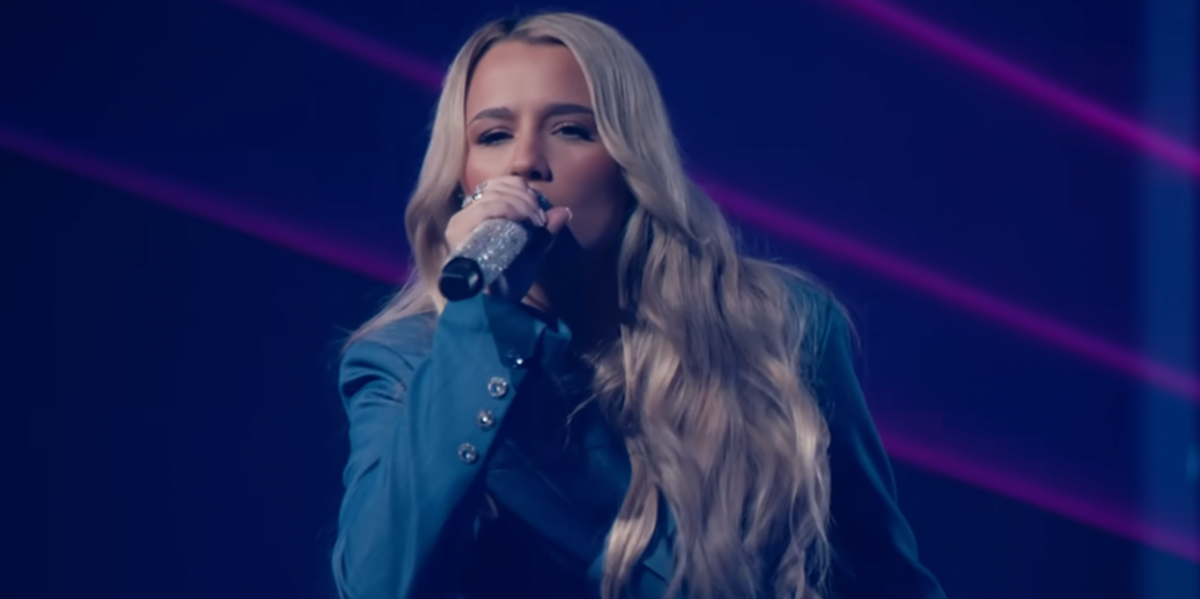
After Gilbert came singer Gabby Barrett, who stood barefoot in a blue pantsuit as she performed "I Hope" and "The Good Ones." Then, Lee Brice sauntered up with "Drinking Class" and a brand new song, "Country Nowadays," which he introduced after name-checking Charlie Kirk. "Be told if I told my own daughter that little boys ain't little girls, I'll be up freaking hot water in this cancel-your-ass world," he sang to rapturous cheers.
 View full post on YouTube
Soon, it was time for TPUSA's main event: 55-year-old Kid Rock, who emerged in the 1990s as a white rapper before pivoting to country rock. Jumping out from beneath the stage, Kid Rock—dressed in tight jorts, a fur vest, and a 1920s fedora—introduced himself before zig-zagging up and down whilst missing his lip-syncing cues. Critics of Bad Bunny lamented his Spanish lyrics, arguing that his foreign language alienated them from the Super Bowl. Kid Rock's first of two songs of the night was "Bawitdaba."
To Kid Rock's credit, he's had twenty-odd years of putting on a show and his presence was a big jolt of energy for a show that would constitute a forgettable night on CMT, let alone right-wing America's answer to Bad Bunny. Even while Kid Rock failed to match lips to lyrics, it's admittedly impressive to watch him do cardio five years short of 60. A lot of it might have to do with the fact "Bawitdaba" kind of slaps, in a "I miss being in the second grade and channel-surfing to MTV" way. But even Kid Rock couldn't resist trying to be serious for a moment. He ended the show on a downer note, with a cover of Cody Johnson's "Til You Can't" that signed off with a hagiographic montage of Charlie Kirk.
Save for "Country Nowadays" and tributes to its founder, the All-American Halftime Show was absent of the politics and the furor that spawned it into being. There was no mention of Bad Bunny or the NFL; without that context, you could slot it into any given NBA game and it would work all the same. This hyper non-specificity coupled with a lack of a real message—any message, political or otherwise—left the All-American Halftime Show devoid of purpose other than to give an irritated and restless base something to watch behind bathroom doors of their friends' Super Bowl parties.
Through sheer showmanship and immaculate direction, Bad Bunny invited millions of strangers to feel like family in a communal space—including a real, honest-to-goodness wedding in the middle of all of it. By contrast, Turning Point USA put on a show that felt hostile as it did hollow. Which vision of America is American? Who gets to say what's American and what's not? It says plenty that only one of the two shows ended with an egalitarian statement: "Together, we are America." Guess which one did?
Comments (0)