
Remember me

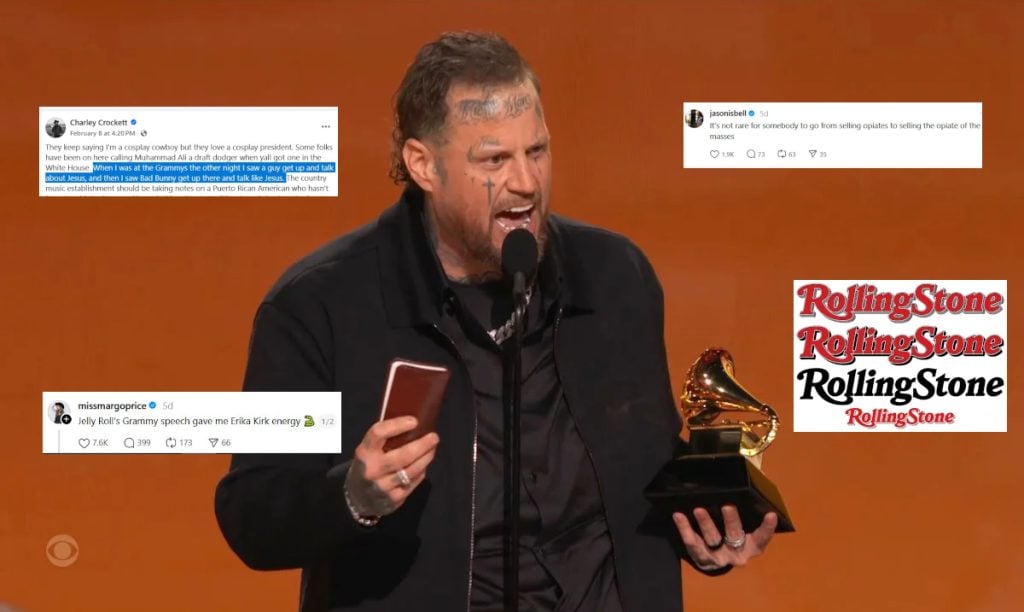
Jelly Roll is finally starting to experience the widespread scrutiny his life, career, and music has deserved for a few years now. But it’s coming in a very unusual, and frankly, misguided manner.
Those who are frequent readers of Saving Country Music know that for the last six months or so, SCM has been reporting on the continued wholesale ignoring of Jelly Roll being captured using the N word three times on video. In footage taken on January 23rd, 2023 at the Ghost Ranch of fellow country rapper Ryan Upchurch (also referred to as simply “Upchurch”), Jelly Roll is heard using the N-word in conversation multiple times, two years after the Morgan Wallen incident of a similar nature.
To read more about the Jelly Roll N-word incident, CLICK HERE.
It was Morgan Wallen being caught on a Ring doorbell camera using the N-word on January 31st, 2021 that set off an incredible firestorm in country music and beyond that in certain circles is still raging to this day. It was arguably the biggest moment in country music in the last 25 years, similar in stature to the cancellation of the Dixie Chicks.
But strangely, there has still not been one single media report on the Jelly Roll matter whatsoever. When the video came out, members of the country rap community felt confident it would end Jelly Roll’s career. But the same media that has been showering Jelly Roll with praise and peddling his redemption story continues to ignore the incident. Furthermore, not one prominent music artist has spoken out about Jelly Roll’s N word use whatsoever, unlike with the Morgan Wallen incident. For whatever reason, mum is the word.
Those who are frequent readers of Saving Country Music also don’t need to be reminded how critical of Jelly Roll this site has been, and of the media coverage of the singer that refuses to probe the holes in his supposed rehabilitation and sobriety story, while continuing to push favorable think pieces and human interest stories that have built Jelly Roll into this magnanimous character of American culture above reproach.
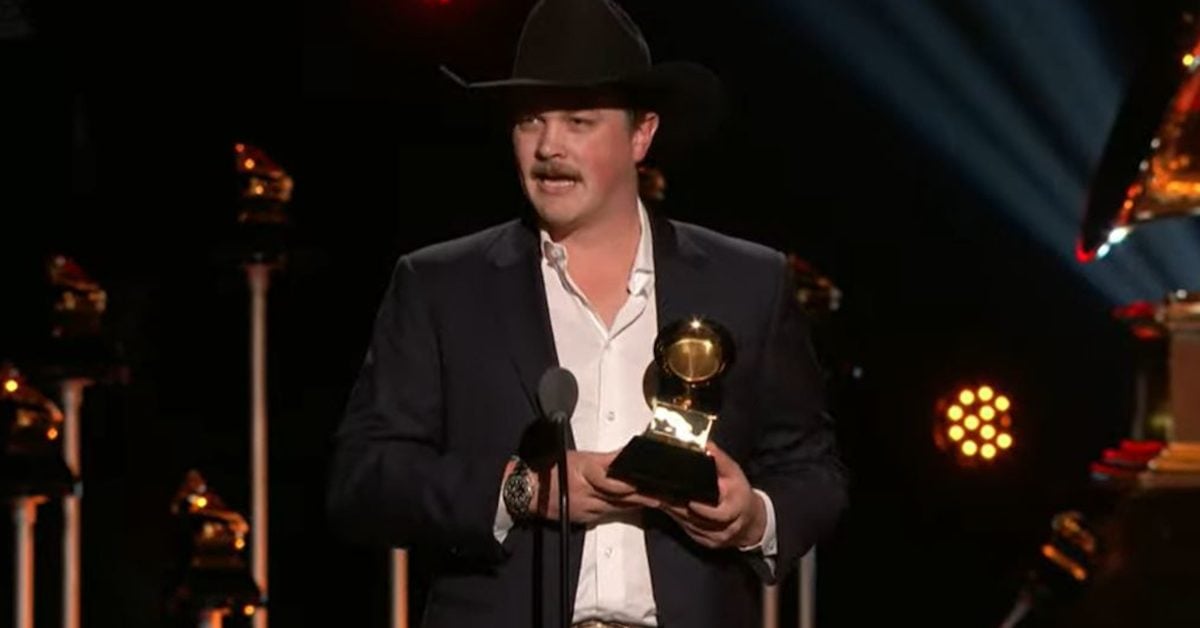
But all of this has started to change after Jelly Roll won multiple Grammy Awards on February 1st, including the Grammy for Best Contemporary Country Album, which was handed out during the televised portion of the presentation.
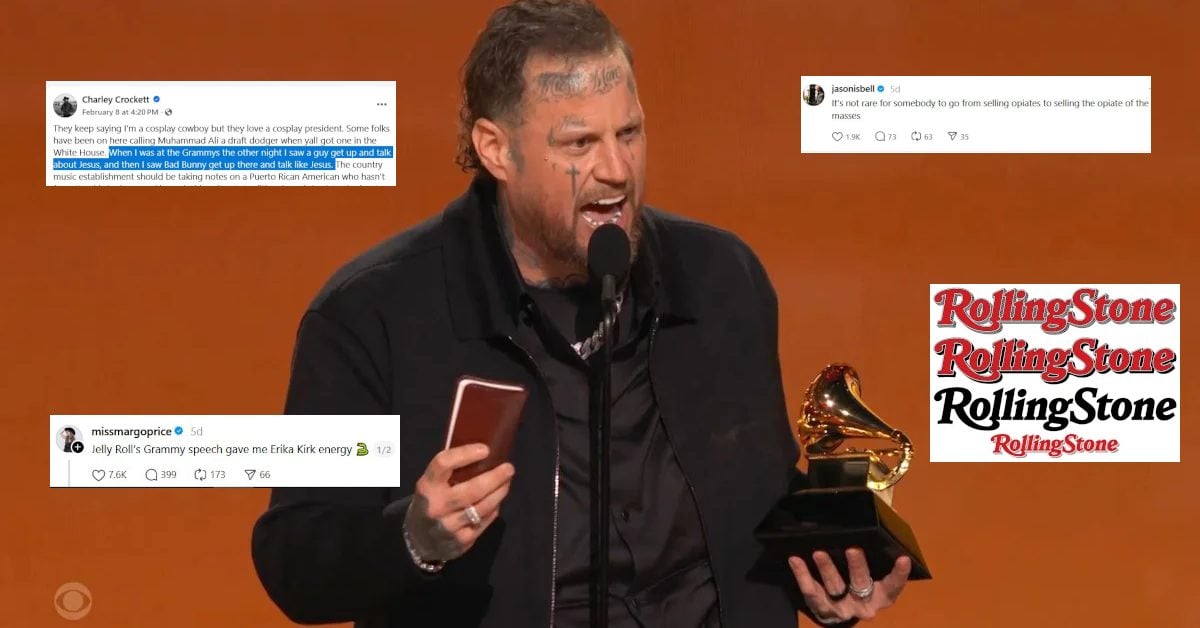
“There was a moment in my life where all I had was a (pocket) Bible this big and a radio the same size in a six-by-eight-foot cell,” Jelly Roll said during his signature fiery acceptance speech.“I believed that those two things could change my life. I believed that music had the power to change my life, and God had the power to change my life. I want to tell you all right now that Jesus is for everybody. Jesus is not owned by one political party. Jesus is not owned by one music label. Jesus is Jesus and anybody can have a relationship with him. I love you Lord.”
It wasn’t Jelly Roll’s N-words caught on camera, but Jelly Rolls J-words that have now set off an incredible firestorm of controversy, with his fellow music artists roundly criticizing him for it, and the media beginning to use it and his non-committal to a political affiliation to undercut his character. “Jesus” all of a sudden is way more offensive to these people than the N word.
After the Grammy Awards, Margo Price took to social media (Threads) to issue numerous criticisms of Jelly Roll, saying “Jelly Roll’s Grammy speech gave me Erika Kirk energy,” and followed it up with, “Plus, the music ain’t good.” Price later shared a photo of herself with Shaboozey saying, “You know who gave a great Grammy’s acceptance speech?”
Shaboozey’s speech made reference to how he is the son of immigrants, and how important immigrants are to the United States. Shaboozey issued the speech during the Grammy’s Premier Ceremony before the televised presentation when he won Best Country Duo/Group Performance, somewhat ironically with Jelly Roll for their song “Amen.”
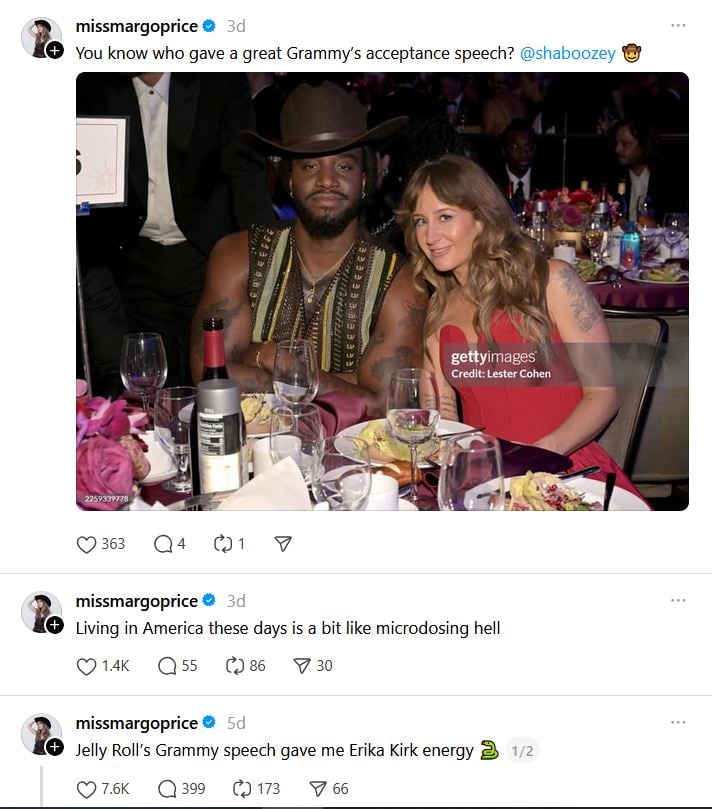
Margo Price was nominated for Best Traditional Country Album, which is why she was at the 2026 Grammy Awards. She was the only woman nominated in the category. Though her criticisms of Jelly Roll were rather pointed, they are also pretty par for the course for Margo.
The comments of Jason Isbell took it to another level, with Isbell stating, “It’s not rare for somebody to go from selling opiates to selling the opiate of the masses.”
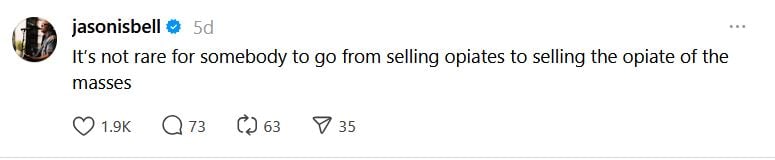
Jason Isbell didn’t name any names in his Threads post. Maybe he was talking about Paul Cauthen, who worked in the drug trade, comes from a strong Christian background, says he could have become a preacher, and currently counts himself as a devout Christian. Adeem The Artist and Waylon Payne both pursued working as preachers before deciding to pursue music.
But of course Jason Isbell was talking about Jelly Roll. His reference to the “opiate of the masses” comes very directly from the father of communism, Karl Marx who said “Religion is the opium of the people.” Communism of course strictly forbids the practice of religion, and is against the freedom of speech, while the First Amendment of the United States resoundingly protects these rights.
Then right before the Super Bowl was about to ensue on Sunday, February 8th with the contentious Super Bowl Halftime show embroglio, Charley Crockett decided that would be the perfect time to go on a political tirade against a host of individuals, including President Trump, Elon Musk … and Jelly Roll, specifically for his references to Jesus.
“When I was at the Grammys the other night I saw a guy get up and talk about Jesus, and then I saw Bad Bunny get up there and talk like Jesus,” Crockett said.
By the way, notice that the only one with the balls to refer to Jelly Roll by name was Margo Price.
Charley Crockett’s missive wasn’t only about Jelly Roll, and Jesus. He made a very salient point when he said about Bad Bunny, “The country music establishment should be taking notes on a Puerto Rican American who hasn’t forgotten his heritage and brought his culture’s traditional music back to the front, showing the world something new with it.”
This is similar to what Saving Country Music said assessing Bad Bunny’s Grammy-winning album.
Crockett also said, “The President is a grifter who bankrupted 6 casinos. That’s pretty extraordinary considering it’s a rigged business in favor of the house. The only thing he’s good at is filing lawsuits and portraying a successful business man as a reality TV actor. Last time I checked Elon Musk was an immigrant from South Africa but there he is standing in the White House buying our elections.”
These statements will now make Charley Crockett one of those artist where no matter what he does, half of country music fans will roundly attack and reject it, just like we see with Jason Isbell, Margo Price, Tyler Childers, and others. Charley Crockett’s career is now cast in that political frame, and will be that way forever. He is officially a politically polarizing artist.
The words from Crockett, Jason Isbell, and Margo Price have been the more high profile callouts of Jelly Roll’s Jesus comments, but social media was riddled with them after the Grammy Awards with people calling Jelly Roll a performative Christian, and that they were getting “MAGA vibes” off of him. This was in part due to Jelly Roll being ambushed by a reporter from Rolling Stone named Nancy Dillon at the Grammy Awards who asked the singer if he was “willing to comment on what’s going on in the country.”
Jelly Roll responded, “So this is the truth, and I’m glad somebody asked, because I love talking about this stuff, and people care to hear my opinion, but so I can tell you that people shouldn’t care to hear my opinion. You know, I’m a dumb redneck, like, I haven’t watched enough … I didn’t have a phone for 18 months. I grew up in a house of, like, insane pandemonium. I didn’t even know politics were f—ing real until I was in my mid-20s in jail.”
Jelly Roll continued, “Like, that’s how disconnected [you are] when you grew up in a drug-addict household. You think we, like, had common calls about what’s happening in rural politics? Like, we’re just trying to find a way to survive, man, you know?”
Jelly Roll did go on to say that he had a lot to say about the “political climate,” and “I’m going through it the next week, and everybody’s going to hear exactly what I have to say about it in the most loud and clear way I’ve ever spoke in my life. So I look forward to it on the Internet.”
But the big narrative was that Jelly Roll had chickened out of an opportunity to speak out politically at the Grammys. Also, it’s been a week since Jelly Roll said he would speak out. He hasn’t so far. It’s a pretty common political ploy to say you will speak on something in the future to get a microphone/camera out of your face, but then never address it at all.
But that only tells part of the story of what happened with Jelly Roll at the Grammy Awards.
After Jelly Roll was accosted by the reporter to speak out politically, he in turn accosted the reporter, following them into a press area. According to another Rolling Stone reporter, Tomás Mier who appeared recently on the Plus One Show with Jess Lucero,
“Nobody’s talked about this, because it happened in the press room and only certain people saw, but this is something that happened and I think we should talk about it,” Mier says. “After Jelly Roll did walk off stage…he came back to speak to Nancy in a not-happy tone about a Rolling Stone article that had been published before, where they associated him with MAGA stuff. And it was a very tense moment, because it was Jelly Roll speaking from a platform down to a reporter who was just doing her job…Everybody in the room just froze. At one point, somebody on his team just came and just told Jelly, like, ‘Jelly, we have to go, like, let’s go’.”
You can see the full interview exchange here:
The article in question was not written by Tomás Mier or Nancy Dillon who asked Jelly Roll the initial question. It was written by Rolling Stone reporter Jonathan Bernstein, who covers country music upon occasion, and just published a biography of Justin Townes Earle.
The article in question was called How Nashville’s Music Row Went MAGA in 2025 (Paywalled). Generally speaking, the article was well-written and refreshingly objective from Rolling Stone. The assertion of the article is also correct.
Basically since after the pandemic, country music has been veering to the right politically, after remaining decidedly non-political ever since the cancellation of the Dixie Chicks in 2003. In large part, this political moratorium was due to a mandate from many record labels and managers to artists to not speak out politically on either side. It would only divide an artist’s fan base.
But there were a couple of important points that the article Rolling Stone article missed on. The first is it said nothing about the role the media and Rolling Stone itself—and specifically Senior Country Editor Joseph Hudak and writer Marissa R. Moss—had played in goading country artists to speak out politically. As Saving Country Music warned at the time, the idea these artists were going to speak out for the left-leaning causes Hudak and Moss were advocating for was absolute hubris.
Goading country performers into political speech, and admonishing them publicly for advocating for right-leaning causes would only result in a backlash, and a break in the moratorium on political speech in country music, which was the best scenario left-leaning journalists could ever hope to achieve.
The situation reached a fevered pitch when the wife of Jason Aldean was regularly attacked in the media for Instagram posts. This was the type of behavior that had Aldean and others break their moratorium on political speech, and started advocating for right-leaning causes. Subsequently, Jason Aldean has become friends with Donald Trump.
The other problem with the Jonathan Bernstein article in Rolling Stone that Jelly Roll questioned was how it unilaterally assigned political alignments to certain performers who had not proclaimed such affiliations, which obviously in the current contentious political climate, can be catastrophic to a performer’s career.
The article states, “When the [Grand Ole Opry] invited Jelly Roll to become its latest member, it did so not within the sacred confines of the Opry House but in a segment during Jelly’s appearance on Joe Rogan’s podcast, which, despite having guests that range from Bernie Sanders to Trump, has become closely associated with the cultural ascendance of MAGA.”
But saying that a performer appearing on the Joe Rogan Experience immediately makes them MAGA is beyond irresponsible. Jesse Welles has appeared on the Joe Rogan Experience. So has Charley Crockett who has now come out with left-leaning perspectives multiple times. Zach Bryan appeared with Joe Rogan. Assuming Jelly Roll is “MAGA” simply because he went on the Joe Rogan podcast was a completely irresponsible assertion by Rolling Stone, unnecessarily politicizing Jelly Roll and his career.
Then the Christian and Jesus role also came into play in the Rolling Stone article.
“It’s not a coincidence that Christian music has been surging in popularity on Music Row at the same time MAGA has captured the culture. Artists like Anne Wilson, Gabby Barrett, and Jelly Roll, all with label homes in Nashville, have actively courted and won over both country and Contemporary Christian Music audiences,” the Rolling Stone article states.
If Jelly Roll was confrontational or aggressive with a reporter, that’s not acceptable behavior from him. He should apologize, and the Grammys should look into it. But Rolling Stone assigning a political alignment to him is just as aggressive and irresponsible, and the ultimate reason for the confrontation to begin with, especially after he was asked a politically pointed question by a Rolling Stone reporter, which has since been used to attack Jelly Roll and discredit him further since he didn’t answer.
Rolling Stone has a bad track record of imposing political affiliations upon artists and others, including, if not especially, country artists and other country reporters. We saw this happen with Eric Church in 2018 when a Rolling Stone cover implied he was a Bernie Sanders supporter who was against the 2nd Amendment—a canard you continue to see brought up whenever Eric Church’s name is mentioned even today. Rolling Stone also published a fictitious story about Toby Keith attacking Kris Kristofferson over politics.
The context for the tense political moment at the Grammy Awards was the recent killing of Alex Pretti by ICE officers, which Rolling Stone then used to call out the hypocrisy of country stars for not standing up for Pretti’s 2nd Amendment rights in a piece written by Marissa R. Moss, as if admonishing them publicly would result in public pronouncements from country stars—a political media theory that has so roundly been proven to not only be ineffective, but very directly counter-productive since 2020.
Central to the debate around Alex Pretti though was the 1st Amendment, which enshrines people’s freedom of speech, or freedom to not speak, along with the right to protest. It also protects the freedom of religion.
By making the criticisms of Jelly Roll about his religious faith, they’re picking the wrong fight. And assigning Jelly Roll political affiliations is outright irresponsible. The reason Jelly Roll is being politically obtuse is likely because he knows if he becomes a politically polarizing artist, it will undermine his career. You also can’t just hand wave off his insistence he’s not informed enough to have an opinion, or it’s not his place to share his political opinions as a performer.
None of this is to say that Jelly Roll doesn’t deserve scrutiny. But going after him for mentioning Jesus, or Assigning “MAGA” affiliations to him because of his religion is patently irresponsible.
The public has clearly started to sour on Jelly Roll’s sermon-like acceptance speeches at award shows when they used to be lauded, and his redemption story was useful to the press who saw Jelly Roll as a subversive force inside country music that they hoped could be useful to their political causes. That’s likely why the press and high profile artists gave him a pass for the N-word incident. They wanted to keep open the opportunity to be able use Jelly Roll as vessel in the culture war.
But as soon as Jelly Roll doubled on his non-political affiliation and dropped the J word, he’s become persona non grata. You must speak out about political causes or the media will turn on you, or even further, say you’re “MAGA” when you have never verified that affiliation. That is why you see artists like Charley Crockett and others feel the need to broadcast their political affiliations, often to the great detriment of their careers.
This also speaks to the elitist “club” mentality that can exist around such things as the Grammy Awards. Either you’re in that club, or you’re not. Clearly, Jelly Roll isn’t, especially how his explanation of how coming from a broken household is the reason he doesn’t think about things in political terms was so summarily brushed away as diversion.
All of these compelled political elements placed upon music artists only works to overly-politicize the musical space, often leading to less political capital for performers to wield through their music itself. It parses fans bases, polarizes performer’s names to where whatever they say is summarily discounted by half the electorate, and makes consensus building nearly impossible behind any cause.
There are plenty of things to criticize about Jelly Roll, and to scrutinize about his past and present. But going after the religious faith he’s used to rehabilitate himself doesn’t just feel like a low blow. It feels deeply un-American, and anti-1st Amendment, especially when you’re quoting Marxist ideology in the process. Jason Isbell was once susceptible to substance abuse. Margo Price has also been sober since 2021. You would think they would have some grace for Jelly Roll using religion to overcome addiction.
Even while strongly criticizing Jelly Roll’s Grammy win for Best Contemporary Country Album, Saving Country Music made it a point to say,
“Unquestionably, Jelly Roll has pulled himself up from his bootstraps, turned his life around, and ascended to the mountaintop of popular society through discipline, self-understanding, admitting to his past sins, and by submitting to the belief in a higher power … [He’s] gone from the gutter and dregs of society to become one of the most popular and applauded artists in all of music, including now being named a Grammy winner. It’s a distinctly American story.”
If Morgan Wallen deserved to be criticized and widely admonished for using the N word, so does Jelly Roll. It’s not just the use of the word, it’s the double standard the media and high profile artists have illustrated by not saying anything about the Jelly Roll incident. Now deciding that “Jesus” is the word that is verboten, and deserving of admonishment takes the hypocrisy to an entirely new level.
Jelly Roll deserves to be forgiven for all his past sins, no different than Morgan Wallen, or Jason Isbell, or anyone else. Even if you’re not a believer, that’s what the teachings of most all formal religions, philosophies, and certainly left-leaning political ideologies tell us.
– – – – – – – – – – –
If you found this article valuable, consider leaving Saving Country Music A TIP.
Comments (0)