As far as human history is concerned, no one knows exactly how far back the practice of dancing goes. However, the Bhimbetka rock shelters in central India contain cave paintings that are at least 10,000 years old and clearly depict human beings dancing. While these ancient images show our deep connection to rhythmic movement, humanity certainly did not invent the art of dance.
Across the natural world, creatures of every size perform complex routines that rival the best human choreography. These dances are rarely for entertainment. Instead, they serve as critical tools for survival, communication, and reproduction. From intricate courtship displays to life-saving defensive maneuvers, animals use movement to navigate their world in fascinating ways. This list explores ten of the most impressive and purposeful dance moves found in the animal kingdom.
Related: 10 Creatures with Real Superpowers That Put Marvel to Shame
10 The Sweet Mating Dance Moves of the Flamingo
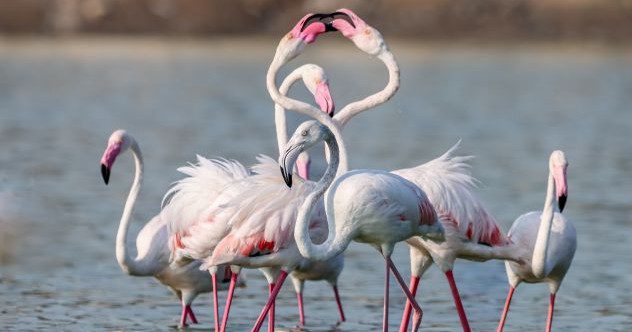
Ornithologists agree that the flamingo is one of the most visually striking birds on Earth. These long-legged waders filter-feed in shallow, alkaline lakes, and their famous pink coloration comes from carotenoid pigments found in shrimp and algae. Yet their most spectacular feature is not their color but their choreography.
During the breeding season, thousands of flamingos gather in massive colonies and perform synchronized courtship displays. They march together in tight formation, stretching their necks skyward, saluting, wing-flapping, and whipping their heads side to side in remarkable unison. This group performance stimulates breeding readiness across the colony and allows individuals to assess potential partners in a highly social environment.
The stakes are high. Flamingos often breed in harsh, fluctuating habitats where food availability can determine whether a chick survives. The elaborate group dance helps ensure that pairs form at the optimal time and that both birds are healthy and hormonally synchronized. While flamingos are generally seasonally monogamous rather than lifelong mates, a single successful display can determine an entire breeding season’s success.[1]
9 Bees Perform a Peculiar Waggle Dance
Despite possessing brains smaller than a sesame seed, bees are capable of astonishing cognitive feats. Research published in Biology Letters has shown that bumblebees can distinguish between time intervals, demonstrating a sense of duration once thought to be largely confined to vertebrates. That internal sense of timing plays a crucial role in one of nature’s most famous dances.
Honeybees communicate the location of food through the “waggle dance,” a vibrating figure-eight pattern performed on the vertical comb inside the hive. The angle of the waggle run relative to gravity corresponds to the direction of the nectar source relative to the sun. The longer the waggle phase lasts, the farther away the food lies. Fellow worker bees watch and decode this performance with extraordinary precision.
This communication system blends solar navigation, memory, and interval timing into a single coordinated routine. By translating movement into a living map, bees turn dance into data—allowing an entire colony to mobilize efficiently toward profitable food sources. Few animals match the elegance and efficiency of this tiny insect ballet.[2]
8 The Male Manakin: Master of the Michael Jackson Moonwalk
The red-capped manakin (Ceratopipra mentalis) may be small, but the male delivers one of the flashiest performances in the rainforest. To attract a mate, he performs a rapid backward glide along a branch that strikingly resembles Michael Jackson’s moonwalk.
Before the show begins, the male meticulously clears a specific perch of moss and debris to create a smooth stage. When a female approaches, he snaps into motion, gliding backward with his legs held stiff and straight. High-speed video reveals that the illusion of smooth movement actually consists of dozens of tiny, lightning-fast steps—executed in perfect rhythm.
He enhances the visual display with sharp snapping and buzzing sounds created by slamming his wings together in rapid bursts, a behavior known as sonation. Studies from institutions such as the Cornell Lab of Ornithology suggest that females evaluate both the precision of the movement and the coordination of the sounds. In this jungle dance competition, timing and technique mean everything.[3]
7 The Courtship Dance of the Great Crested Grebe
The Great Crested Grebe (Podiceps cristatus) is renowned for one of the most elaborate courtship rituals in the avian world. While many birds rely primarily on song, grebes engage in a highly synchronized performance that tests partnership compatibility before breeding begins.
The ritual opens with mirrored head-shaking displays, where both birds move in precise symmetry. This leads into the famous “penguin dance,” in which the pair dives underwater to gather strands of aquatic vegetation. In a dramatic climax, they rush toward one another and rise chest-to-chest out of the water, frantically paddling to maintain their upright posture while presenting the weeds.
This offering symbolizes shared nest-building responsibilities and reinforces pair bonding for the season. Any mistimed movement can disrupt the ritual, making coordination essential. By the time the sequence concludes, the grebes have demonstrated physical stamina, attentiveness, and mutual commitment—qualities vital for raising young successfully.[4]
6 Seahorse Dance
Male seahorses are among the few animals in which the male becomes pregnant. In species such as the lined seahorse (Hippocampus erectus), females deposit their eggs into a specialized brood pouch on the male’s abdomen, where he fertilizes and carries them until birth. Before that transfer occurs, however, the pair must complete a remarkably delicate courtship dance.
Unlike species that perform a single mating display, seahorse couples engage in daily greeting rituals during breeding season. Each morning, the pair meets to brighten their colors and perform a slow, synchronized ballet. They often link tails and spiral upward through the water column in unison, carefully matching each other’s movements.
This dance is more than romantic flair—it synchronizes reproductive timing. The coordinated rising motion helps align the female’s ovipositor with the male’s pouch opening at precisely the right moment for egg transfer. Without this careful choreography, successful fertilization would be far less likely. In the seahorse world, love truly requires perfect timing.[5]
5 Dancing Birds Love Rocking Out to Music
In 2017, a viral video of a parrot enthusiastically bobbing its head to Queen’s “Another One Bites the Dust” reignited a long-running scientific question: can animals actually keep a beat? While many species respond to sound, only a handful appear capable of true rhythmic synchronization, known as spontaneous motor entrainment.
Parrots, in particular, have demonstrated this ability in controlled studies. Research published in Current Biology and reported by outlets such as Scientific American suggests that species capable of vocal learning—like parrots—possess neural connections between auditory and motor regions that allow them to move in time with music. Unlike reflexive motion, this synchronization can adjust to tempo changes, indicating active rhythm processing rather than random bouncing.
In the wild, parrots use rhythmic movements and vocalizations to bond with flock members and reinforce social cohesion. In captivity, dancing to human music may function as social enrichment. What looks like a goofy groove is actually a glimpse into sophisticated neural wiring—proof that, at least for some birds, rhythm truly lives in the brain.[6]
4 The Life-or-Death Dance of the Peacock Spider
The male peacock spider (genus Maratus) may measure only a few millimeters long, but its courtship performance rivals any stadium spectacle. Native to Australia, these spiders rely heavily on vision, and males possess brilliantly colored abdominal flaps that they raise like miniature fans during mating displays.
Once a female is spotted, the male lifts his third pair of legs and begins an intricate series of side-steps and vibrations. He unfurls his iridescent abdomen, showcasing bold reds, blues, and oranges in carefully timed movements. Alongside the visual routine, he produces subtle seismic signals—sometimes called “rumble rumps”—that travel through the ground to the female.
The stakes are high. If the female is unimpressed, she may attack and consume him. While cannibalism does not occur every time, rejection can be fatal. Each movement must be precise and evenly paced. For the peacock spider, dancing is not just about romance—it is a high-risk audition where timing determines survival.[7]
3 The Lyrebird’s Amazing Concert and Dance
The Superb Lyrebird (Menura novaehollandiae) is famous for its astonishing mimicry, capable of reproducing chainsaws, camera shutters, and dozens of other bird calls. Yet its vocal talents are only half the story. Research published in Current Biology revealed that the lyrebird pairs specific dance moves with distinct song types during courtship.
During breeding season, the male constructs a small mound of soil that serves as his performance stage. He flips his elaborate tail feathers over his head, forming a shimmering canopy that frames the display. As he sings, he executes synchronized side-steps, hops, and turns that match the rhythm and structure of each song.
Scientists identified multiple song categories, each accompanied by its own choreography. This level of audiovisual coordination suggests that females evaluate not only the male’s feathers and voice but also his cognitive control and motor precision. The lyrebird is essentially performing a one-man musical, where choreography and soundtrack must align perfectly to win over an audience of one.[8]
2 The Clever Dance Moves of the Spanish Shawl
The Spanish Shawl (Flabellinopsis iodinea) is a brilliantly colored sea slug found along the Pacific coast of North America. Its vivid purple body and neon-orange cerata serve as warning signals to predators, advertising the defensive stinging cells it acquires from its prey.
Unlike most nudibranchs, which move slowly along the ocean floor, the Spanish Shawl can swim. When threatened by predators such as starfish or fish, it launches into a dramatic escape routine. The slug flexes its body into repeated U-shaped bends, thrashing rhythmically to propel itself into open water.
This movement is both functional and mesmerizing. The flowing cerata trail behind like the fringe of a dancer’s costume, giving the species its common name. The “dance” is not about courtship but survival. By combining chemical defenses with athletic swimming, the Spanish Shawl turns a defensive maneuver into an underwater performance worthy of any stage.[9]
1 The American Woodcock Busts a Move
The American Woodcock (Scolopax minor), affectionately nicknamed the “timberdoodle,” is famous for its dramatic springtime “sky dance.” During breeding season, males spiral high into the air before zigzagging downward in a whistling descent, all to impress watching females.
Yet even outside the mating display, the woodcock performs a peculiar rhythmic walk. As it moves across forest floors and brushy fields, it rocks its body back and forth in a steady, almost comical bobbing motion. To human eyes, it appears as though the bird is grooving to an invisible beat.
Scientists believe this movement serves a practical purpose. The rocking may create subtle ground vibrations that prompt earthworms—the woodcock’s primary food source—to shift within the soil. With its highly sensitive bill, the bird can detect those movements and pinpoint its prey. What looks like a whimsical dance is actually a finely tuned hunting strategy, proving once again that in the animal kingdom, rhythm often means survival.[10]






Comments (0)