
Remember me










Vanguard research expects 10 years of better stock investment opportunities outside of America.
So far in 2026, the U.S. stock market is delivering uninspiring results. The S&P 500 index is basically flat year to date (down 0.03%), while the tech-heavy Nasdaq-100 index is down 2.2%.
But if you look beyond the U.S., share prices are growing. The Vanguard Total International Stock ETF (VXUS +1.20%), a fund that includes thousands of stocks from companies in global markets, is up 9% year to date, outperforming both the S&P 500 index and the Nasdaq-100 index.
And the rest of the world's stocks have outperformed both of those U.S. benchmarks in the past year. The VXUS is up about 31% in the past year, compared to 12% for the S&P 500 index and 11.7% for the Nasdaq-100.
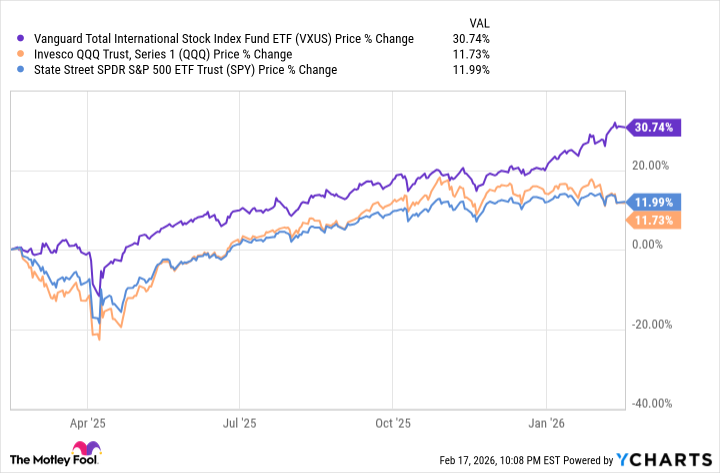
This recent outperformance by international stocks might not be a fluke. It could be a sign of sustainable strength. According to recent research from Vanguard, other countries' stocks are likely to keep beating America's for the foreseeable future. Let's look at why international stock investing could be savvy move for 2026 and beyond.

Image source: Getty Images.
Vanguard forecast: International stocks are likely to outperformVanguard's 2026 economic and market outlook projects 4.9%-6.9% average annual returns for the next 10 years for "ex-U.S. equities" (international stocks outside the U.S.). It only projects 4%-5% of average annual returns for U.S. equities. If Vanguard's analysis is correct, international stocks are about to beat the U.S. by a significant margin for the next decade.
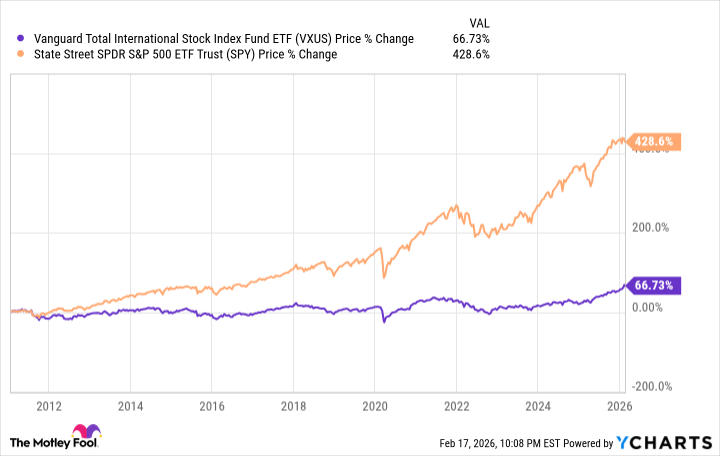
This is a surprising prediction. For most of the past 16 years since the Great Financial Crisis, U.S. stocks have strongly outperformed international. For example, ever since its inception in January 2011, the Vanguard Total International Stock ETF has gained about 67%, while the S&P 500 index is up about 429% in that timeframe.
The main reason why Vanguard is less bullish on U.S. stocks is that its research team believes U.S. tech stocks are already priced for exceptionally high earnings expectations. Even if the artificial intelligence (AI) boom successfully delivers strong productivity gains, bigger corporate earnings, and roaring economic growth, America's AI stocks might already be pricing in those happy results. There might not be enough upside left in U.S. tech stocks.
Instead of tech stocks, Vanguard sees better risk/reward trade-offs in high-quality U.S. bonds, U.S. value stocks, and non-U.S. developed market equities (international stocks in countries with some of the most advanced, prosperous economies, like Japan, Canada and Europe).
How to invest in international stocks right nowVanguard's research didn't endorse any one specific international stock ETF. But one fund that can help you easily buy the rest of the world's stocks -- including developed markets -- is the Vanguard Total International Stock ETF. This fund lets you own 8,691 stocks across more than 40 countries. About 38% of the fund's holdings are in European stocks, with another 27% dedicated to emerging markets.

Vanguard Total International Stock ETF
Today's Change
(1.20%) $0.99
Current Price
$83.37
The ETF charges an exceptionally low expense ratio of 0.05%. The fund has delivered average annual returns of 16% for the past three years, and 9.8% for the past 10 years. This fund offers a simple, low-cost way to quickly "buy the world."
America's economy might keep growing strong, and the AI boom might have more room to run. But even if you don't want to "sell America," you still might want to get in on the diversification benefits and growth opportunities of international stocks.