
Remember me

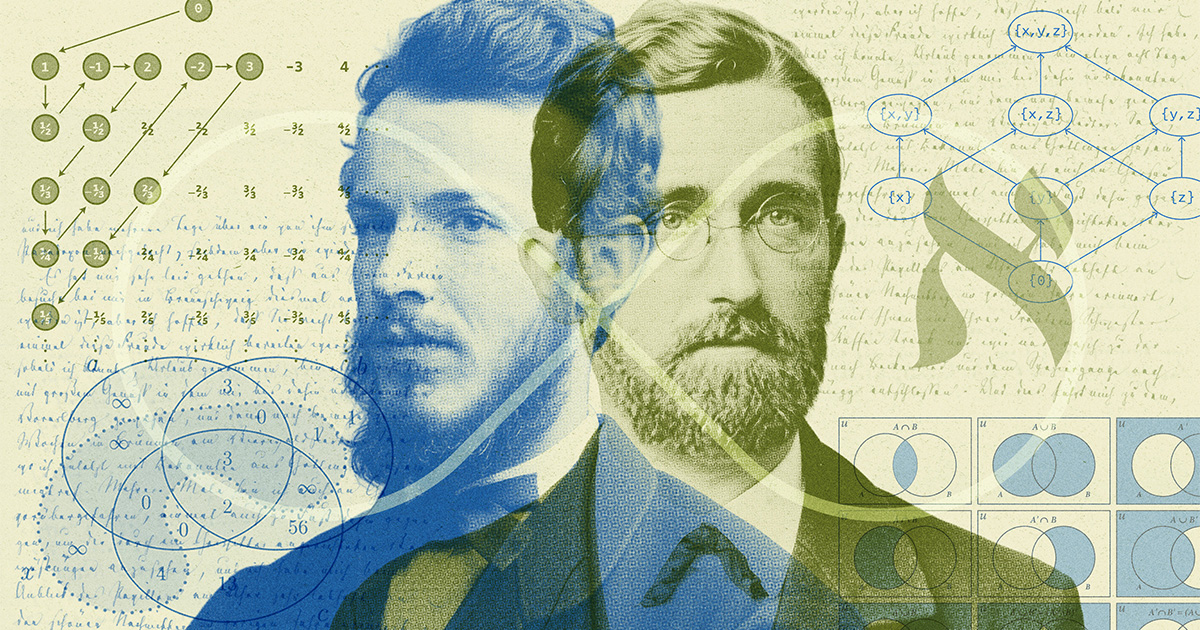







He had learned in school that Cantor was the sole founder of set theory — and that it all started with a proof he published in 1874. In that proof, Cantor showed that there are different sizes of infinity, putting to bed the notion that infinity was merely a piece of mathematical trickery.
Goos began research for a podcast about Cantor’s discovery. But he soon found that the true story was more complicated than he’d been told.
“My approach originally was to tell the story everybody tells. It’s a beautiful story,” he said. “But it’s a wrong story. It’s not really what happened.”
The Trojan HorseThe true story was that Cantor wasn’t a lone genius. He had a partner — at least for a time.
Whenever Cantor met like-minded mathematicians, he was known to court them eagerly. He would show up at a collaborator’s residence at daybreak, excited to discuss some new idea he’d had, sometimes waiting for hours until they woke up. So it was with Dedekind. After their 1872 encounter in Gersau, Cantor took every opportunity to ask the older mathematician for advice.
In November 1873, Cantor began an exchange that would forever alter the course of human knowledge. “Allow me to put a question to you,” he wrote to Dedekind in a hastily penned letter. “It has a certain theoretical interest for me, but I cannot answer it myself; perhaps you can.”
Cantor had found an outlet for the zealous drive his father had instilled: the infinite nature of the number line. “He had a very strong sense of mission,” said José Ferreirós, a historian and philosopher of mathematics at the University of Seville in Spain. “He was convinced that the introduction of actual infinity was going to change not only mathematics, but science in general.” To Cantor, this kind of infinity didn’t contradict God’s supremacy. It just meant that rather than being remote and unknowable, God was everywhere, residing between all things.
 DEDEKIND TO CANTOR
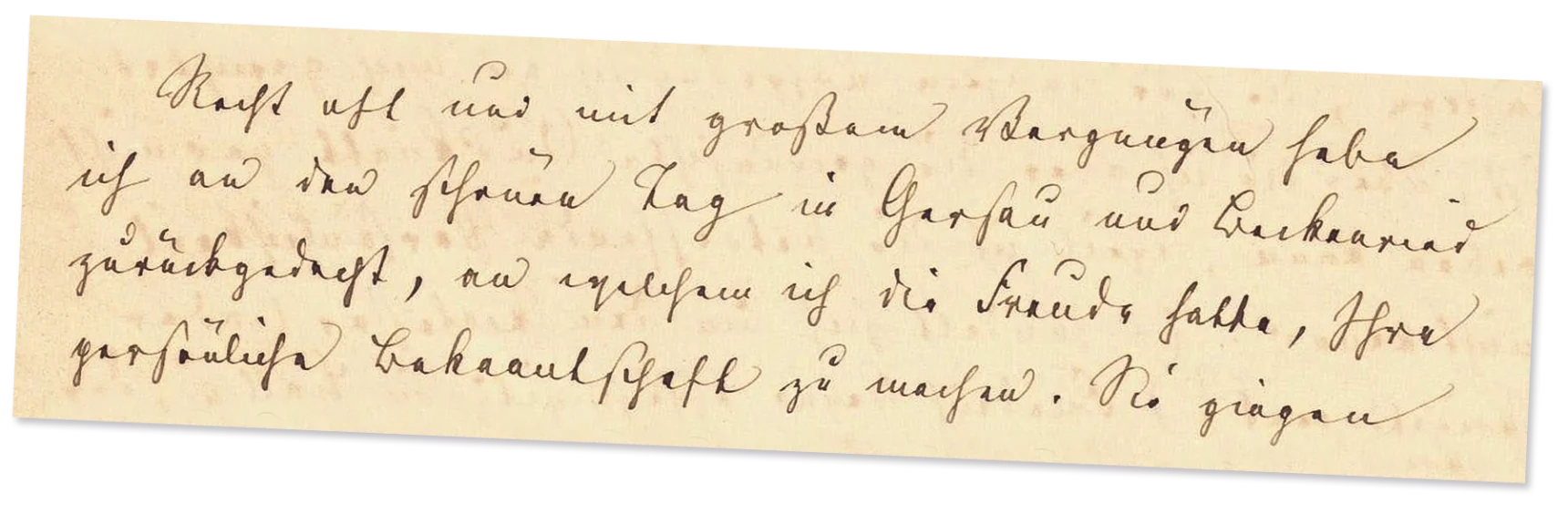 14 July 1873
 “I have often and with great pleasure recalled the beautiful day in Gersau and Beckenried when I had the pleasure of making your personal acquaintance.”
He began studying the real numbers as a single, infinite package, asking questions no one had thought to ask before. Was there a difference between the infinity signaled by the three dots in 1, 2, 3, … , and the one built into the mysterious continuum of the number line? In other words, were there more real numbers than whole numbers?
On its face, the question seemed nonsensical. What would it even mean for these infinite sets to be different sizes?
Cantor wanted to find out.
He asked Dedekind whether the two sets of numbers could be put in “one-to-one correspondence” — a pairing of every real number with its own distinct whole number. He’d managed to do this, he wrote, for a different set: He’d proved that the rational numbers (numbers that can be written as a fraction) could each be assigned a unique whole number, without leaving any numbers left over. That is, even though there appeared to be far more rational numbers than whole numbers, the two sets were actually the same size. Both were therefore what mathematicians would later call “countable.”
How Can Infinity Come in Many Sizes?
But Cantor couldn’t figure out how to compare the whole numbers to the real numbers in the same way. Dedekind quickly replied that neither could he — but that he’d worked out a proof that the algebraic numbers (the numbers you get as solutions to algebra problems) could be counted. “I would not have written all this,” Dedekind wrote to Cantor in closing, “if I did not consider it possible that one or the other remark might be useful to you.”
From there, the mathematical volley continued. Energized by Dedekind’s progress, Cantor spent the following days plugging away at the remaining question — the real numbers. Could he finally show that, unlike the algebraic numbers, they were a bigger infinity than the whole numbers?
On December 7, 1873, he wrote to Dedekind that he thought he’d finally succeeded: “But if I should be deceiving myself, I should certainly find no more indulgent judge than you.” He laid out his proof. But it was unwieldy, convoluted. Dedekind replied with a way to simplify Cantor’s proof, building a clearer argument without losing any rigor or accuracy. Meanwhile Cantor, before he’d received Dedekind’s letter, sent him a similar idea for how to streamline the proof, though he hadn’t worked out the details the way Dedekind had.
Cantor considered what he had in hand: two sets, both infinite, but one somehow larger than the other. The implications were revolutionary. He began to dream of not one infinity, but an entire hierarchy of them. And if infinities could be so concretely compared, then they had to be real, not just figures of speech.
His proof, he realized, had the potential to shake the math world to its core. But not without angering some of its most prominent figures.
One of those figures was Leopold Kronecker, a mathematical ideologue who detested infinity. He didn’t believe in the number line’s packed nooks and crannies. According to the mathematician Ferdinand von Lindemann, who proved that π isn’t algebraic — you can never pose an ordinary algebra problem where π is the answer — Kronecker once told him his work was worthless, since such “transcendental” numbers didn’t exist.
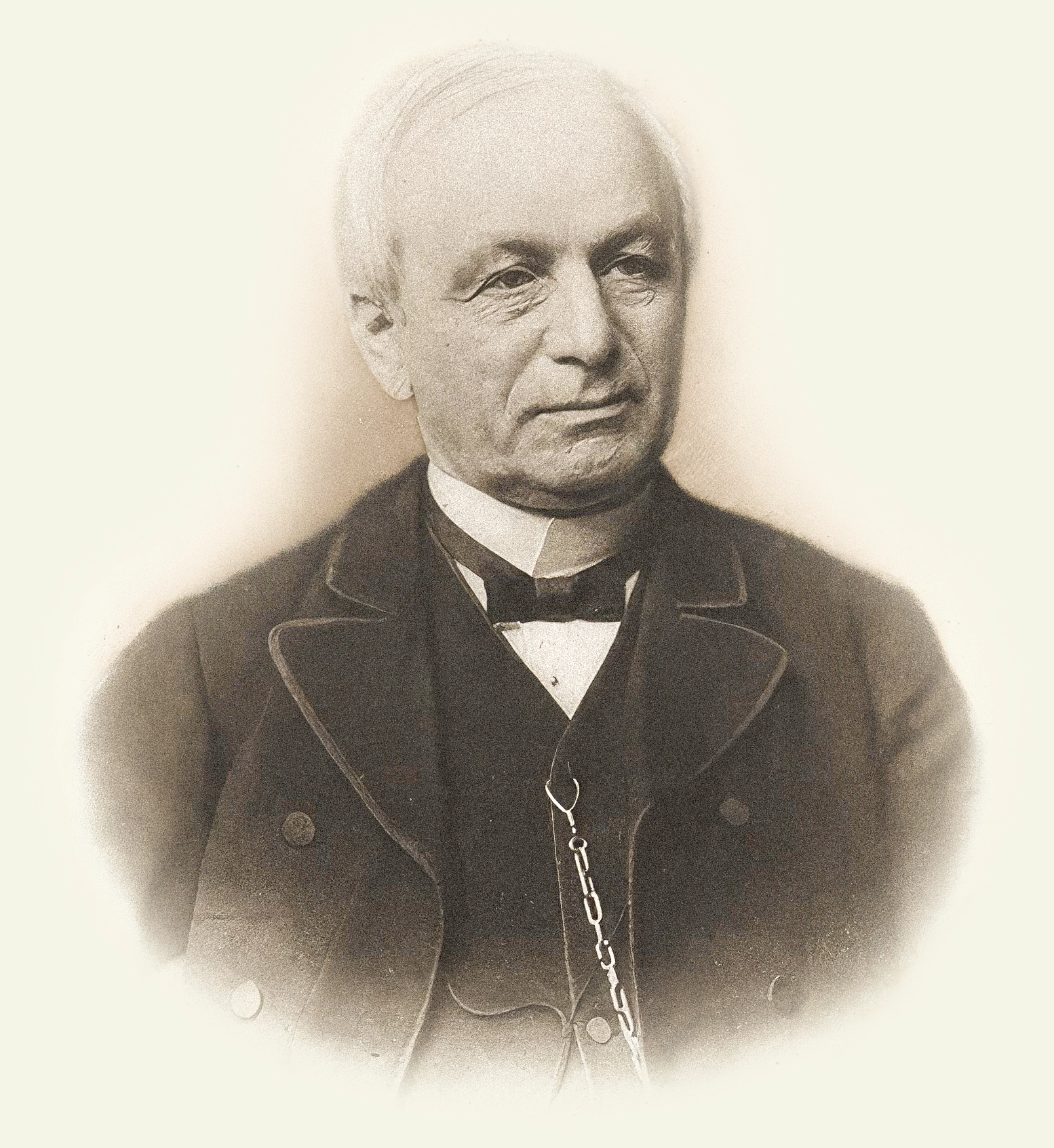
To Leopold Kronecker, infinity had no place in mathematics. When Cantor challenged this belief, Kronecker set out to destroy his reputation and stop him from publishing.
Kronecker was also a major gatekeeper in the world of math. He was on the editorial board of Crelle’s Journal, one of the world’s preeminent math publications. And he never hesitated to use his enormous influence to push his reactionary agenda. Often, he would decide which results would reach other mathematicians quickly — or at all.
Cantor, after discussing his work with his mentor Karl Weierstrass, wanted to publish the findings in Crelle. There, he figured, he’d be able to bring infinity into the mainstream. To reveal the mind of God to the entire world. To become a shining star on math’s horizon.
Cantor’s sense of mission, that “secret voice” within him, began to swell.
Cantor had a good relationship with Kronecker. But several years before, Dedekind had beaten Kronecker to a major result, and Kronecker’s dislike for him was well known. If Cantor submitted a paper co-authored with Kronecker’s nemesis — a paper that openly declared that multiple sizes of infinity exist — it might never get published.
So he made two decisions.
The first was to build a mathematical Trojan horse.
Weierstrass had been most excited about the proof that algebraic numbers are countable. (He would later use that result to prove a theorem of his own.) So Cantor chose a misleading title that only mentioned algebraic numbers.
CANTOR TO DEDEKIND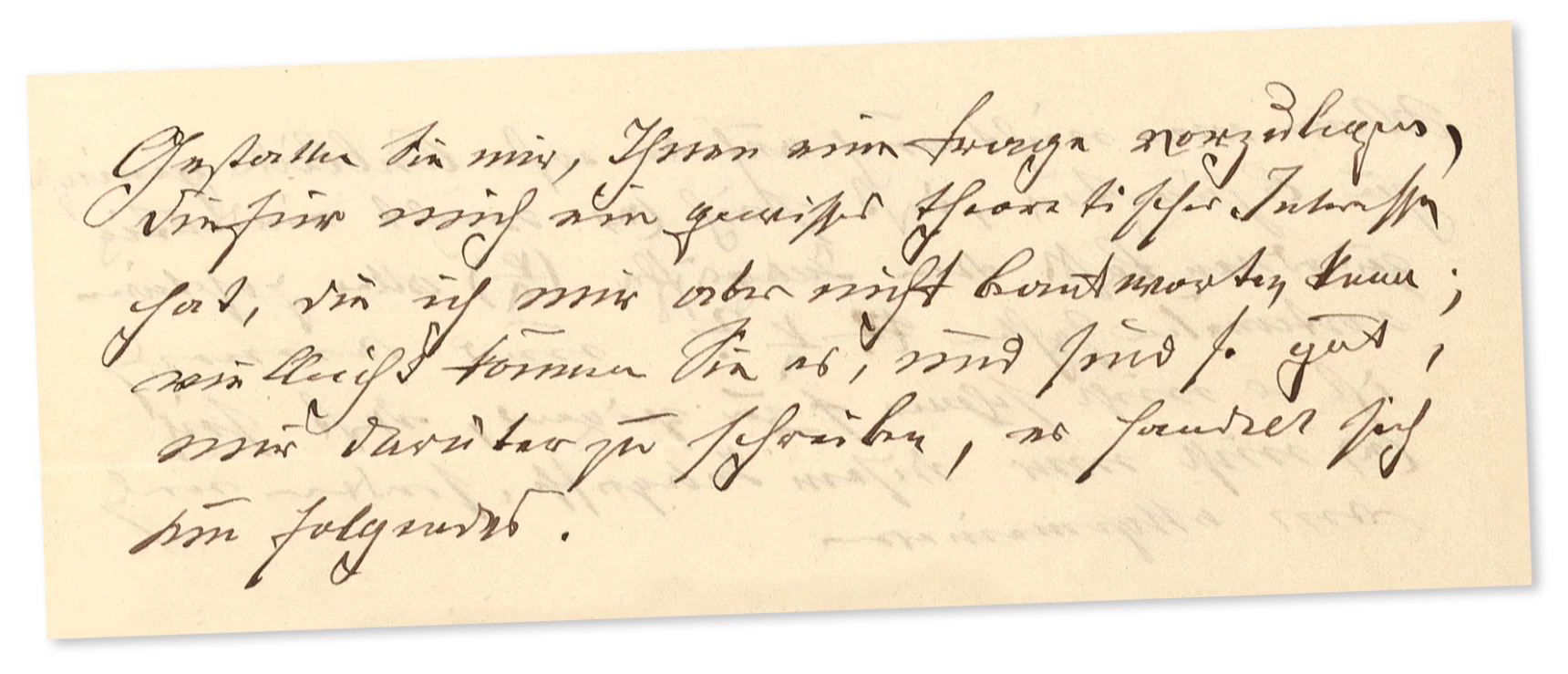 29 November 1873“Allow me to put a question to you. It has a certain theoretical interest for me, but I cannot answer it myself; perhaps you can, and would be so good as to write me about it. It is as follows.”
But he saw that proof — Dedekind’s proof — as a decoy, a wedge he could use to pry open the forbidden gates of infinity. Writing his paper, Cantor put the proof about algebraic numbers first. Below it, he added his own proof that the real numbers cannot be counted — Dedekind’s simplified version of it, that is. Cantor downplayed this second section’s true import. “He deliberately chose a wording that would not sound suspicious to Kronecker and all those who hated infinity,” Goos said.
Cantor’s second decision was to claim full authorship for himself. He carefully erased every trace of his collaborator’s contribution, including stray uses of terms that anyone in the know would recognize as Dedekind’s.
In classic Cantor fashion, he slapped the paper together within a day and submitted it to Crelle. The following morning, Christmas Day 1873, he posted a letter to Dedekind, letting him know that Weierstrass had convinced him to publish. “As you will see,” he wrote, “your remarks, which I value highly, and your manner of putting some of the points were of great assistance to me.”
Writing the StoryThe first evidence of Cantor’s deception was uncovered in the early 20th century by another great German mathematician. Emmy Noether was a Dedekind acolyte. She would often wax poetic about his mathematical prescience. As she liked to tell her students, “Everything is already in Dedekind.” In 1930, she was collecting all of his mathematical work into a four-volume publication when she happened on some of the letters he’d kept from his correspondence with Cantor. She partnered with the French philosopher Jean Cavaillès to gather and publish them as well.
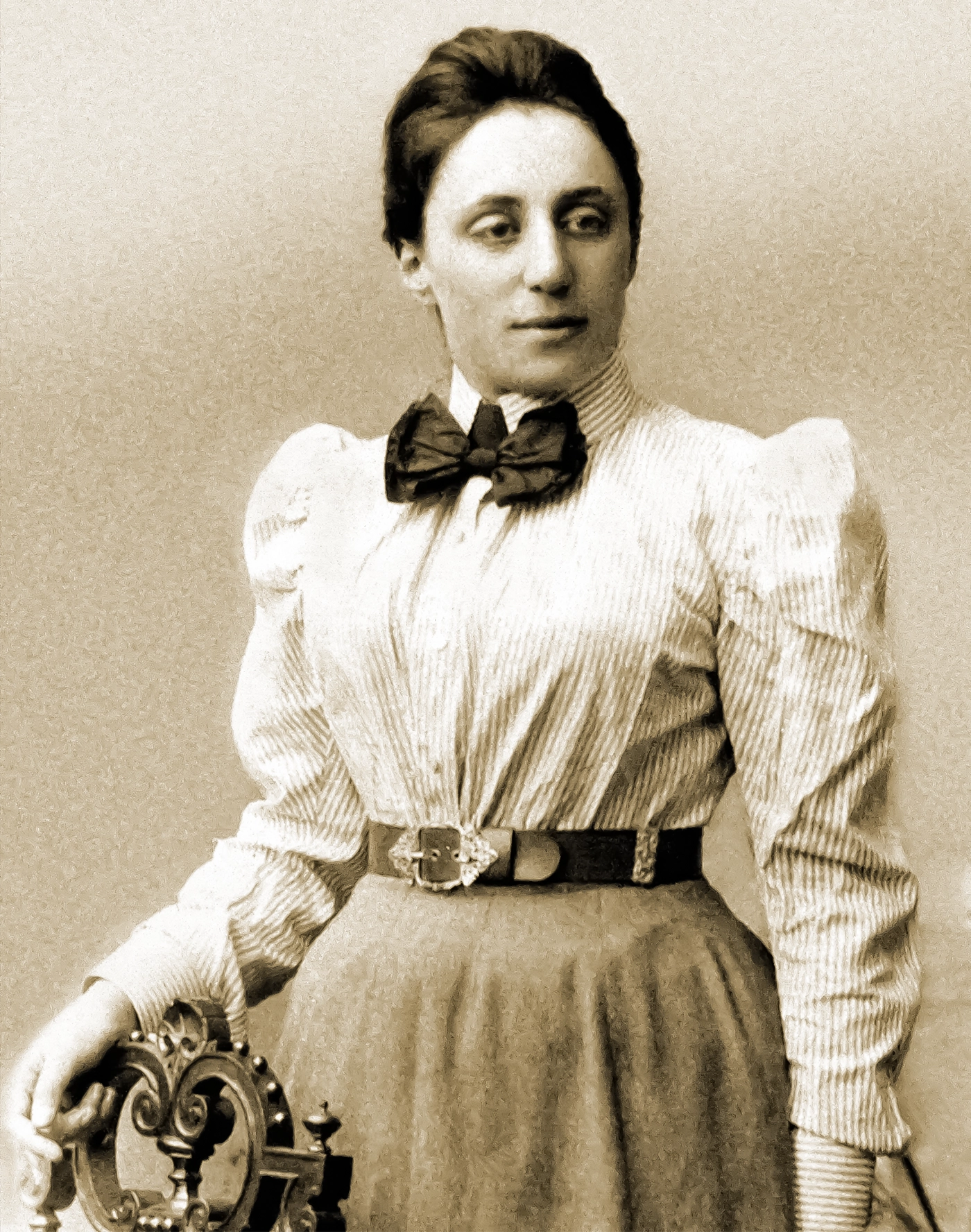
The renowned mathematician Emmy Noether helped collect the first evidence of Cantor’s wrongdoing.
Ian Dagnall Computing/Alamy
It had been over a decade since Dedekind and Cantor had died. Noether and Cavaillès spent the next few years tracking down letters from Dedekind’s estate. In 1933, after Adolf Hitler’s rise to power, Noether, who was Jewish, fled from Germany to the U.S., where she died two years later from cancer. But Cavaillès completed their project in 1937.
The correspondence as it was presented in the book was strange. It began with a flurry of letters starting shortly after Cantor and Dedekind met in 1872. The letters, from Dedekind’s estate, included only those that he’d received, not ones he’d sent to Cantor. Then the correspondence suddenly ended in January 1874, and several years of silence followed. When the exchange resumed in 1877, Dedekind’s own letters to Cantor now appeared as well. Dedekind had apparently decided to keep a copy of everything he was sending to his fellow mathematician.
There was also a note Dedekind seemed to have written to himself after he saw Cantor’s 1874 publication in Crelle. In it, he recounted how he’d sent Cantor the first proof in the paper and the revised version of the second — only to see them both appear “almost word for word” in print just a few months later under Cantor’s name alone.
Dedekind never went public with this claim, and Noether and Cavaillès didn’t comment on it. “I think for them it was a very conscious decision not to say anything and just to let the letters speak for themselves,” said Ferreirós, the historian in Seville. “That was the honor code of the time.”
No one else called attention to it either — at least not in print. The earliest biographies of Cantor, written by his mathematical disciples, simply lauded his genius.
Comments (0)