
Remember me







Descending into the windowless basement of a second world war air-raid bunker built for civilians in central Berlin is arguably an eerie enough evocation of what it means to endure life in a conflict.
But in a modern twist, before they have even walked into the first room of the city’s new Ukraine Museum inside the bunker, visitors are “targeted” by a Russian drone just before its operator prepares to release the lethal shot, and see themselves in the firing line on the screen of the weapon’s camera.
“We want to show people something of the physical reality of the conflict,” says Wieland Giebel, one of the museum’s curators. “We hope to bring it home to them that this is a war going on here and now in Europe, and that we ignore it at our peril.”
The museum opened in the same week as the fourth anniversary of the Russia’s full-scale invasion of Ukraine. It has been created from remnants of the war, and assembled with the help of the National Military History Museum in Kyiv and frontline troops from the 7th Rapid Response Corps in Pokrovsk.
Alongside demolished equipment and images of the destruction and death, it chronicles the invasion, taking in its historical origins and weaving in accounts of the lives of those it has irrevocably affected. It also pays homage to Ukrainians and their resilience.
“People are in danger of getting tired of the war,” Giebel says. “This is a living, moving exhibition which aims to jolt them out of doing so.”
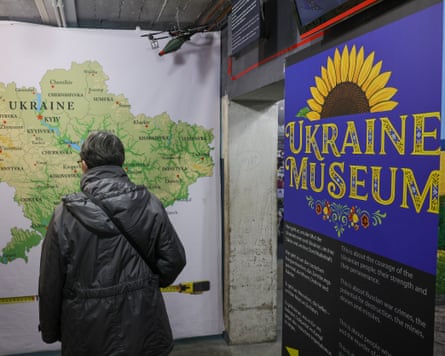 The entrance to the museum. Photograph: Omer Messinger/Getty Images
The only museum of its kind in the world outside Ukraine, and privately funded, it will remain for at least as long as the war lasts, he says. “Every anniversary is one too many.”
Giebel and his fellow curator Enno Lenze founded the Berlin Story Bunker, which holds historical event exhibitions, in 2014. Built in 1942, it was so solidly constructed that it remains an indestructible part of the cityscape.
The men travel regularly to Ukraine, delivering aid and equipment, including bullet-proof vests for children, and bring back new objects and pieces of information for the museum.
One such item, placed at the centre of the museum, is a silver-grey Fiat Scudo with shattered windscreen, a large tear in its roof and blood-spattered seats. It had served as a “social taxi” evacuating elderly people in Kherson, and delivered children to hospitals before a Russian drone hit it in April 2025.
Footage from the Russian drone recorded before the impact, which was traced on a Russian Telegram channel by Ukrainian intelligence, shows how the van was deliberately targeted, killing Oleg Salnyk, a 28-year-old aid worker. His bloodied face was used in the resulting Russian propaganda footage, marked with red lines.
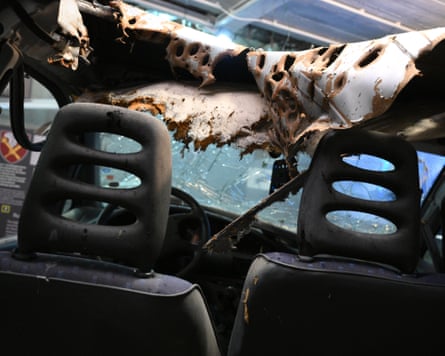 The remains of the Fiat Scudo ‘social taxi’. Photograph: Ralf Hirschberger/AFP/Getty Images
His friend and colleague Oleg Degusarov, who was also in the van, survived the attack, but has shrapnel lodged in his neck.
Twenty Russian drones collected with the help of Ukraine’s military hang from the ceiling of the museum. They include the Molniya, the cheapest, built for about €100 (£87) using common items such as duct tape, poles and a disposable camera, which have been used to drop grenades and kill civilians.
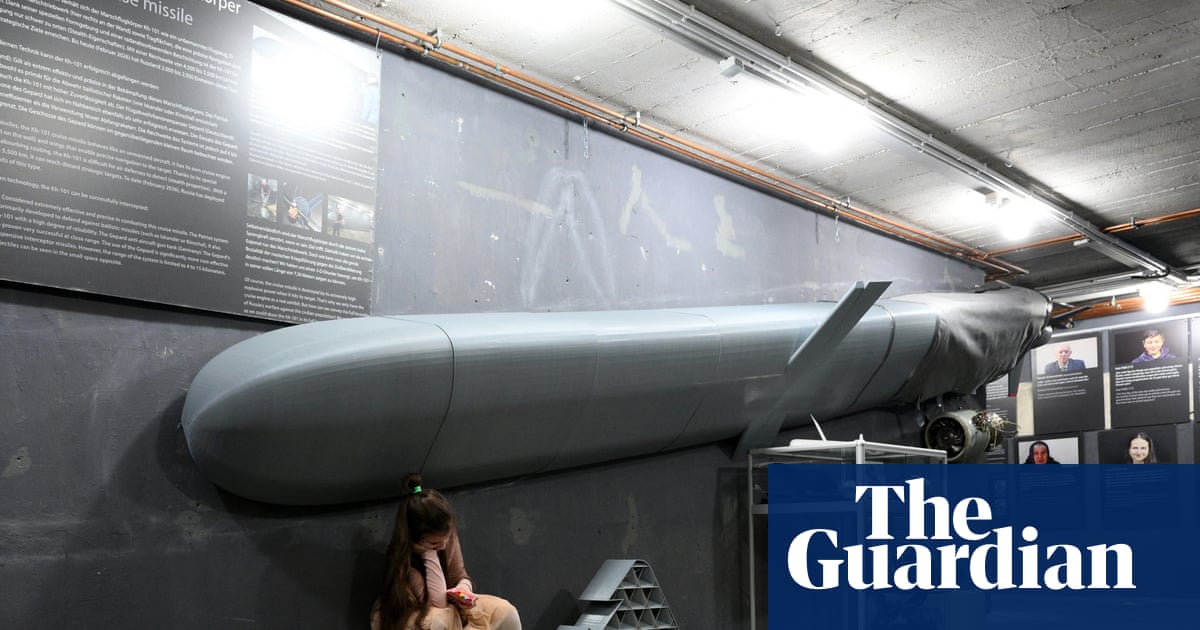
The largest missile in the exhibition has been reconstructed in eight parts by a 3D printer “as we were not allowed to import the original”, Lenze says. He wanted to show “just how big a cruise missile is when it’s flying towards you”.
It is flanked by a large photograph of the block of flats in Kyiv that was badly damaged by the original missile. The former TV anchor turned frontline reporter Roman Sukhan, who has contributed to the exhibition, explains that the missile killed a friend of his, a doctor who lived in the flats.
“The war is always very close,” he says. He would like to think the exhibition will also bring home to Germans “just what a threat Putin poses to everyone”.
Germany is one of Kyiv’s biggest suppliers of weapons, a key supporter diplomatically and hosts about 1.3 million Ukrainian refugees, but division over the extent to which the German taxpayer should continue to fund arms deliveries is rife.
The curators admit they are not neutral in warning of jeopardy over the rise in support that Russia-friendly parties are receiving. Their exhibition also points unforgivingly to a range of Putin apologists amongst the political elite, highlighting the “dangerous” role they have played and continue to play in public debate by downplaying the threat posed by the Russian president. “Help or be an arsehole” is one of the slogans on the wall.
Lenze and Giebel are not ones for subtle gestures. They were celebrated for persuading erstwhile reluctant authorities to let them place the wreck of a Russian T72 tank in front of the Russian embassy in Berlin on the first anniversary of the invasion in 2023, which had been towed from the outskirts of Kyiv.
Hanna Maliar, a former Ukrainian deputy defence minister until 2023 who assisted the museum, said: “My advice to Germany is whatever you do, don’t get rid of your bunkers.”
Comments (0)