While Democrats have seethed, Republicans have largely defended Trump's broader decisions, though
some signs of
discontent are starting to show.
What they're saying: "Any suggestion that the White House is not working efficiently and successfully with our partners in the legislative branch is a suggestion not based in reality," White House spokesperson Abigail Jackson tells Axios, listing off several legislative wins Trump has also scored.
Here are five ways Trump has sidestepped Congress in his second term.
1. Iran strikes
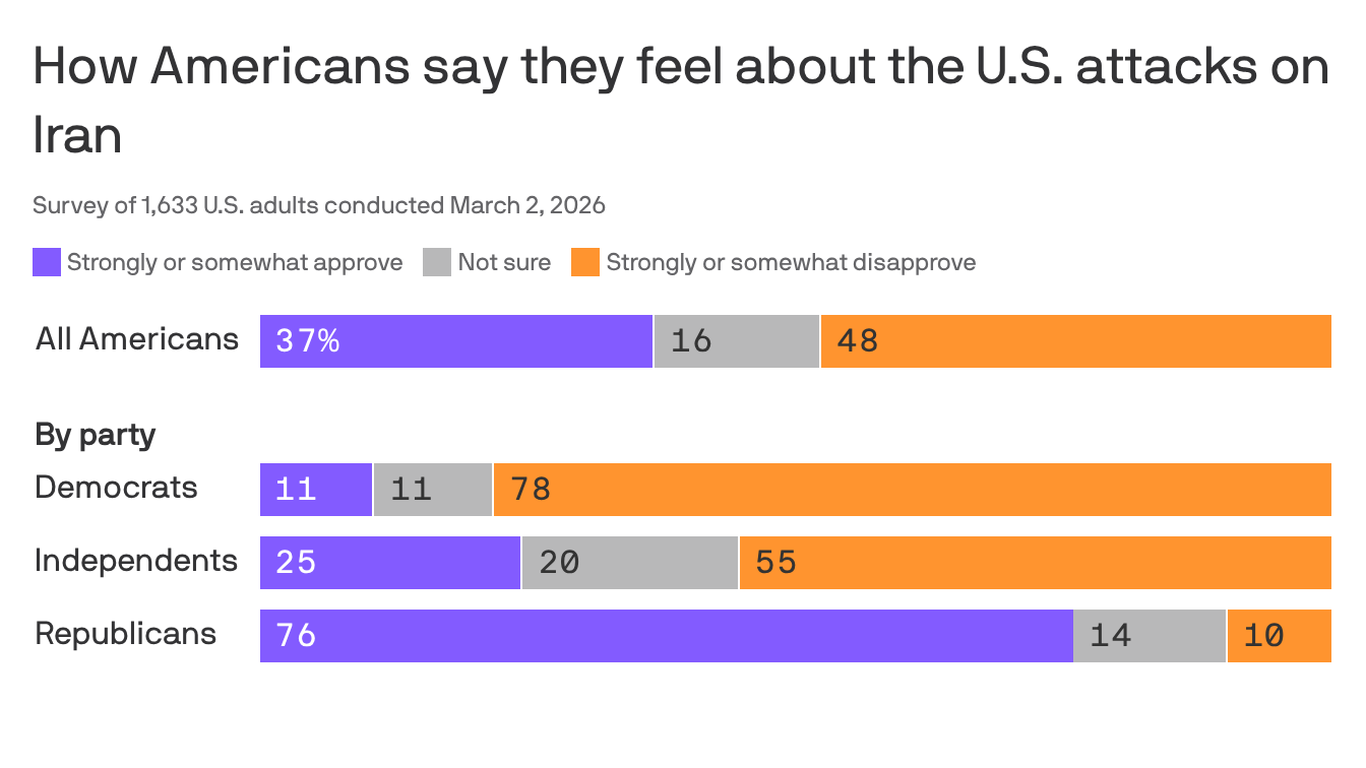
The military action targeting Iran is setting up a new showdown between the White House and a bipartisan front of lawmakers who say he overstepped his authority.
State of play: While the president is the commander-in-chief, only Congress has the constitutional power to declare war.
Democrats are urging Congress to vote on war powers resolutions, spearheaded by Sen. Tim Kaine (D-Va.). The measure would immediately remove the military from hostilities against Iran unless authorized by Congress.It's unclear when or if Congress will act on the resolution. The Senate is
due back Monday and the House is expected back on Wednesday.Democrats
appear divided over the issue,
dampening chances that it'll pass in the House.2. Venezuela raid
Trump's strikes on Venezuela and the capture of Venezuelan President Nicolás Maduro also went forward without Congress' sign off.
Democrats
largely criticized the president for overstepping his authority by not receiving congressional authorization or briefing lawmakers ahead of time.However, Republicans in Congress defended Trump's decision.A war powers resolution aimed Trump's operation in Venezuela
failed in January in both the House, with the Senate blocking a final vote on the measure.3. Tariffs
Trump did not ask Congress for approval to institute sweeping tariffs on countries around the world.
Reality check: The Supreme Court ruled last month that most of the tariffs were illegal, setting up a scenario where the administration could have to repay billions to importers.
An outraged Trump signaled he would turn to another law on the books — not Congress — to impose another round of tariffs. However, that law would still require Congressional approval to extend them beyond a 150-day period.4. Name changes
Trump has ordered several symbolic name changes that he didn't have the authority to unilaterally authorize.
He signed an executive order to change the name of the Defense Department to the
Department of War. However, officially renaming the department would
require Congressional approval.The Kennedy Center board voted unanimously in December to rename the venue the "
Trump-Kennedy Center."The move drew
instant backlash from lawmakers. An official renaming would
require an act of Congress.
Flashback: Last May, the House passed a bill that would formally rename the Gulf of Mexico as the "Gulf of America," echoing a Trump executive order. The Senate has yet to take up the bill.
5. Gutting federal agencies
Early in his second term, Trump moved to shutter and consolidate federal agencies, leading to layoffs and departures at the EPA, NASA, USAID, Veterans Affairs and others.
Yes, but: Trump's moves led to a slew of lawsuits, and courts ruled that he had exceeded his authority in certain cases.
Go deeper:



Comments (0)