This is a rush transcript. Copy may not be in its final form.
AMY GOODMAN: The U.S. is sending more troops and fighter jets to the Middle East as the regional war expands, four days after the U.S. and Israel assassinated Iran’s Supreme Leader Ayatollah Ali Khamenei and struck sites across Iran. Iranian authorities say at least 787 people have died so far. On Monday, a mass funeral was held for the 165 people killed in an attack on a girls’ school in the Iranian southern city of Minab; most of the people killed were children. UNESCO condemned the strike, saying, quote, “The killing of pupils in a place dedicated to learning constitutes a grave violation of the protection afforded to schools under international humanitarian law,” unquote. Israel is also accused of striking the Gandhi Hospital in Tehran.
Iran has retaliated by launching four days of strikes on Israel and U.S. allies across the region. On Monday, Iranian drones hit the U.S. Embassy in Saudi Arabia. The Pentagon has now revealed six U.S. soldiers died in an Iranian attack on a military facility in Kuwait. The U.S. State Department has urged U.S. citizens in over a dozen Middle East countries to leave.
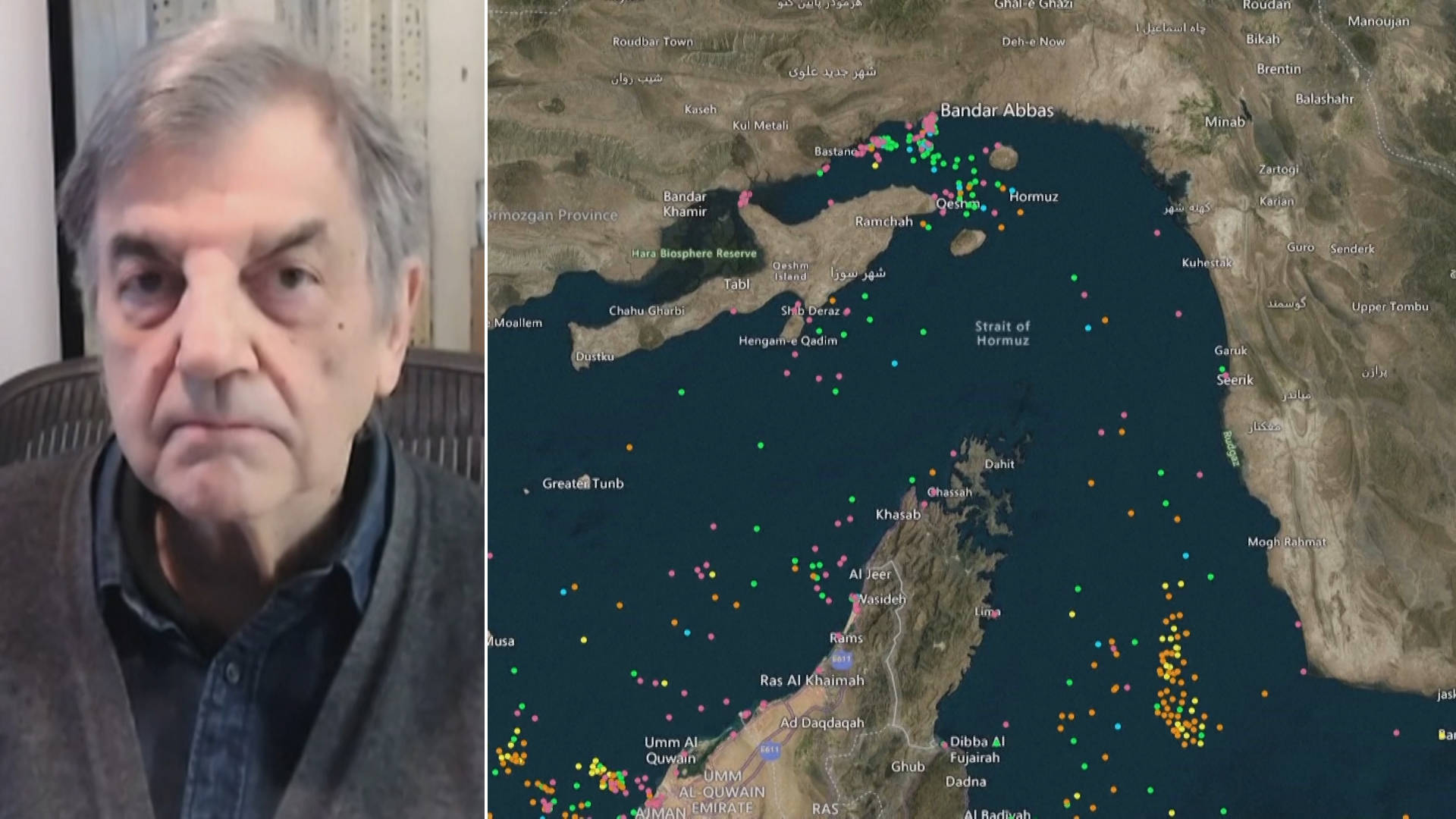
The war has sent oil and gas prices skyrocketing. On Monday, a commander in Iran’s Revolutionary Guard Corps threatened to set ablaze any ship that passes through the Strait of Hormuz.
Meanwhile, Israeli ground forces are moving deeper into Lebanon as Israel and Hezbollah exchange rocket fire. On Monday, Israel struck the Beirut office of Al-Manar TV. Israeli strikes have killed at least 52 people in Lebanon so far.
The Trump administration continues to give shifting rationales for why it attacked Iran amidst ongoing negotiations over Iran’s nuclear program. Secretary of State Marco Rubio spoke Monday.
SECRETARY OF STATE MARCO RUBIO: The president made the very wise decision. We knew that there was going to be an Israeli action. We knew that that would precipitate an attack against American forces. And we knew that if we didn’t preemptively go after them before they launched those attacks, we would suffer higher casualties.
AMY GOODMAN: In a social media post early today, President Trump said the United States could fight wars, quote, “forever,” claiming it has, quote, “virtually unlimited” supply of weapons. Trump expressed a similar message at the White House Monday.
PRESIDENT DONALD TRUMP: We have the strongest and most powerful, by far, military in the world, and we will easily prevail. We’re already substantially ahead of our time projections. But whatever the time is, it’s OK, whatever it takes. We will always — and we have from — right from the beginning, we projected four to five weeks, but we have capability to go far longer than that.
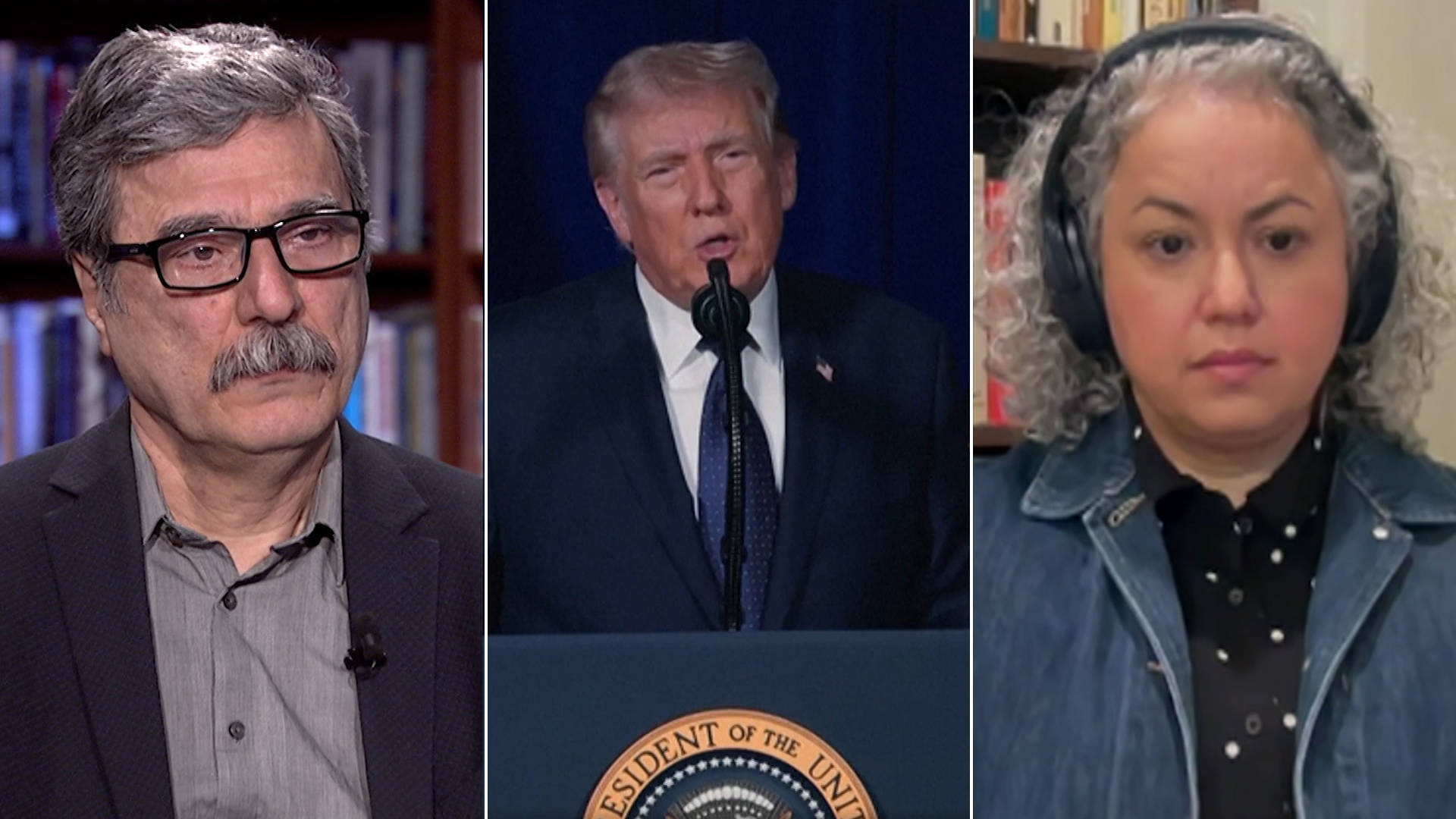
AMY GOODMAN: We begin today’s show with Negar Mortazavi, Iranian American journalist, host of The Iran Podcast, senior fellow at the Center for International Policy.
Negar, thanks so much for joining us again after our special broadcast on Saturday when the strikes began. Can you talk about what’s happened on the ground at this point? I know that most of the internet, almost all of the internet, is down in Iran.
NEGAR MORTAZAVI: Good morning. Thanks for having me.
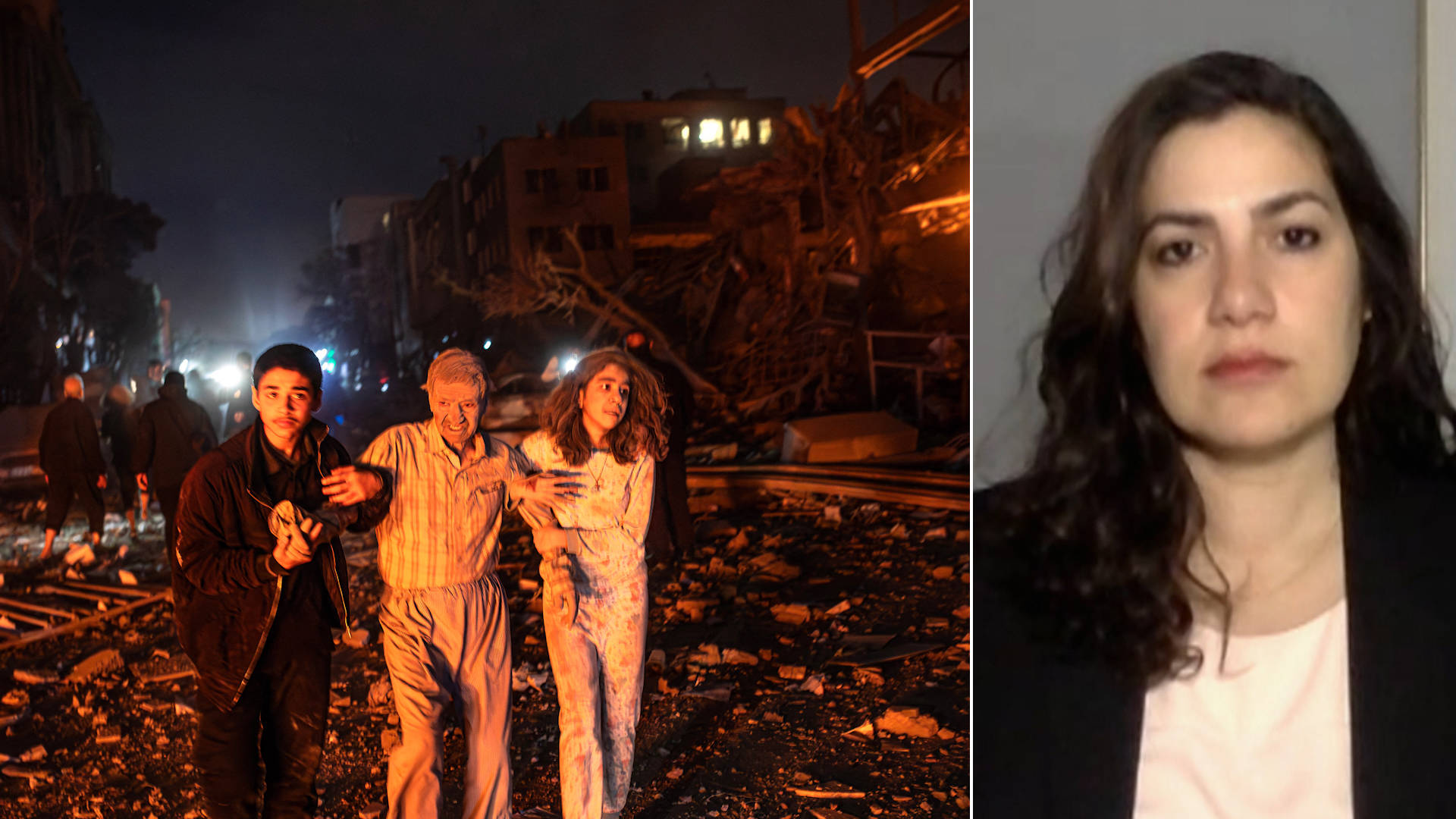
Yes. So, as you said, on the first day of the attack, we saw that elementary school in the city of Minab being one of the targets, 160 children killed. And I was just looking at videos from the funeral of that, of those children in that city. And there seems to be a very, very large crowd essentially coming out in that town to grieve for those children.
We’ve seen civilian infrastructure being part of the targeting. And the death toll on the Iranian side is rising, over 500, the latest I saw, mostly civilians. And it’s just very difficult to get in touch with people. Communication is very limited. And it’s just this feeling of horror and anxiety for those who are on the ground in Tehran especially. People are hearing explosions, and it’s not very clear what the targets are. And those who can leave the city have been — either left or have been trying to leave the capital. But the attacks are also across the country.
And it’s just reminding people very quickly of the June war last year, the 12-Day War, when Israel attacked Iran and then the U.S. joined, but then also starting to — people who remember the 1980s war between Iran and Iraq are starting to have sort of memories of that era, which was also a very horrific war and lasted very long.
JUAN GONZÁLEZ: And, Negar, could you talk about the three-person leadership council that’s managing the day-to-day affairs as the country’s leaders attempt to decide on a successor to Ayatollah Khamenei?
NEGAR MORTAZAVI: So, Article 111 of the Iranian Constitution had already predicted this, that in the case of the passing or death — in this case, killing — of the supreme leader, immediately a council is formed, consisting of the president, which now is the moderate Masoud Pezeshkian; the head of judiciary, a conservative cleric right now, Gholam-Hossein Mohseni-Eje’i; and then also one clergy member of the Guardian Council, the powerful Guardian Council, which is Alireza Arafi, a fairly conservative and hard-line clergy also. And then they will be in charge of essentially making decisions and running the country in place of a supreme leader until the successor is picked by the leadership council. And so, that’s the process.
But this, it’s in a wartime. I don’t know if this is going — this decision is going to happen right now. It depends on also how long the war is going to continue. There seems to be no end in sight, even though the U.S. had announced that this is going to be short. I think from the press conferences yesterday, it’s just not clear how long it’s going to go. So, I don’t know if this — if they can sort of do this succession during the wartime, or they’re going to see this as a transition — this is an interim council — and then potentially choose a supreme leader after the war is over.
And I’ll just end with the fact that the clergy from the Guardian Council, Alireza Arafi, seems to be one of the likely candidates — at least that’s being talked about — as potentially being the successor. But there’s also other — there are other candidates who had been sort of on a list from the past.
JUAN GONZÁLEZ: And President Trump has in public statements offered, quote, “complete immunity” to any members of the Islamic Revolutionary Guard Corps, the IRGC, who lay down their arms. What’s your sense of how the IRGC is functioning right now, given especially this quite, quite impressive resistance that the Iranian government has launched against not only the United States and Israel, but many of the Gulf states that have been maintaining U.S. bases?
NEGAR MORTAZAVI: So, you know, the U.S. has military superiority absolutely, and they’ve caused a lot of damage from day one, including killing the country’s supreme leader. But I don’t think they understand the dynamics of this country. There seems to be a total lack of understanding. And when you listen to the comments of the president himself, secretary of state, the presser yesterday with the secretary of war, it’s just — I don’t — I don’t think they understand the situation they’re dealing with.
You know, many of us Iran analysts had been warning that starting a war with Iran is going to potentially be even more difficult and challenging than the war in Iraq, which already was a big failure on the U.S. side. And the irony is that President Trump himself had been attacking, if not mocking, past presidents for starting these kind of endless, unnecessary wars in the Middle East, including attacking President Obama for thinking or potentially wanting to attack Iran. And now he’s become the president that has attacked Iran for the third time — the first time 2020, assassination of top general Soleimani; second time last year, Midnight Hammer; and this is the third time.
And so, the Iranian thinking, or sort of the policy, the defense doctrine or posturing in Iran, is that he’s going to keep coming back for us, unless we fight back. And this is exactly what we’re seeing the Iranians doing, essentially playing the long game here, that, first of all, they see this as an existential threat. They’re fighting a war of survival, and that’s why they’re essentially doing fighting with all their might, whatever is left of it, and that they’re not going to stop soon, until they have inflicted, as they think, enough pain so that this doesn’t keep coming again, because in six months and eight months, in a year, this “mow the grass” sort of policy that Israel has vis-à-vis Gaza, and of course now we’re seeing in Lebanon, that’s something that the Iranians want to end.
AMY GOODMAN: To say the least, Negar, in these last 30 seconds, you’ve been critical of the Iranian government, but you’re also, to say the least, fiercely critical of what’s taken place right now.
NEGAR MORTAZAVI: Absolutely. I mean, it is a repressive state — that’s a fact, nobody denies that — in how the government treats its own citizens. We just saw protests in January, thousands of people being killed by this government. But you can hold both truths at the same time, that the military intervention is not going to help that situation. This is not helping Iranian protesters, Iranian dissidents or any Iranian who’s living on the ground. I think that’s just a fact that’s being missed, that somehow this is helping, this is going to bring better governance or democracy, nation-building to Iran. We just haven’t seen the U.S. have a successful track record time and again when they’ve tried this military intervention in the region.
And I honestly don’t think that is the goal for the U.S. or for Israel. This is a geopolitical situation. They want a weakened Iran. For the Israelis, I think they potentially want a failed state situation, a country that poses no threat to them, and they can potentially go in and attack anytime they want.
AMY GOODMAN: Negar Mortazavi, we want to thank you so much for being with us, Iranian American journalist, host of The Iran Podcast, senior fellow at the Center for International Policy.
Coming up, we look at the escalating regional war in the Middle East. We’ll speak with Palestinian American journalist Rami Khouri. Stay with us.