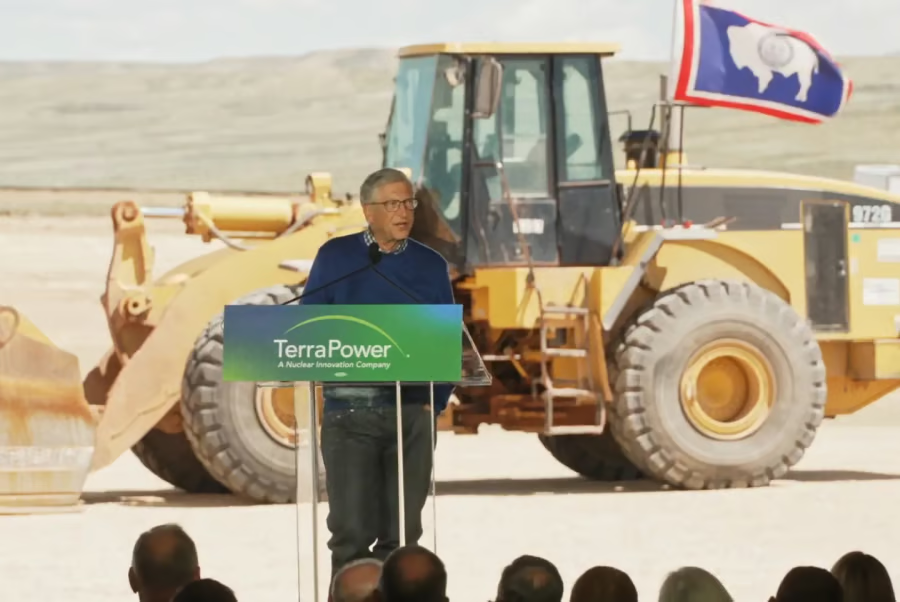
A nuclear reactor company co-founded by Bill Gates has received the first nuclear construction grant from the US government in almost a decade.
TerraPower is at the forefront of a new generation of nuclear reactors designed to make nuclear energy safer, cheaper, and easier to deploy than the large plants built in the 20th century. The company plans to have its site, which broke ground in 2024, operational by 2031, a much faster timeline than conventional nuclear plants in the West, which often take more than a decade to complete.
Alongside the reactor being about a third the size of a conventional nuclear reactor, TerraPower’s design also differs in that it uses liquid sodium rather than water to cool the reactor.
The benefit is that sodium can operate at much higher temperatures without high pressure, reducing the risk of explosions or pressure failures. According to TerraPower, this allows the reactor to use a much simpler containment system that should lead to more efficient operations.
As reported by the Associated Press, the current administration has shifted the thinking on nuclear energy, which, over the past two decades, was widely viewed by policymakers as an expensive power source. It has also been clouded by safety concerns, with the Fukushima disaster in 2011 leading several countries to abandon nuclear power entirely.
President Donald Trump ordered the Nuclear Regulatory Commission to be less risk-averse, which has led to several small nuclear reactors breaking ground across the country. Alongside TerraPower’s Wyoming plant, Kairos Power is developing a demonstration system in Tennessee, and Natura Resources is building another demonstration unit in Texas, expected to be completed this year.
Other countries, such as the UK, are also trialling small nuclear reactors to add more reliable energy to the grid.
AI bringing nuclear power back to life
While strengthening grid reliability is one motivation for expanding nuclear power in some countries, artificial intelligence appears to be the primary driver in the US. Data centers are expected to require vast amounts of additional electricity to power AI systems, and tech giants are looking for ways to rapidly increase energy capacity.
TerraPower has repeatedly highlighted its potential for deployment as a dedicated energy source for AI data centers. Nuclear power provides consistent output and has a longer operational lifespan than most other energy sources.
The need for rapid energy expansion has pushed many data centers toward natural gas, which can ramp up quickly to meet spikes in demand from AI workloads. However, natural gas is not a clean energy source, and most large technology companies have commitments to reach net zero by 2030 or 2035. Those targets are increasingly expected to be missed due to the surge in AI energy demand and the Trump administration’s rollback of net-zero policies.
Google has already said nuclear power will support its data centers by 2030, using Kairos reactors to deliver 50 megawatts of power. By 2035, Google hopes to secure up to 500 megawatts of nuclear capacity from the startup. In June last year, Meta signed a 20-year agreement to purchase nuclear power from the Clinton Clean Energy Center in Illinois, which is expected to begin supplying power next year.
More about Innovation
Data centers operators looking further afield
The expansion of data centers and AI training over the next five years is expected to add at least 40 gigawatts of new capacity by 2030. Over the same period, data centers’ share of global electricity consumption is forecast to rise from about 1.7 percent to roughly three percent.
This growth has sparked complaints from communities near major data center projects, with some arguing they will ultimately face higher electricity costs. OpenAI and other companies have attempted to reassure local residents that they will cover the energy costs required for their facilities.
To overcome this “not in my backyard” backlash, some operators are exploring more unconventional locations for future infrastructure. Elon Musk has discussed the possibility of launching data centers into space, where they could access abundant renewable energy. A wind turbine startup is also planning to demonstrate a data center submerged in the ocean, powered by an offshore turbine and cooled by the surrounding seawater.
Also read: AI data centers are hijacking energy infrastructure planning as power demand reshapes decisions across the sector.






Comments (0)